Unrest in Bahrain in 2014 (NSC)
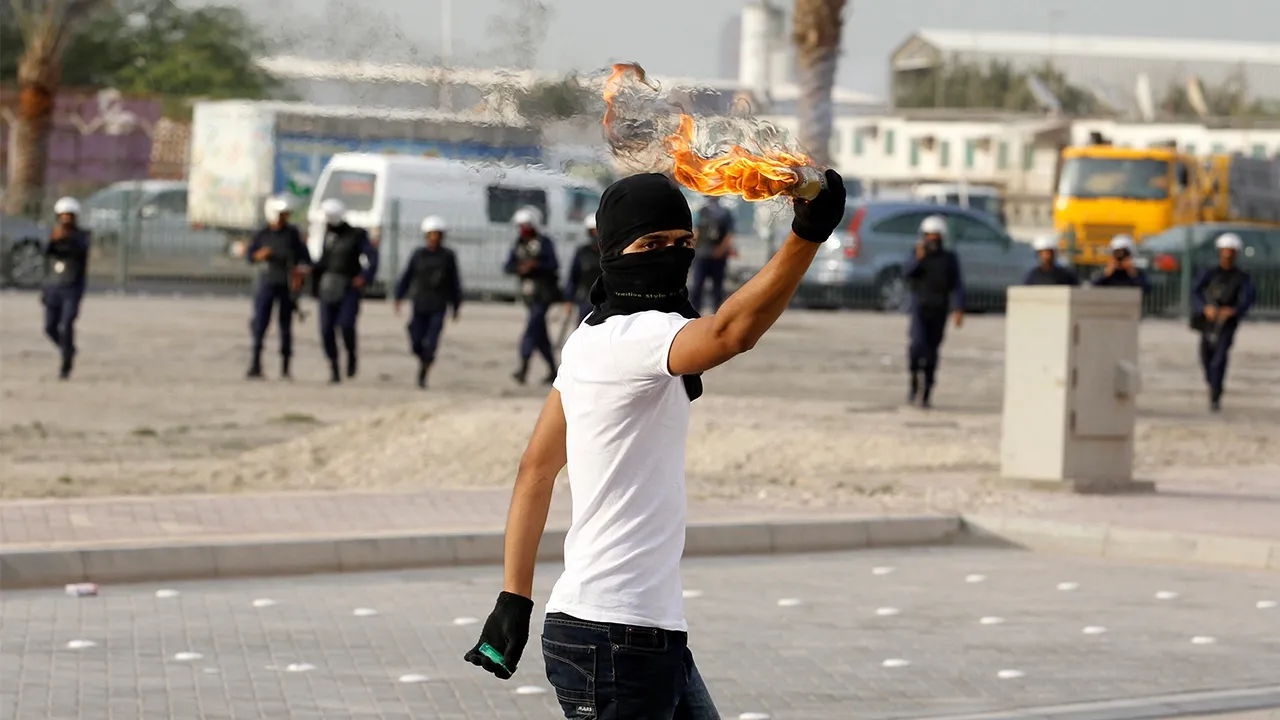
Set in August 2014. Political unrest in Bahrain has led to a government crackdown.
- Level
- High School, Higher Education
What is a simulation?
Simulations offer students the chance to role-play either the U.S. National Security Council or the UN Security Council.
How do I use them?
A simulation comprises two readings (a council guide and the case notes) of roughly 2,500 words each. They also offer detailed guidance for preparing for and running the simulation in the classroom and reflecting on the experience.
Educator Overview
Case Overview
Set in August 2014. In the small island country of Bahrain, government and security forces have clashed with protestors seeking democratic reform. The ruling al-Khalifa family has responded to these protests with force and mass arrests. The most recent clashes between government forces and protestors are not the first but certainly the bloodiest. In February 2011, Bahraini activists, inspired by uprisings in Tunisia and Egypt, gathered in the capital to seek political reform. The fact that Bahrain’s leaders are part of the Sunni minority and the demonstrators represent the Shiite majority gives the uprising a sectarian complexion, in addition to the broader social issues of disenfranchisement and limited economic opportunity. The U.S. government has decided to convene a National Security Council (NSC) meeting to consider whether and how to support political reform in Bahrain, which hosts the U.S. Navy’s Fifth Fleet, without further destabilizing the country or compromising U.S. interests or values.
Decision Point
Three years after Bahrain’s 2011 uprising, progress toward reform has stalled. In January 2014, the government suspended its “national dialogue” with opposition groups. The government blamed the opposition for the breakdown. Soon after, renewed unrest gripped the country. On February 14—the anniversary of the initial uprising—thousands of protestors calling for King Hamad’s ouster gathered in Bahrain’s capital, Manama. The protestors met stiff resistance from security forces. This resulted in several injuries and dozens of arrests. Outside the capital, a bomb struck a police bus in a Shiite village, killing one police officer. Three more officers were killed by another bomb weeks later. Although mainstream opposition groups denied any connection to the bombings and condemned the acts, the attacks only amplified an already severe crackdown by Bahrain’s security forces, especially in predominantly Shiite areas. Activists, along with international human rights organizations, are pressuring the United States, one of Bahrain’s principal economic and military partners, to respond.
In this context, the president has called a National Security Council (NSC) meeting to decide how to respond to the unrest. Specifically, the NSC will need to decide whether the United States should continue to support the government of Bahrain, which has proved to be a staunch U.S. ally, or support the protesters’ demands—potentially at the expense of U.S. strategic interests. They may also decide to seek out some middle ground.
Learning Goals
CFR Education extended simulations use a variety of pedagogical tools to create an effective, meaningful, and memorable learning experience for students that builds their global literacy. Students will develop crucial skills such as critical thinking, communication, collaboration, and creativity. Students will complete authentic assessments that feel relevant: instead of five-paragraph essays and book reports, students will write policy memos and participate in a role-play of a meeting of a foreign policy–making body. There are no right or wrong answers in actual policy deliberations, and there are none here, either; students will walk away from this experience with an appreciation for the complexity of policy questions.
In this simulation, students will learn about the National Security Council, as well as meeting these learning outcomes specific to this simulation:
- Students will understand the potential consequences of instability in Bahrain for the interests of the United States in the Persian Gulf.
- Students will consider how the United States should balance its strategic interests in the Middle East while also upholding its values.
- Students will evaluate the policy options available to the United States for dealing with a crisis in Bahrain.
Concepts and Issues
Concepts
- Interests versus values
- Sectarianism
- Political reform
- Alliances
- Dispute resolution
Issues
- Free flow of energy resources in the Middle East
- U.S.-Bahrain Free Trade Agreement
- U.S. military presence in the Persian Gulf region
- U.S. support for democratic governance
Policy Options
This section presents context, potential benefits and drawbacks, and other information about the policy options outlined in the case. You can use this information several ways:
- To develop questions or topics (beyond those in the role sheets) for students to consider during in-class discussion and in their research
- To assist in grading policy and position memos
- To evaluate student performance during the role-play
- To develop prompts to steer the role-play
- To assign students specific policy options to defend or arguments to make during the role-play
- To make the simulation less challenging by providing this material to your students
The instability in Bahrain has far-reaching implications for both the United States and the Persian Gulf. Throughout the unrest in Bahrain, the United States has continued to advocate for dialogue between the opposition and government loyalists. Ultimately, both U.S. interests and values are at stake.
Bahrain under the Al Khalifa family has long been a U.S. ally. It helps ensure the free flow of energy resources from the Middle East to other parts of the world, deters U.S. adversaries such as Iran, and hosts the U.S. Navy’s Fifth Fleet, which patrols the surrounding waters, including the Strait of Hormuz. Bahrain and the United States also work together closely on defense and counterterrorism issues. Moreover, the United States enjoys close commercial and economic relations with Bahrain, reinforced by a bilateral free trade agreement.
In recent years, escalating tensions between the United States and Iran have underscored Bahrain’s strategic importance to U.S. interests. In April 2019, Iran threatened to close the Strait of Hormuz after President Trump renewed sanctions that had been waived under the Iran nuclear deal. That summer, Iranian forces and proxies conducted a series of attacks on commercial tankers and oil facilities in the Strait of Hormuz and Saudi Arabia. Escalating tensions prompted the United States to bolster its military presence in the Middle East, including by deploying an aircraft carrier strike group to the Persian Gulf. Throughout 2019 and 2020, tensions have remained high in the Persian Gulf, with Iranian forces harassing U.S. naval ships and boarding oil tankers passing through the Strait of Hormuz.
Instability in Bahrain could endanger these strategic and economic interests. For example, increased U.S. pressure on the Bahraini government for democratic reforms could anger the ruling family, which could reduce bilateral cooperation in response. Intensified domestic opposition could weaken or topple the government, resulting in a power vacuum or an uncertain transition during which the United States would lack a reliable partner.
A new crackdown by the authorities could spark an international backlash, forcing the United States to distance itself from the Bahraini government. In such a case, American values need to be considered. Support for democracy and freedom has traditionally been a principal component of U.S. foreign policy; therefore, the United States cannot simply ignore the Shiite population’s demands for a more just and equitable society in Bahrain. However, by the standards of the Persian Gulf, Bahrain is considered to be relatively progressive—for example, with respect to women’s rights. Strong U.S. pressure on the regime could cause instability that would endanger the few freedoms that Bahrainis enjoy.
Seeking to balance its interests and values, the United States has not fully embraced the Bahraini demonstrators. In particular, it has stopped short of supporting the opposition’s demand for an end to the Al Khalifa family’s rule. The core question is whether the United States should continue to stand behind the Al Khalifa family despite its nondemocratic practices or more firmly back the aspirations of Bahrain’s Shiite majority. Former Secretary of State Hillary Clinton summed up the U.S. predicament in Bahrain when she declared, “As a country with many complex interests, we’ll always have to walk and chew gum at the same time. That is our challenge in a country like Bahrain, which has been America’s close friend and partner for decades. And yet, President Obama and I have been frank, in public and in private, that mass arrests and brute force are at odds with the universal rights of Bahrain’s citizens and will not make legitimate calls for reform go away.”
The United States has numerous options for dealing with a crisis in Bahrain. The question is what combination of them would be most successful in this case. The United States should consider the following options:
- move the Fifth Fleet to Kuwait or Qatar, or threaten to do so unless the Bahraini government implements certain reforms
- pressure the Bahraini government with a cessation of all arms and military assistance, or make military assistance conditional upon political progress
- threaten to suspend the U.S.-Bahrain free trade agreement over Bahrain’s violation of certain parts of the agreement
- target foreign aid toward organizations deemed favorable to U.S. interests, such as specific opposition groups or reformers within the monarchy
- publicly criticize the Bahraini government
- articulate U.S. concern for the situation in Bahrain in an international forum such as the United Nations in order to highlight the issue and call on other countries to put pressure on Bahrain
- recognize the strategic benefits of the U.S. relationship with the Al Khalifa regime and offer full U.S. support to the ruling family
Considerations
To weigh the policy options, NSC members will need to consider the effects of Bahrain’s unrest—and any U.S. policy responses—on U.S. interests and values. The situation itself poses both long-term and potentially immediate challenges to the United States. The principal chronic challenge is to values. The United States has for decades maintained a close relationship with Bahrain despite its nondemocratic government. Bahrain is hardly the only such country. The United States also partners closely with other autocratic states in the Middle East, including, prominently, neighboring Saudi Arabia. These relationships subject the United States to accusations of hypocrisy surrounding its global efforts to promote democracy and human rights as core American ideals. Still, successive U.S. administrations have believed that maintaining close ties with autocratic Arab states serves U.S. strategic interests. To various extents, policymakers have sought to advance human rights and reforms in the region. But they have tended to do so within the framework of friendly relations and have not generally punished or threatened Arab governments in an attempt to advance U.S. values.
NSC members could recommend that the United States more forcefully push Bahraini leaders to reform, making it more uncomfortable for the al-Khalifa family to avoid meaningful steps. If successful, this could constitute an appealing middle ground that addresses opposition grievances, thereby increasing the country’s long-term stability, while leaving in place a government broadly favorable to U.S. interests. However, excessive pressure from Washington could anger the monarchy, causing it to reduce bilateral cooperation or retaliate diplomatically, such as when it declared senior U.S. official Tom Malinowski persona non grata in 2014. On the other hand, if the United States excludes democracy and human rights completely from its agenda with Bahrain, leaders in Manama could understand the exclusion as permission to crack down against the opposition and harden their stance against reform. A new crackdown might spark an international backlash, forcing the United States to distance itself from the Bahraini government. In addition, Bahrain is already considered relatively progressive by the standards of the Persian Gulf region, for example in the area of women’s rights. Retrenchment by the monarchy could endanger what rights and freedoms Bahrainis already enjoy. The overall question is what if any U.S. response to growing tension and unrest could increase Bahrain’s stability, thereby serving U.S. interests, while advancing U.S. values.
Acute challenges to U.S. interests could also arise, depending on how the situation in Bahrain evolves. Should a Shia-led uprising succeed in ousting Bahrain’s rulers or transforming the country into a constitutional monarchy in which elected leaders hold sway, Bahrain’s strategic posture could change dramatically. Under such conditions, Bahrain’s new leaders might be aligned with Iran, a country that poses significant challenges to U.S. interests. These leaders, also believing that the United States gave them too little support when they struggled against the monarchy, could turn against Washington. In the most extreme case, such a shift could cause Bahrain to evict the U.S. military and end cooperation on counterterrorism and other issues, depriving the United States of a long-standing partner and a naval foothold in the Persian Gulf. Depending on the speed and scope of such a change, the United States might be left scrambling to protect its military assets in Bahrain and its strategic and economic interests in the Middle East. Even short of this scenario, intensified opposition activity that weakened or toppled the government could produce a power vacuum in which the United States lacks a reliable partner.
On the other hand, withdrawing U.S. support for Bahrain’s government in the heat of an uprising could also have adverse consequences. The monarchy could survive and reconsolidate its position. Should leaders believe the United States had abandoned them, they could reduce or even end their cooperation with Washington.
These possibilities raise the question of whether and how the United States should try to get on the right side of history when popular movements seek to overthrow nondemocratic U.S. allies. A similar question arose in 2011, when President Barack Obama called for the president of Egypt at the time, Hosni Mubarak, to leave office. Mubarak, a longtime autocratic leader and U.S. ally, was facing mass protests in Cairo’s Tahrir Square that erupted as part of a wave of uprisings across the Arab world. (The protests succeeded in chasing Mubarak from office.) Although applauded by advocates of human rights and democratic accountability, Obama’s policy shift sparked concern in remaining Arab autocracies, where rulers worried that their friends in Washington might similarly abandon them should their citizens rise up. If reinforced by U.S. policy toward Bahrain, this sentiment could make Arab governments less willing to cooperate on U.S. objectives. Conversely, visible steps to intensify the U.S. commitment to Bahrain’s current rulers may provide reassurance. This could serve the valuable purpose of increasing Arab cooperation with the United States on a range of vexing issues in the Middle East, such as terrorism, the Islamic State group, and the threats posed by Iran.
Running the Simulation
CFR Education extended simulations are project-based learning activities. Project-based learning (PBL) leads to better learning outcomes and improves skills, and is more fun than traditional instructional methods. The website that students will navigate throughout the simulation is divided into several parts:
In the NSC Guide, students will learn about the National Security Council, the body they will be simulating. Included are details on its history, how it works, who its major players are, and more. There is also a video interview with experts who have served on the body.
In the Case Notes, students dive into the actual situation they will be trying to solve in their simulation. At the beginning is a clear decision point: the question that students will debate during the role-play. This is followed by detailed background material and a discussion of the role that the United States plays.
Preparation and Role-Play includes details on the various roles students could take on, guidelines for the memorandum they will write (the student playing the role of president has a slightly different task), as well as an outline of how the discussion will flow during the role-play.
The Wrap-Up is an important part of the project and includes reflection questions and guidelines for reflecting in a class discussion and in a second memorandum. For historical cases, this section also includes a short description of how the decision point was addressed by policymakers in real life.
The simulation also includes Student Resources, which include a reading list to support research, additional directions and exemplars for writing assignments, and other tips students may find helpful.
Tips for Role-Play
Once students have read the simulation and prepared their position memos, here is how we recommend structuring the role-play:
| Round | Timing | Objectives | Procedural Notes |
|---|---|---|---|
| One | 2 to 3 minutes per participant | Present initial positions to the president.Investigate the nuances of the positions through questioning.Clarify the central questions to be debated. | Each participant presents their position statement. If time permits, the president may ask questions to understand each NSC member’s position and bring out the essential questions they wish to debate. |
| Two | 30 to 60 minutes | Clarify the obstacles, risks, opportunities, and threats.Evaluate the various positions on their merits. | This is the debate portion of the role-play, when participants can defend their recommendations against others’ and identify potential areas of compromise agreement. |
| Three | 30 to 60 minutes | Narrow the options to a few comprehensive and well-focused strategies that the president prefers.Provide the president with clear recommendations (from NSC members), perhaps as a consensus or through a vote.Arrive at a final presidential decision. | This round should start with the president’s stating one to three preferred options to be fleshed out. |
Tips for the National Security Advisor
In Round 1, call on everyone for their opening statements, keeping to a strict time limit—if students have more to say, they can say it in Round 2. The president doesn’t have a specific time limit, but you should keep things moving by not letting the president get bogged down on one issue or policy option.
In Round 2, students do not need to follow a prescribed speaking order; you can call on them as they raise their placards. Work to include everyone and prevent anyone from dominating. As debate goes on, remind students they can change their minds. If it will help move things along, help students see when they are agreeing with each other without realizing it. Feel free to pose questions or propose discussion topics if you feel that certain issues are not receiving adequate consideration. Ultimately, it’s up to you to judge when Round 2 has run its course and it is time to move on to Round 3. You will want to move on when all policy options have been discussed and all of the president’s questions have been answered. The room does not need to come to a consensus—every option just needs to have a fair airing.
In Round 3, ask students to make a final case for their positions. If, during the course of the discussion, some students seem to have coalesced into blocs, you could ask one student to present on behalf of the bloc. If consensus seems possible, you could work toward it; if not, just make sure each option has been clearly presented to the president. Remember, the NSC is not democratic and is an advisory, not decision-making, body. There is no vote, and the president does not need to choose the most popular option.
Tips for the President
Before Round 1, review all the position memos, if you can. During Round 1, as students are presenting their opening statements, you can ask questions to clarify or help draw out the differences between one policy option and another. Try not to get too deep in the weeds, though—that is what Round 2 will be for.
In Round 2, you can take a more active role. If you have concerns about a policy option, ask questions; if some policy options seem stronger than others, say so. If an element of the issue is not being discussed, raise it.
In Round 3, once you have heard all the policy options, it is all down to you. You should choose whichever policy option you think is best, or combine the strongest elements of several different options. Remember, the NSC is not democratic and is an advisory, not decision-making, body. There is no vote, and you do not need to choose the most popular option. Your decision must be made and announced before the wrap-up discussion, although the written presidential directive can come later.
Tips for Online Classes
We suggest conducting the role-play in three rounds, and that three-round structure is a helpful way to approach chunking the role-play for online learning as well. You can conduct each round synchronously or asynchronously.
In round one, participants present their positions.
- In a synchronous meeting, you can go through opening statements using videoconferencing software, allowing for live clarifying questions.
- However, this is probably the easiest round to conduct asynchronously. You could disseminate positions in writing by having participants share their position memos or write a summary for the purpose of the role-play. You could also have participants record a video of themselves delivering their opening statement and disseminate it for all to watch.
In round two, participants debate the various policy options.
- In a synchronous setting, you can simply run a full-class discussion for round two. If you need more structure or want to prod reticent participants, consider starting by randomly assigning students to breakout rooms, assigning each breakout room one policy option. After working through pros and cons, representatives from each breakout room can share out to kick off the general discussion.
- In an asynchronous setting, consider a discussion forum, with a thread for each policy option. Coach the National Security Advisor and President to be active in the forum, raising questions and responding to points.
In round three, debate begins to coalesce around the policy options that the president favors.
- This round can be approached similarly to round two, but the president should set the topics for breakout rooms or forum threads.
Flashpoints
To add spice or challenge to the role-play, partway through the discussion throw in one of the following flashpoints—additional hypothetical developments that fit within the case’s existing decision point—or create your own.
- The U.S. Embassy in Manama reports that King Hamad bin Isa al-Khalifa has entered a hospital with a sudden and severe illness. Some unconfirmed reports indicate that the king may in fact have died. The reports set off intense speculation about a struggle for succession within the ruling family. U.S. diplomats and intelligence officers expect opposition leaders to try to take advantage of the crisis and press their demands.
- King Hamad announces plans for a new national dialogue aimed at agreeing on sweeping political reforms. He indicates a willingness to fully reconsider the powers of the monarchy, the parliament, and other institutions, saying that “no idea should be off the table.” He specifically mentions that the al-Wefaq political society has agreed to participate, and al-Wefaq leaders quickly confirm this. Immediate news reports express hope for progress, but also concerns that the dialogue could intensify divisions within the monarchy and within the opposition.
- In a blistering speech, a prominent Iranian cleric castigates the Bahraini monarchy for what he calls its “long-standing subjugation and cold-blooded murder of our Shia brothers and sisters.” According to Iranian media, the cleric is speaking with the support of Iran’s senior leadership. He calls for the Iranian government to take action in support of Bahraini Shias, using force if necessary. Bahraini leaders quickly condemn the speech and raise the alert status of their security forces. The principal Bahraini opposition figures do not immediately react.
After introducing a flashpoint, you might want to help students refocus their discussion by considering critical questions such as these:
- Who is affected by this event or development, and how?
- Is there any uncertainty about what has taken place? How credible is the report?
- Does this event or development affect the feasibility of any policy options? If so, how?
- Does this event or development affect the desirability of any policy options? If so, how?
NSC Assessment
Case Assessment
- What is the situation in Bahrain as presented in this case, and how does it threaten U.S. national security?
- Why are the Bahraini activists dissatisfied with the al-Khalifa regime and what are their demands?
- How has the Bahraini government responded to popular unrest? What have been the consequences of the government’s actions?
- What are the United States’ interests in Bahrain? How might pursuing these interests conflict with U.S. values?
Writing Assignments — Overview
- What are the four categories of tools available to U.S. leaders crafting foreign policy, and what is the range of specific tools in each?
- What is the interagency process and how is it related to the NSC system?
- What are the various committees in the NSC system and how do they interact to drive U.S. policymaking and implementation?
- What are the responsibilities of the national security advisor (NSA)?
- What are the major departments and agencies involved in the U.S. national security and foreign policy–making process? What are their responsibilities?
Each CFR Education extended simulation involves writing assignments that help students think through policy options and reflect on their learning experience.
In NSC cases, there are three types of writing assignments.
- Before the role-play, everyone but the president writes a position memo.
- After the role-play, the president writes a presidential directive.
- As part of the wrap-up, everyone writes a written reflection.
Simulations (on the student-facing side) have instructions for written assignments, and samples for each of these writing exercises. You can also find sample rubrics below.
Samples:
Below are sample rubrics for your use in assessing the writing students will do as part of this extended simulation.
These are single-point rubrics. Jennifer Gonzalez, who writes the blog Cult of Pedagogy, has a great explainer, but the bottom line is that single-point rubrics are relatively easy for students to digest but still have all the advantages of giving structure to instructors’ feedback.
NSC Position Memo Rubric
| CONCERNS What needs improvement | CRITERIA What is expected | ADVANCED What is excellent |
| Subject and Background paragraphs - Briefly explains the significance of the issue in the context of U.S. foreign policy - Clearly identifies the central question - Does not summarize the case | ||
| Objectives bullet points - Lists several objectives of the department the writer represents - Objectives are grounded in knowledge of the role of the department - Objectives help to shape the analysis of options described in the next section | ||
| Options and Analysis paragraphs - Lists all options mentioned in the case - Lists other potential options - Analysis considers advantages, disadvantages, and trade-offs | ||
| Recommendation and Justification paragraphs - Clearly identifies a preferred option or options - Supports the choice with appropriate analysis - Explains why other options are less preferable - Written with the president as the intended audience |
NSC Presidential Directive Rubric
| CONCERNS What needs improvement | CRITERIA What is expected | ADVANCED What is excellent |
| Purpose - Provides context for the memo - Is succinct | ||
| Decisions - Clearly states the decisions made - Explains the decisions convincingly - Details how to implement them | ||
| Communications strategy - Contains an effective strategy for relevant foreign governments - Contains an effective strategy for the public |
NSC Written Reflection Rubric
| CONCERNS What needs improvement | CRITERIA What is expected | ADVANCED What is excellent |
| Subject paragraph - Is brief - Places the issue in the larger context of U.S. foreign policy - Clearly states whether the writer agrees or disagrees with the president’s decision | ||
| Options and Analysis paragraph - Discusses each option that came up during the role-play in discrete paragraphs - Weighs the advantages and disadvantages of each option - If options from the position memo are discussed, those options contain additional analysis | ||
| Recommendation and Justification paragraph - Makes a clear recommendation based on the writer’s personal position - Supports the recommendation effectively | ||
| Reflection paragraph or paragraphs - Reflects on and critiques the president’s decision - Is written from a personal point of view, not that of the assigned role |
Downloadable rubrics are available here: