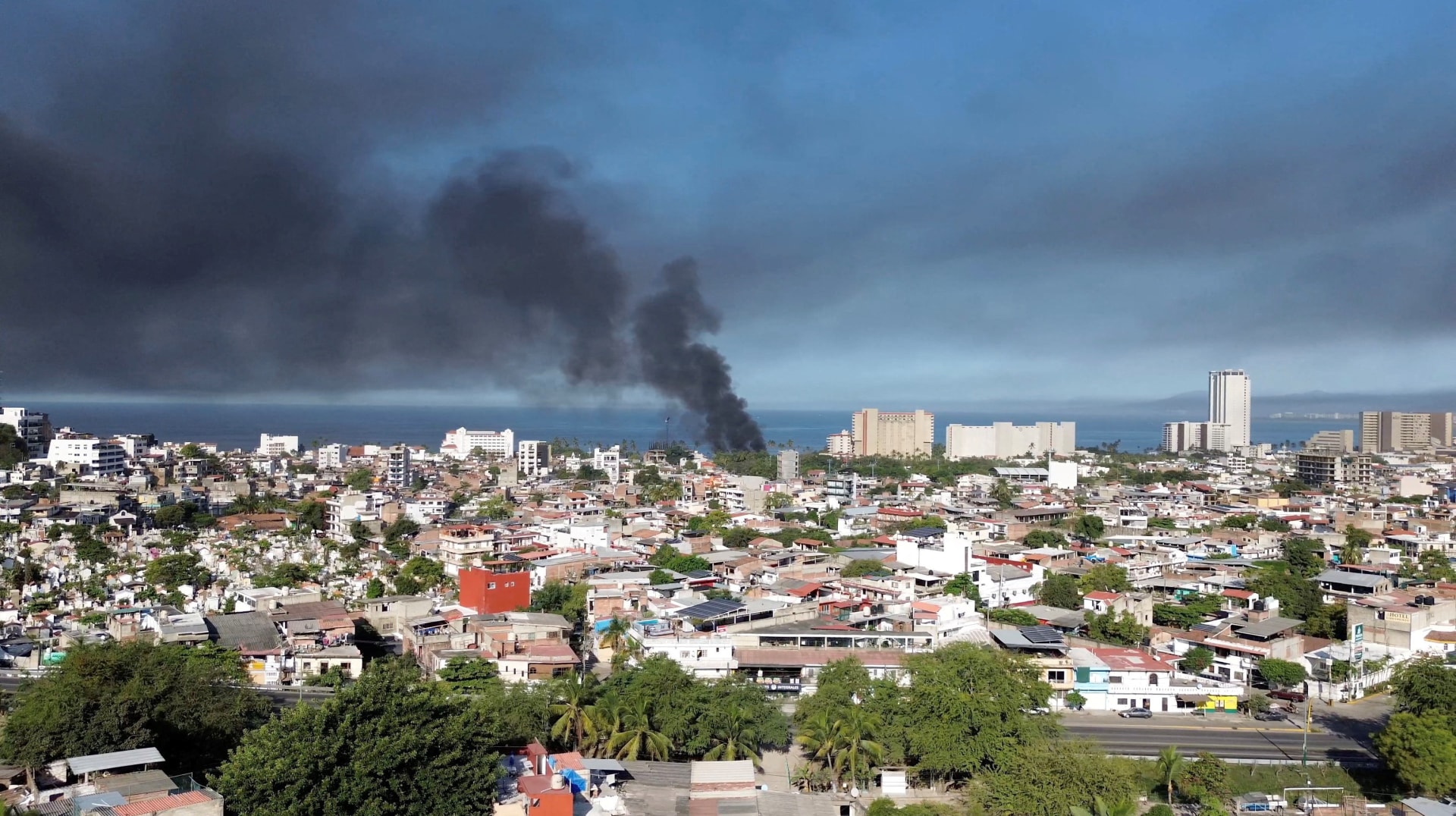
Smoke billows amid a wave of violence, with torched vehicles and gunmen blocking highways in more than half a dozen states, following a military operation in which a government source said Mexican drug lord Nemesio Oseguera, known as “El Mencho,” was killed, in Puerto Vallarta, Jalisco, Mexico, on February 22, 2026, in this screen grab obtained from a social media video.@morelifediares via Instagram/Youtube/via Reuters
TYPE
Criminal Violence
IMPACT ON U.S.
Medium
STATUS
Unchanging
Related
Mexico
Updated September 25, 2026
RelatedMexico
Updated September 25, 2026
Overview
Mexico’s narco trafficking organizations have waged a decades-long campaign of violence that has claimed hundreds of thousands of lives, destabilized governance across large swaths of the country, and strained the U.S.-Mexico relationship. Bilateral tensions have worsened under the Trump administration, which has designated major cartels as foreign terrorist organizations, publicly alleged government-cartel collusion, and pressured President Claudia Sheinbaum to adopt a more aggressive security posture.
Smoke billows amid a wave of violence, with torched vehicles and gunmen blocking highways in more than half a dozen states, following a military operation in which a government source said Mexican drug lord Nemesio Oseguera, known as “El Mencho,” was killed, in Puerto Vallarta, Jalisco, Mexico, on February 22, 2026, in this screen grab obtained from a social media video.@morelifediares via Instagram/Youtube/via Reuters
United States and Ecuador Jointly Arrest Over Thirty CJNG Members
Ecuadorian Interior Minister John Reimberg announced that Ecuadorian police, U.S. special operations forces, and the Drug Enforcement Administration jointly arrested over thirty members of the Jalisco New Generation Cartel (CJNG) during an early-morning raid (CBS/AFP).
Mexican authorities detained José Ángel Rivera, known as “Don Flaco,” in Mexico City in a joint operation with the FBI and the Drug Enforcement Administration; Security Minister Omar García Harfuch said Rivera coordinated and financed an organization moving fentanyl precursor chemicals from China to Mexico and the United States (Reuters).
United States Unseals Indictments Against Five CJNG Members
The U.S. Justice Department unsealed indictments against five alleged high-ranking members of the Jalisco New Generation Cartel (CJNG) as part of the Trump administration’s ongoing pressure campaign against the cartel, acting U.S. Attorney General Todd Blanche said (Reuters).
Mexican Journalist Killed in Oaxaca
Mexican journalist Francisco Leyva was found dead in Oaxaca, the state’s Attorney General’s Office said, marking at least the fourth killing of a journalist in the country since June (Reuters).
Sheinbaum Rejects DEA’s Comments Linking Mexican Government and Cartels
Mexican President Claudia Sheinbaum rejected comments from the head of the U.S. Drug Enforcement Administration, who said there is “a deadly connection” between the Mexican government and the country’s drug cartels, calling the remarks “unfortunate” and baseless (Reuters).
Historical Drivers of Mexico’s Drug War (1980–2018)
In the 1980s, Mexico’s criminal groups and drug traffickers became organized [PDF], assigning distinct regional areas of control for each group and establishing networks and trafficking routes. However, as production and distribution increased, the groups began fighting for territorial control and access to markets, leading to an increase in violence across Mexico.
The Mexican government officially declared war on criminal organizations in 2006 when former President Felipe Calderon launched an initiative to combat cartels using military force. In 2012, President Enrique Peña Nieto revised the Calderon government’s strategy, shifting efforts away from violent exchanges and toward improving law enforcement capacity and supporting public safety.
However, after the Sinaloa Cartel’s Joaquin “El Chapo” Guzman was arrested in 2014, re-arrested in 2016, and finally extradited to the United States in 2017, a power vacuum was created within the Sinaloa Cartel, resulting in an accompanying increase in violence between rival factions seeking new territory and influence. Despite an initial decrease in homicides following Peña Nieto’s reforms, Mexico continued to struggle with corruption and crime-related violence. By 2016, drug-related homicides had increased by 22 percent, with more than twenty thousand killed. In 2017, a mass grave containing the remains of more than 250 victims of crime-related violence was uncovered in Veracruz State. The violence rapidly intensified to a peak of 33,341 homicides in 2018. Additionally, from 2017 to 2020, a journalist was killed [PDF] every week on average.
Security Policy Under AMLO (2018-2024)
Recognizing widespread assertions that the use of military force had only increased the level of crime-related violence in Mexico—and accusations that the military had committed human rights abuses and carried out extrajudicial killings—then-presidential candidate Andrés Manuel López Obrador, popularly known as AMLO, promised on the campaign trail to revolutionize the fight against cartels and revert to a civilian-led police force. As part of his “hugs, not bullets” policy, AMLO emphasized poverty alleviation programs, the legalization of marijuana, and new sentencing guidelines for drug traffickers.
After winning the election and assuming office in December 2018, AMLO announced the creation of a new National Guard, a hybrid civilian police and military force, to fight cartels. In 2019, under a deal with the United States, AMLO deployed much of this force to the southern border with Guatemala to stem migration. However, AMLO’s tactics largely failed to curb violence. Though homicide rates dropped marginally, the country still reported over thirty thousand crime-related deaths per year.
Despite initially advocating a less securitized approach to reducing drug trafficking and violence, AMLO expanded the military’s role in policing. While the military’s involvement was intended as a temporary measure, Mexico’s Congress passed a reform in August 2022 that allows the military to carry out domestic law enforcement until 2028. AMLO also promised to bring the National Guard under the army’s command despite an April 2023 Supreme Court ruling that it must remain under civilian command.
President Claudia Sheinbaum, AMLO’s chosen successor, assumed office in October 2024, pledging to continue social programs to address the root causes of violence. But in practice, Sheinbaum has shifted away from AMLO’s non-confrontational posture toward a more assertive, intelligence-led approach, driven in part by pressure from the Trump administration to move more aggressively against the cartels. Security Minister Omar García Harfuch has framed the strategy around four pillars: National Guard consolidation, stronger intelligence and investigative capacity, poverty alleviation, and deeper coordination among federal, state, and local authorities. The government has reported a marked increase in arrests and in seizures of drugs and weapons, alongside expanded cooperation with U.S. agencies.
In February 2026, Mexican security forces killed Nemesio Rubén Oseguera Cervantes (“El Mencho”), the leader of Jalisco New Generation Cartel (CJNG), with the help of U.S. intelligence. The operation represented one of the most significant disruptions to drug trafficking since the trade gained a foothold in Mexico in the 1980s. The U.S. Drug Enforcement Administration has designated CJNG as one of Mexico’s most powerful trafficking organizations, responsible for distributing vast amounts of cocaine, methamphetamine, and increasingly, fentanyl, into the United States.
In a retaliatory show of force, CJNG members instigated a coordinated wave of violence across Mexico, setting fire to vehicles, blocking roads and highways, and forcing civilian lockdowns across major cities—underscoring the reach and power cartel groups continue to wield throughout the country. Analysts warn that a CJNG leadership succession crisis could trigger internal power struggles and further destabilize Mexico’s security landscape.
Sheinbaum’s government points to falling homicides as evidence that its strategy is working, reporting that the daily murder rate dropped by 37 percent between September 2024 and the end of 2025. Critics, however, caution that the official figures may understate the true toll, and that forced disappearances have risen over the same period.
Violence remains acute in Colima, Guanajuato, Morelos, Baja California, and Quintana Roo, as well as against public officials. High-profile assassinations continued throughout 2025, including the November killing of Uruapan mayor Carlos Manzo, an outspoken critic of cartel violence and one of dozens of politicians murdered during the year. Manzo’s death helped trigger a wave of youth-led protests in Mexico City and other cities against cartel violence and government corruption.
Key Actors
Sinaloa Cartel
One of Mexico’s oldest and most powerful transnational criminal organizations (TCOs), based in Sinaloa state, and a leading producer and supplier of fentanyl and other illicit drugs to the United States; locked in an internal power struggle since 2024
Jalisco New Generation Cartel (CJNG)
One of Mexico’s most powerful and wide-reaching TCOs, with operations in roughly half of Mexico’s states; the Sinaloa Cartel’s primary rival and a leading supplier of fentanyl and other illicit drugs to the United States
Mexican Government
Led by President Claudia Sheinbaum and seeking to strengthen security and the rule of law by prioritizing intelligence gathering and investigations while deploying military and law enforcement forces against criminal organizations, even as local-level collusion with criminal groups persists
United States
Has exerted intense pressure on the Mexican government to crack down on criminal organizations trafficking illicit drugs across the U.S. border and offers intelligence sharing to Mexican security services; designated the Sinaloa Cartel and CJNG as foreign terrorist organizations in February 2025