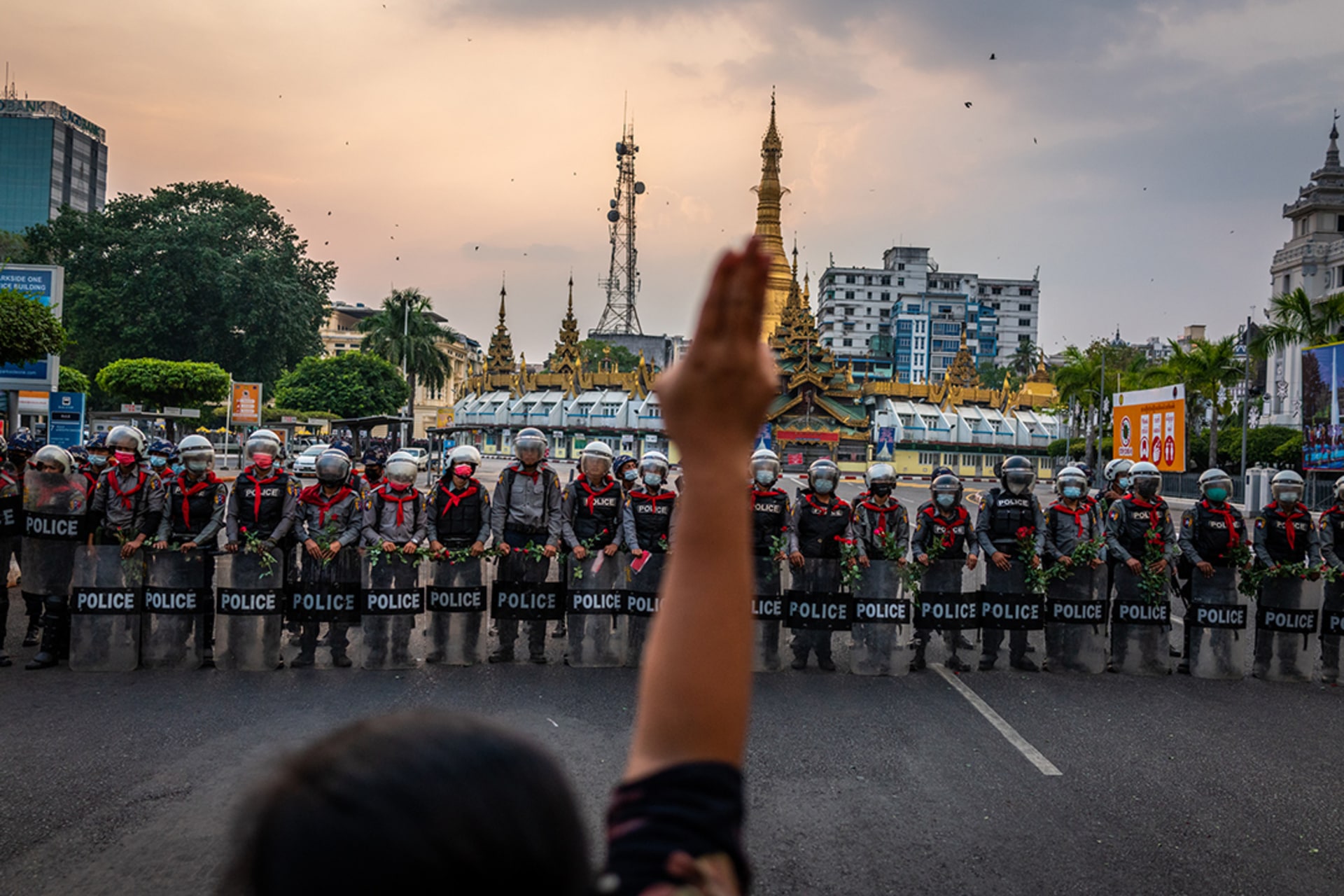
A protester makes a three-finger salute in front of a row of riot police, who are holding roses given to them by protesters, on February 6, 2021, in Yangon, Myanmar.Stringer/Getty Images
TYPE
Civil War
IMPACT ON U.S.
Limited
STATUS
Unchanging
Related
Myanmar
Updated August 27, 2026
RelatedMyanmar
Updated August 27, 2026
Overview
Myanmar’s military seized power in a February 2021 coup, triggering a civil war that has killed over 100,000 people and displaced 5.2 million. Resistance forces and ethnic armies control an estimated 42 percent of the country against the junta’s 21 percent, though the conflict has entered a stalemate with neither side holding a decisive advantage. Junta leader Min Aung Hlaing assumed the presidency in April 2026 under a nominally civilian government widely dismissed as a façade for military rule.
A protester makes a three-finger salute in front of a row of riot police, who are holding roses given to them by protesters, on February 6, 2021, in Yangon, Myanmar.Stringer/Getty Images
Min Aung Hlaing Visits Thailand, Seeking Political Legitimacy
Min Aung Hlaing, the head of Myanmar’s military-backed government, arrived in Thailand for an official visit to reassure the Thai Prime Minister that his government was restoring stability; the two leaders also announced their readiness to begin a new chapter of economic cooperation (AP).
Thai Prime Minister Calls for Re-Engagement With Myanmar
Ahead of Min Aung Hlaing’s visit to Thailand, Thai Prime Minister Anutin Charnvirakul delivered a speech at ASEAN’s headquarters, calling for a “calibrated re-engagement” with Myanmar (Reuters).
International Red Cross Visits Aung San Suu Kyi
Myanmar’s detained former leader, Aung San Suu Kyi, met with a representative of the International Red Cross in Naypyidaw (Reuters).
Suu Kyi’s health condition has been difficult to determine as she has not met with any foreign leader or envoy since being ousted and placed in detention in February 2021 (NYT).
Min Aung Hlaing Criticizes ASEAN Peace Plan for Myanmar
Min Aung Hlaing, the head of Myanmar’s military-backed government, criticized ASEAN’s peace plan for Myanmar in a speech to parliament marking his hundredth day as president after a discredited election, and outlined his government’s own plans to restore peace and stability (AP).
Myanmar’s Military Escalates Attacks on Civilians, ACLED Finds
Myanmar’s military has sharply increased its repression of and aerial bombing campaign against civilians since the ruling junta reconfigured its military command structure in March, the Armed Conflict Location & Event Data Project (ACLED) reported (Reuters).
Background
Since gaining independence from British rule in 1948, Myanmar (formerly known as Burma) has struggled to govern its multiethnic society effectively. Following a coup in 1962, Myanmar’s military junta has primarily held control of the country, engaging in conflicts with ethnic minority groups fighting for greater autonomy.
These ongoing tensions have their roots in the country’s complex ethnic makeup and the legacy of British colonial rule, which exacerbated divisions among different communities. The conflicts have resulted in widespread human rights abuses, displacement of civilians, and persistent instability across many regions of Myanmar.
In 1990, Myanmar held its first general election since the 1962 military coup. The National League for Democracy (NLD), led by Aung San Suu Kyi, won by a landslide. Suu Kyi, the daughter of the nationalist leader who fought for Burma’s independence and the most prominent democratic activist, was placed under house arrest by the junta before the vote. After the election, the junta refused to recognize the results.
The NLD’s success in the 1990 election made the junta realize its limited support among the populace. To maintain its grip on power, the junta embarked on a decades-long process to enshrine military rule through what it called “disciplined democracy” or a “roadmap to democracy,” which included drafting a new constitution in 2008. The constitution reserved significant power for the military, including control over important ministries and 25 percent of parliamentary seats, effectively granting it veto power over amendments. This approach allowed for limited reforms but ensured the military’s continued influence.
Under the junta’s roadmap, the government held general elections in November 2010. In the leadup to the vote, the junta passed new election laws that prohibited anyone serving a prison sentence or married to a foreign national from running for president—a clear attempt to block Suu Kyi from the ballot, who was still under house arrest and married to a British citizen. The NLD decided to boycott the elections, and the military-backed Union Solidarity and Development Party (USDP) won.
In 2015, the NLD returned to participate in general elections, with Suu Kyi unofficially leading the party. The NLD won Myanmar’s first competitive national election in over twenty-five years. Due to the revised election laws, Suu Kyi could not officially become president but became de facto leader as State Counsellor. The NLD entered a power-sharing arrangement with the military according to the 2008 constitution, leading a civilian parliament while the military continued to control crucial executive ministries and oversee security policy.
Despite her reputation as a democratic icon, Suu Kyi lost international support as her NLD government defended the military’s ethnic cleansing against Myanmar’s Rohingya people, a Muslim ethnic minority group of one million. The Rohingya live in western Myanmar’s Rakhine state, which borders present-day Bangladesh. The Rohingya have long faced persecution from the ethnic Bamar majority, who often call them “Bengali” to discredit their right to live in Myanmar. Myanmar’s government asserts that the Rohingya did not settle in historic Burma before British rule began in 1823. This criterion determined which groups are considered “indigenous ethnic” within the 1982 Citizenship Law. Thus, Rohingya are not considered citizens by Myanmar’s government, making them the largest stateless population in the world.
Tensions between Buddhist and Muslim communities in Myanmar’s Rakhine State escalated dramatically after a series of Rohingya militant attacks in October 2016 and August 2017. These attacks on military and police outposts, led by the Arakan Rohingya Salvation Army, killed twelve Burmese security forces personnel in total. In both years, the military responded with brutal crackdowns on Rohingya villages, causing at least 6,700 deaths between August and September 2017 and forcing over 700,000 people to flee across the border to Bangladesh. Widespread reports indicate indiscriminate killings and burning of Rohingya villages, with the UN Human Rights Commissioner calling the situation in Rakhine State “a textbook example of ethnic cleansing.” Since 2017, living conditions for the more than one million Rohingya across the border in Cox’s Bazar, Bangladesh, have continued to deteriorate.
In November 2020, the NLD won the general election again by a large margin. The military contested the results as fraudulent, sensing the continued democratic success of the NLD posed a long-term threat to its rule. In early February 2021, Myanmar’s military carried out a coup, detaining senior leadership of the democratically-elected government, including de facto head of state Suu Kyi, and forcing other members of parliament into hiding. After seizing power, General Min Aung Hlaing, the leader of the military junta, instituted a year-long state of emergency.
Protests immediately broke out in the capital, Naypyidaw, demanding the restoration of civilian rule and democratic governance. In response, security forces employed lethal force, killing more than six hundred people. The military junta also instituted curfews and other limitations on gatherings to curb the demonstrations. Doubling down, the military launched violent campaigns across the country, targeting resistance villages, and silencing and torturing dissenters, displacing thousands in the process.
As international condemnation amplified, an opposition force of ousted officials, oppressed ethnic groups, and pro-democracy protestors united to form the National Unity Government (NUG) in April 2021. The NUG publicly states its goal of governing Myanmar as a “federal democratic union.” Shortly after, the new coalition formed the People’s Defense Force (PDF)—an armed wing to fight the junta and its allied forces.
As the junta repressed protests, popular support for the democratic resistance movement grew: in 2022, the PDF claimed 65,000 fighters, which rose to 85,000 soldiers in 2024. Rebel ethnic groups across the country’s states have played a critical role in strengthening the PDF’s efforts, with a common goal of pushing military forces back from local villages. Several of the twenty-five active ethnic armies coordinate with the pro-democracy forces, including the Kachin Independence Army (KIA), Shan State Army, and Karen National Liberation Army (KNLA).
In late October 2023, a coalition of three ethnic armed groups in Shan State launched a coordinated offensive—named Operation 1027, for the date the offensive commenced—against the junta. Known as the Three Brotherhood Alliance, this coalition consists of the Arakan Army (AA), the Myanmar National Democratic Alliance Army (MNDAA), and the Ta’ang National Liberation Army (TNLA). Initially formed in 2019, the group’s 2023 coordinated offensive posed the strongest challenge to military rule since the February 2021 coup. Insurgents used drones to bomb military and police outposts in eastern Kayah State, bordering Thailand; western Rakhine State, bordering India; and northern Shan State, bordering China. By the end of 2023, the offensive captured over 180 military outposts in Shan State.
The military continues to leverage its technological advantages, many of which are granted by foreign suppliers like Russia and China, to fight armed opposition groups. However, waning morale has hindered military cohesion. Military forces have dwindled from the start of the civil war, with only approximately 130,000 soldiers remaining from a collective of 300,000 in 2021.
Recent Developments
While the military still possesses technological superiority, its forces have not been effective in countering rebel offensives. It has lost critical infrastructure and townships, and the country is experiencing significant economic pressures and high rates of food insecurity. The military resorted to forced conscription in February 2024 to address its manpower shortage. Since then, the military has conscripted about thirty thousand people, prompting an exodus of young people fleeing Myanmar’s cities.
In August 2024, the Three Brotherhood Alliance seized the Northeastern Regional Military Command (RMC) in Lashio—a key military headquarters and economic access point to China. Lashio remains under MNDAA control, though fears persist in the city over the MNDAA’s imposition of martial law and rumors of forced conscription.
In December 2024, fighting in the city of Maungdaw in Rakhine State ended with victory for the Arakan Army, an ethnic Buddhist militant group. With the Arakan Army taking control of villages and townships in the state, local minority groups, such as the Rohingya, fear continued ethnic persecution.
Throughout the conflict, both domestic and international support for the NUG has risen. A 2024 survey revealed that around 93 percent of respondents in Myanmar have a favorable opinion of the NUG. In January 2025, the junta announced plans for general elections by the end of the year or early 2026 to consolidate political control. Observers fear elections could lead to more violence. The junta also extended its state of emergency by six months.
China has steadily increased its involvement in the conflict, seeking an end to the fighting to preserve the military junta and ensure stability. Beijing has brokered several ceasefires, with mixed results and temporary truces. China’s economic interests in Myanmar include critical minerals, oil and gas, and BRI infrastructure projects. Myanmar also provides deep-sea port access and a key alternative to the Strait of Malacca trade route. Though China continues to provide military support to the junta, it also maintains relations with the NLD.