El Salvador’s Troops Are Fighting Haiti’s Gangs. Who Is Protecting Civilians?
El Salvador’s troop surge has given Haitians hope, but it has also added another armed force to an already uncoordinated fight. Four steps could protect civilians and expand aid access as military operations intensify.
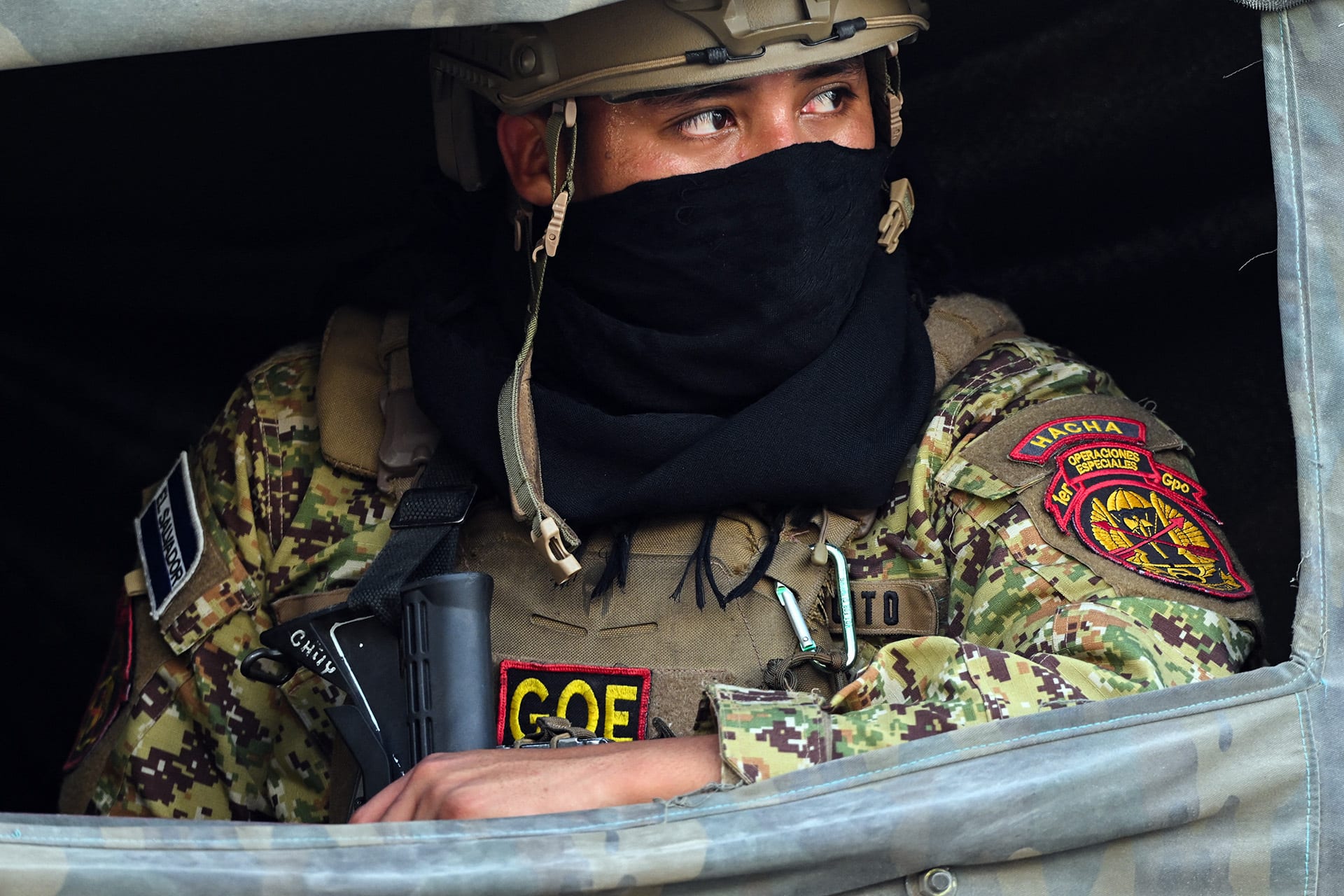
On October 18, gang members ambushed an armored vehicle in Port-au-Prince, setting it on fire and seizing its occupants. The abduction was hardly unusual: the United Nations recorded ninety-two kidnappings in Haiti’s capital alone between July and September. What set this incident apart, however, was the four men inside: Salvadoran aviation technicians serving with the UN-authorized Gang Suppression Force (GSF).
Within days, El Salvador’s president, Nayib Bukele, announced a rescue operation and deployed one hundred special forces troops. Following Bukele’s October 28 call with Haitian Prime Minister Alix Didier Fils-Aimé, El Salvador announced it would deploy more than two thousand troops in total. In a separate call, President Donald Trump told Bukele to “do what you have to do,” in effect blessing the improvised operation.
Bukele’s surge is just the latest iteration of an international response to Haiti’s insecurity that remains largely one-dimensional: meet violence with more violence. It amounts to a counterinsurgency strategy—clear, hold, build—without the troops or funding to hold and build.
The Salvadoran forces join Haiti’s duct-tape security architecture, led, on paper, by a Haitian National Police (HNP) plagued by corrupt ties to the very gangs it is tasked with defeating. More than one year into its mandate, the GSF only had 1,563 personnel as of mid-October, less than one-third of its 5,500-troop ceiling. And then there’s Vectus Global, a private military company run by Blackwater founder Erik Prince, which is supporting a lethal drone campaign that targets gang members and that has resulted in the deaths of eighty-seven civilians, including twenty-one children, between July 2025 and September 2026, according to the UN Integrated Office in Haiti.
Against this backdrop, the humanitarian indicators are moving in the wrong direction: 5.8 million Haitians facing acute hunger and 1.5 million displaced, both records. The unfolding ad hoc security approach appears to be making important strides in weakening gang control, but without civilian protection and a long-term plan to hold territory, it risks further destabilizing a country scarred by past international interventions.
Bukele chronicles war operation, crowdsources intelligence
Since his troops went missing, Bukele has used the social media platform X, formerly Twitter, to communicate with Haitians, source purported intelligence on gang leaders, and document an increasingly kinetic operation. On the streets of Port-au-Prince and in soccer stadiums in Miami, videos show Haitians and members of the diaspora cheering Bukele and his troops. Given the desperation on the ground, it is an understandable reaction. El Salvador’s deployment of more troops in two weeks than the UN-backed mission did in over one year has generated a long-dormant sentiment among many Haitians: hope.
And yet, the clean social media narrative of Bukele as Haiti’s liberator masks a more chaotic story on the ground. The arrival of Salvadoran troops in late October appears to have bypassed standard predeployment protocols, such as country-specific training and deconfliction procedures. Making the situation even more complicated: Salvadoran nationals are working with three different armed actors. In August 2025, the Wall Street Journal detailed that Vectus had hired mercenaries from El Salvador to support its operation, meaning the country’s citizens are part of the GSF, Vectus, and Bukele’s surge. The friendly-fire close calls that have followed El Salvador’s surge now foreshadow the threat to civilians trapped in gang strongholds as the military operation escalates.
In an October 31 incident, stray bullets struck the U.S. embassy and nearly hit U.S. personnel during a firefight between Salvadoran soldiers and gangs. When the United States sent a diplomatic note of protest over the incident, El Salvador reportedly pushed back with a four-point response to the allegation. Offline, the top U.S. official in Haiti has also sounded the alarm. A day after Bukele said Salvadoran helicopters repelled gangs attacking Chadian GSF troops on November 3, U.S. Chargé d’Affaires David Howell texted Prime Minister Fils-Aimé and pressed for deconfliction, Axios reported. “They nearly killed GSF troops as I understand it,” Howell wrote, adding, “They are going to kill [GSF] troops or civilians and or get themselves killed.” El Salvador has denied Howell’s account.
Bukele’s decision to crowdsource targeting information raises a similar danger. When video of the compound of one of Haiti’s most powerful gang leaders, Wilson Joseph, also known as Lanmò San Jou, was posted on X and tagged Bukele, the Salvadoran president responded: “Where is that house? Give us the exact address, and we’ll destroy it.” Days later, in a post that has garnered over twelve million views on X, Bukele shared a forty-eight-second clip of what he described as Salvadoran helicopters launching rockets at Joseph’s house, saying he destroyed the 400 Mawozo gang’s headquarters. According to the Miami Herald, Salvadoran helicopters were supporting the Vectus-backed Haitian National Police drone task force during the 400 Mawozo attack, which reportedly took place at 2:30 a.m. on November 8. The video posted by Bukele appears to have been filmed during daylight hours.
A head of state turning to social media for potential targets in a lethal third-country military operation raises serious questions about whether human rights law is being respected and civilian protections are being considered. Typically, the United States would be concerned, but the Trump administration appears unperturbed—at least on the surface.
Asked on November 8 whether he thought the ongoing operations of the Salvadorans were undermining the U.S.-backed GSF initiative, U.S. Secretary of State Marco Rubio said no, explaining that Bukele had told Trump what he was doing and that the president understood. But he added a condition: “we have to make sure there is deconfliction,” stressing the operation can work “as long as the chain of command is well established.” Rubio clearly laid out the stakes: “If the Gang Suppression Force effort doesn’t work, then we’re out of ideas . . . there’s no plan B.”
The five forces accelerating Haiti’s crisis
Intervention in Haiti is undoubtedly needed. The nation, less than two hours by plane from Miami, is suffering on almost every recordable front. Of the five criteria that aid workers often use to gauge the severity of a humanitarian crisis—armed conflict, mass displacement, looming famine, natural disasters, and political collapse—Haiti maxes out all five. However, without a strategic plan to address these needs, a military escalation will likely only make conditions worse.
Armed Conflict. Doctors Without Borders (MSF) reported an escalation in armed conflict in areas it serves after the Salvadoran technicians went missing. In the week that followed the ambush, its Tabarre and Cité Soleil hospitals received thirty patients injured by gunshots or drone strikes. Lethal drone strikes have become commonplace since March 2025, when the Haitian government hired Vectus Global. The United Nations has since found no indication that authorities had investigated the circumstances of these attacks, and Human Rights Watch has said that many appear to be attempts to target and kill people in “circumstances that amount to unlawful, extrajudicial killings.”
Before Bukele’s troop surge, aid organizations had spent months working with the GSF to ensure the force’s rules of engagement accounted for humanitarian operations and civilian protections. With Salvadoran troops already firing weapons, aid organizations fear the deployment will forgo this process altogether.
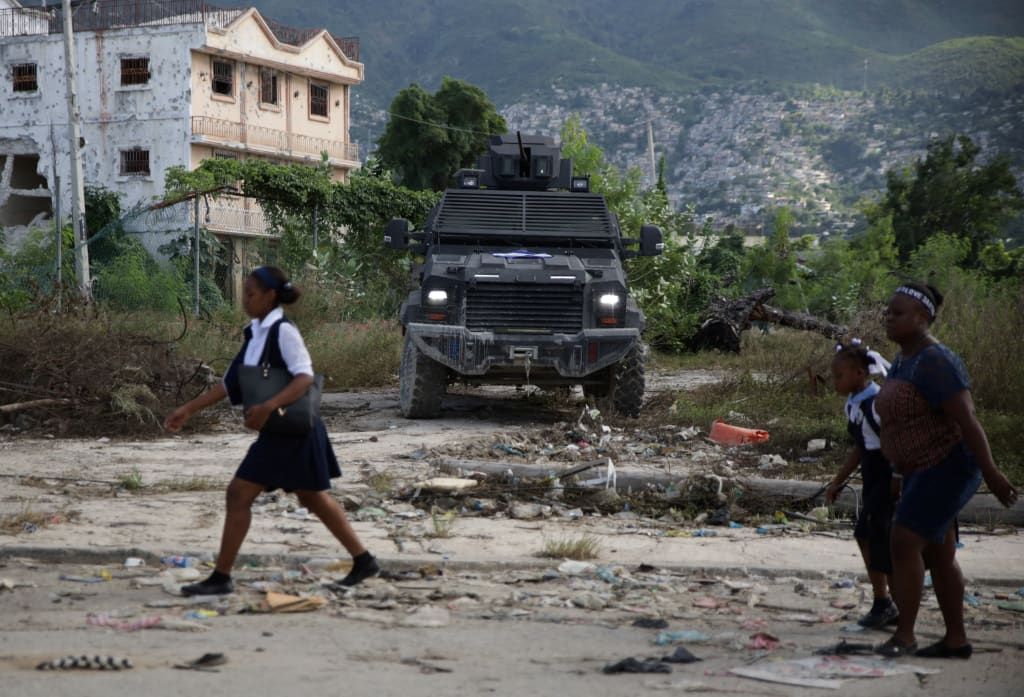
Mass Displacement. On the ground, two dozen gangs have been battling for control of Haiti’s capital and, increasingly, rural areas of strategic importance. A September 2026 International Organization for Migration report detailed how gang-fueled armed conflict drove a 2 percent increase in internal displacement between May and August 2026. Thirteen percent of Haiti’s overall population has now been forced to flee their homes; in Port-au-Prince, more than two hundred thousand people are packed into improvised and overcrowded shelters, ranging from traffic circle medians filled with flimsy tarps to mothballed nightclubs prone to flooding.
As Salvadoran troops, the GSF, the HNP, and Vectus dislodge gangs across Port-au-Prince, more civilians are likely to flee. Even if they find a safe space, it will already be overcrowded with others who have made the same decision over the last four years.
Looming Famine. The recent gang expansion taking aim at Artibonite, Haiti’s agricultural breadbasket, is having an alarming effect on displacement and food security. Gangs have cut off farmers from their markets, destroyed food stocks, and prevented people from growing food. New food insecurity reports from the Famine Early Warning Systems Network (FEWS NET) and the Integrated Food Security Phase Classification (IPC)—both gold-standard international monitoring instruments—forecast a worsening outlook through the first half of 2027. Over half of Haiti’s population is presently experiencing crisis levels of hunger, with 1.8 million people a step removed from famine conditions; that number is projected to grow to nearly two million between March and June 2027.
In the near term, increased urban fighting will make food deliveries more difficult. However, should armed forces secure key roadways currently controlled by gangs—including National Routes 1 and 2—humanitarian access could expand in the medium term.
Natural Disasters. In late October, heavy rains flooded 2,600 homes across the country’s south, exacerbating food security and internal displacement issues. The region already hosts 407,000 internally displaced people who have fled gang violence. Making matters worse, the IPC warns rainfall deficits and above-average temperatures caused by an unusually powerful El Niño event threaten upcoming harvests, including in areas where people can still safely farm.
Political Collapse. The crisis triggered by the July 2021 assassination of Haitian President Jovenel Moïse shows no signs of stabilizing. The country’s Provisional Electoral Council scheduled a long-delayed first round of presidential and legislative elections for December 13. However, in October, they were postponed to July 18, 2027, due to persistent insecurity, reinforcing the feedback loop between armed conflict and political crisis. Haiti has not held an election since 2016—meaning critical decisions about the country’s security, including the use of a foreign army and a private military company, continue to be made by unelected officials.
Four recommendations to improve humanitarian conditions
The Miami Herald reported on November 9 that Prime Minister Fils-Aimé has set up a central security “coordination cell under his oversight” to prevent friendly fire and align operations between multiple armed actors, though no details have been shared. This is a critical step, but the following actions should also be taken to ensure civilian protections and scaled-up aid programs.
First, Haitian authorities should ensure that the coordination cell includes a seat for the UN Office for the Coordination of Humanitarian Affairs. This will help deconflict all military operations with humanitarian aid programs. Coordination was underway with the GSF, but a more complicated environment demands an immediate solution. Fils-Aimé should separately ensure the Salvadoran troops undergo the same training as the GSF with respect to protecting civilians.
Second, countries should convene an international donor conference in the coming weeks, with a specific focus on shelter and health care. The UN humanitarian appeal for Haiti remains less than 50 percent funded with only weeks left in the calendar year. Haiti’s hospitals are already at full capacity and, as MSF’s October statement indicates, should expect more casualties with any escalation. One country should do more: France, currently ranked as Haiti’s seventh-largest donor. Its $8 million contribution to an $880 million appeal is less than 1 percent of total needs.
Third, the United Nations should work with the Haitian government to establish an international monitoring mechanism that includes Salvadoran operations. From the importation of cholera to widespread sexual exploitation and abuse, past international interventions show the catastrophic consequences of poor oversight in protecting civilian populations.
Finally, the UN Security Council should convene an open meeting under the agenda item “The Question Concerning Haiti,” which would allow all stakeholders now on the ground to outline their strategy. This would ensure a public accounting of the military, humanitarian, and human rights situation following the addition of the Salvadoran troops. In addition, the Haitian government should publicly release its force agreement with El Salvador, including rules of engagement.
Haiti’s government and its international partners face an inflection point: unify operations and protect civilians or allow the armed actors to splinter while pursuing independent objectives. One option protects civilians and places a check on armed conflict; the other fosters chaos on the battlefield and leaves the Haitian people more vulnerable than ever before.
This work represents the views solely of the author(s). The Council on Foreign Relations is an independent, nonpartisan membership organization, think tank, and publisher, and takes no institutional positions on matters of policy.