The Demise of Democracy Isn’t Here Yet
CFR President Michael Froman analyzes the high level of participation and youth involvement in recent global elections.
The fate of democracy around the world is the subject of much debate. There are disturbing data points, particularly around press freedom, which are setting off alarms. There are worrying illiberal and authoritarian turns, concerns about election administration and integrity, and pockets of anxiety about the peaceful transfer of power. That said, there are also some notable positive data points which should not be overlooked. Just look at the developments of the last few weeks.
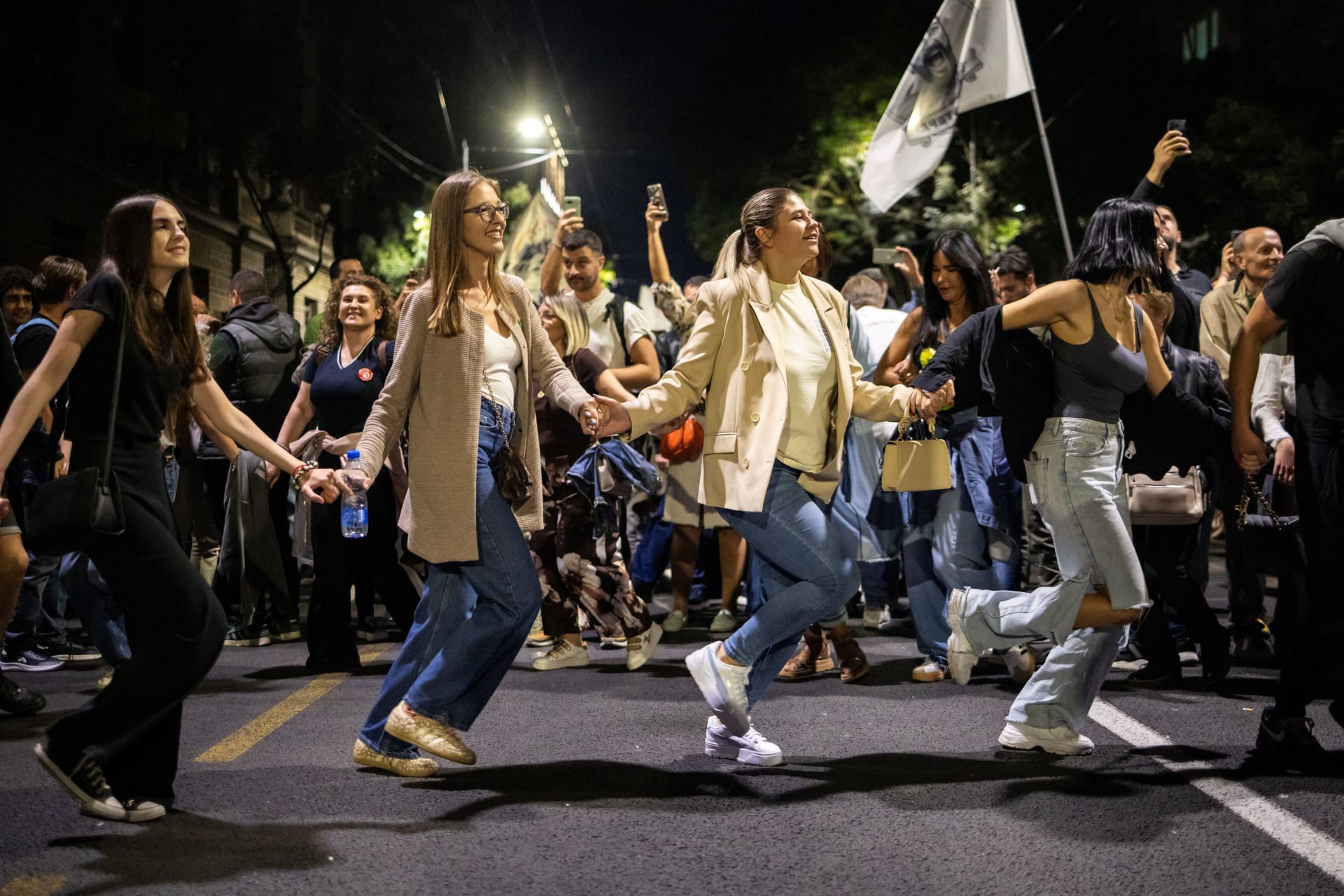
Serbia held an election that saw voter turnout at nearly 70 percent—its highest level since the breakup of Yugoslavia in 1992. There, a student-led protest movement defeated Aleksandar Vučić, a populist who has dominated Serbian politics since 2014.
In Brazil, where voting is mandatory but fines for abstention light, turnout eclipsed 80 percent. Three million people who did not vote in round one cast a ballot in the second round, returning eighty-one-year-old Luiz Inácio Lula da Silva for a fourth term.
And in Israel, an estimated sixty-seven thousand Israelis living abroad flew back to Israel to vote, adding to the historic turnout in what was viewed as a referendum on Prime Minister Benjamin Netanyahu’s nineteen years of governing, including his handling of Gaza, Lebanon, and Iran.
There is not a single theme that ties these elections together. Serbia saw the rejection of a longstanding leader, Brazil returned an incumbent, and well, we might not know the complexion of the next Israeli government for some time. Serbia lurched to the left, Brazil remained left, and Israel’s choices seem to be between a center right and a further right government.
If there is a throughline, it is the level of participation—and perhaps the role of the youth.
Take Serbia as an example, where the dominant role youth played in the election was perhaps the clearest. Serbia’s conservative leader Vučić, who led for more than a decade, was defeated by a student-led protest movement. The movement was formed less than two years ago in response to a railway station disaster that killed sixteen people. The tragedy set off protests among students, which snowballed into a broad anti-government movement as evidence pointed to government fraud and corruption as the cause of the collapse. During the elections held last Sunday, October 25, Vučić’s Serbian Progressive Party earned less than 40 percent of the vote, while the opposition Student List earned 53 percent, capturing 141 seats in the 250-seat parliament. Like his friend up the Danube, Viktor Orbán, who showed himself the exit after youth turnout proved decisive in removing him from power during elections in Hungary in April, Vučić conceded defeat. Like the student-led opposition in Serbia, Hungary’s Péter Magyar and his Tisza Party built a campaign centered on corruption and rode a strong youth turnout to end Orbán’s sixteen-year reign.
CFR’s own Charles Kupchan arrived in Belgrade the Thursday before the vote. He found crowds estimated around 150,000 gathering in the city center in what amounted to “a massive protest.” When asked about his experience, he said, “The atmosphere was electric. The crowd was singing and chanting as it coursed through the streets, excited by the prospect that the Vučić era was about to come to an end.”
What comes next in Belgrade is hard to read, but Kupchan put his finger on the key point: “The student movement now has wind in its sails and lots of political momentum. It needs to focus on turning that momentum into good policies and good governance.”
In Brazil, Lula surged to a comeback victory in the second round of presidential elections, winning 51.8 percent of the vote compared to 48.2 percent for Flávio Bolsonaro. Lula was propelled to victory in no small part by a wildly successful digital strategy. Despite restrictions that prevented some of Lula’s social media posts from being shared, he benefited from the creation of a WhatsApp channel called “Lula’s Army.” While the strategy was undoubtedly Gen Z in style, the Lula’s Army channel was launched by a forty-two-year-old congressman and included a broad swath of Brazil’s population, including “sixty-year-old aunties.” It ultimately grew to ten million members in the run-up to the election.
The effect of this massive mobilization was an increase in overall turnout. Many Brazilians who sat out round one, or cast a null or blank ballot in support of none of the candidates, wound up supporting Lula in round two, giving him a victory by a margin of 4.4 million votes. In the first round, more than thirty-three million Brazilians—21 percent of voters—did not cast a ballot. In the second round, blank and null votes were at their lowest level of the century and 3 million people who abstained in round one decided to show up at the polls. With the vast majority of those voters casting their ballots for Lula, the incumbent president achieved what had not been done since 1989: winning an election after finishing runner-up in the first round.
In Israel, election turnout hit 77.7 percent—its highest level since 1999. As CFR’s Elliott Abrams wrote, “Israel’s election this week was an excellent democratic exercise.” Nevertheless, with no party or bloc having earned a majority in the Knesset, the future of Israeli governance is murky at best. Netanyahu’s bloc earned fifty-three seats, while the opposition bloc led by Gadi Eisenkot earned forty-eight seats. The Arab parties earned a historic nineteen seats. Approximately 640,000 Israelis between the ages of eighteen and twenty-two were eligible to vote in the elections on Tuesday, making up roughly 10 percent of the electorate.
Of course, a healthy election does not guarantee a government that can overcome polarization and gridlock. Will the student movement in Serbia pivot and learn what it means to govern? Will Lula use his fourth mandate to address the issues of discontent that propelled his reelection? Will Israel, with its divided and polarized electorate, see a shift in policy?
Turning protest into lasting change is hardly a cakewalk. Just yesterday, I had the privilege of hosting Maria Ressa, a journalist and Nobel Peace Prize laureate, at the Council. She reflected on the role of journalism and protests in her own country, the Philippines, which ultimately led to former President Rodrigo Duterte being sent to The Hague to stand trial at the International Criminal Court. She cited the daily protests in Georgia, as well as the ones in Serbia, as positive signs that democracy is still very much alive.
Next month, we’ll see major elections in Spain. France will hold consequential presidential elections in the spring. And, of course, there’s the United States, where much uncertainty surrounds the upcoming midterm elections.
For now, though, reports of democracy’s demise might be premature at best. And we may well have the kids to thank for that.
Happy Halloween.

Let me know what you think about the health of democracy and what this column should cover next by replying to [email protected].