Science Fair Series: When the Sun Strikes
Event date
From Science Fair Series.
Speakers
- Adjunct Professor, Georgetown University; Principal Consultant, Everything Lives LLC
- Research Astrophysicist, Beryllium10 Knowledge Technologies
Presider
- Kat DuffyCFR ExpertSenior Fellow for Digital and Cyberspace Policy and Director of LEAD AI, Council on Foreign Relations
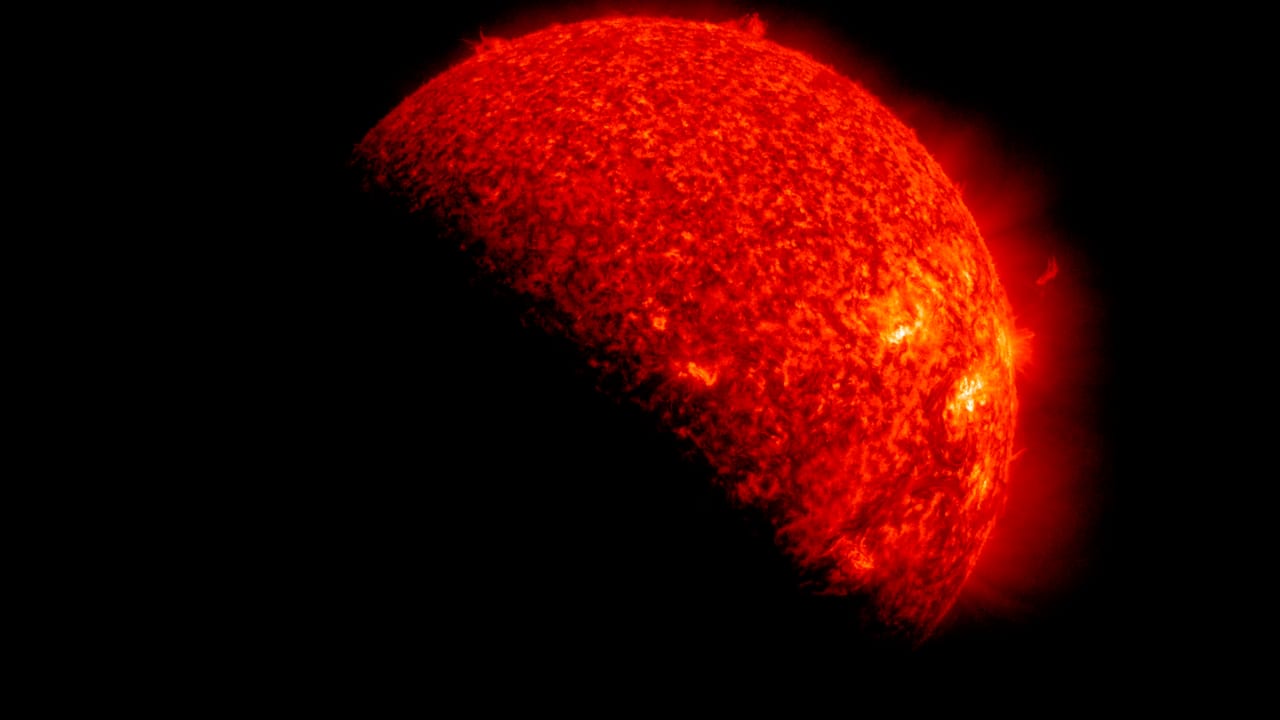
Join astrophysicist Barbara J. Thompson, one of the founders of NASA’s Center for HelioAnalytics, and Newton Campbell Jr., adjunct professor at Georgetown University and a 2026 TIME100 AI honoree, to discover how AI is accelerating our understanding of the Sun, why that knowledge can transform critical infrastructure in orbit and on earth, and where geospatial AI is creating new possibilities for sustainable development and human flourishing.
The Science Fair Series highlights scientific and technological advances with consequences for foreign policy. Sessions are designed for all CFR members, regardless of scientific background. This meeting is presented by LEAD AI, a CFR initiative working to ensure that the deployment of AI systems reinforces democratic resilience, safeguards human agency, and resists the consolidation of authoritarian control.
This event is made possible through support from the MacArthur Foundation, Rockefeller Philanthropy Advisors, Humanity AI, the Hewlett Foundation, and the Packard Foundation.
DUFFY: Hi, everyone. This is so exciting. Convening people in D.C. a day after an election is always quite a—quite a feat. I thank you all for joining us.
CAMPBELL: Yes. Was there an election yesterday?
DUFFY: What? (Laughter.) I’m sure everyone got a great night’s sleep.
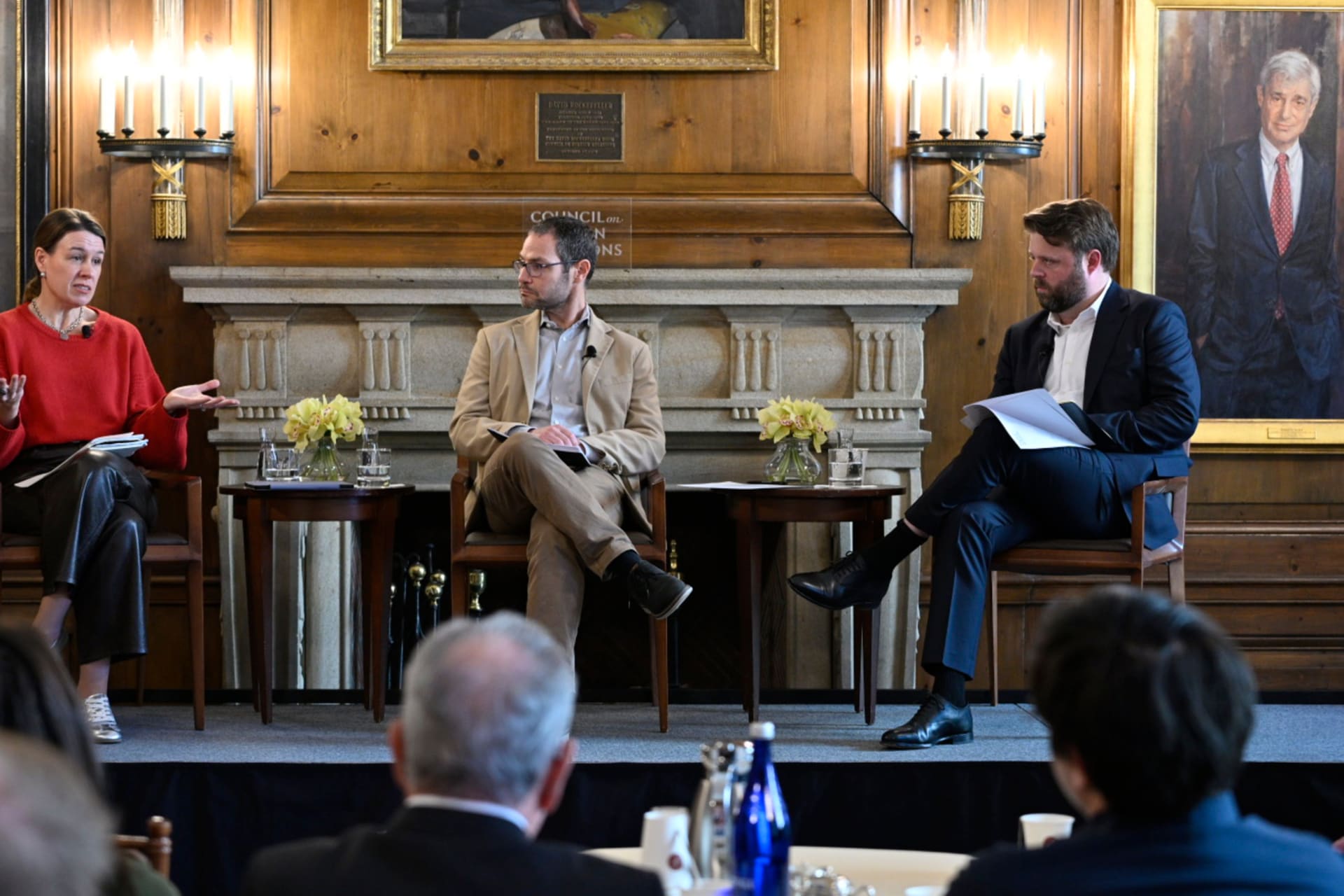
So with that, I want to welcome you all to Science Fair. So my name is Kat Duffy. I am a senior fellow here at the Council for digital and cyberspace policy, and I also direct our LEAD AI initiative. And today’s Science Fair Series we’re calling “When the Sun Strikes.” And I am absolutely delighted to be joined by Dr. Newton Campbell and Dr. Barbara Thompson.
The Science Fair Series is a product of the program that I run, LEAD AI. And it highlights scientific and technological advances with consequences for foreign policy. Sessions are designed for all CFR members. And so thank you as well to our CFR members who are joining online. And you do not need a scientific background or certainly physics expertise to enjoy this conversation. The event is made possible through support from the MacArthur Foundation, Rockefeller Philanthropy Advisors, Humanity AI, the Hewlett Foundation, and the Packard Foundation. So we are grateful to all of our donors.
And we are joined by our CFR members here in Washington, as well as CFR members online. But we are also very pleased to welcome our early career professionals. Where are y’all at? I’m seeing you. (Laughter.) I love it. They are not—yes, let’s give them a round of applause. It’s very exciting they’re here. (Applause.) They are not yet old enough to apply for our Term Membership Program, which makes me feel ancient. (Laughter.) But they have an interest in international affairs and engaging with the Council. And I’m so grateful they could all be here to join us today.
And so with that, I want to start us off. We’re going to do a discussion for about a half an hour, twenty-five minutes. And then we will open it up to a Q&A to folks here in the room and online as well. There is nothing more boring than reading someone’s bio. It’s a cardinal sin, in my book. And so I’m going to start by asking—and I’ll start with you, Newton—if you could just briefly introduce yourself, and explain just your background and your specific area of expertise.
CAMPBELL: So I’m Newton Campbell. Thanks, Kat. I’m Newton Campbell. I am a computer scientist and applied mathematician, through my own consulting company these days, since being back. I am working as an artificial intelligence expert both for NASA Goddard Space Flight Center and the United Nations doing all sorts of work in artificial intelligence, both the newer kind, as I often call it, with commercial LLMs and MCP servers and all of that stuff, but also helping identify insights using machine learning, and bringing that to NASA missions and R&D. With the United Nations—(inaudible)—for the Early Warning for All initiative. And that initiative was sparked by the United Nations back in 2023. And the idea was, how do we provide early warning systems for all countries by 2027? Which is a very ambitious goal. We will see if we make it. But I am the—I’m the co-coordinator for the AI group there. And I’m also sparking an NGO that works on OSINT for sustainable development as well.
DUFFY: And, Barbara, over to you.
THOMPSON: Hi. I’m Barbara Thompson. I was at NASA Goddard for thirty years, where I did—and I recently left. But while I was there, I focused heavily on solar emissions, data science, AI, both developing missions and using the data, and also the international programs and the international partnerships and commercial partnerships that made those missions and that data—the use of that data possible. Another thing that I did is I served as a space weather forecaster with the Space Weather Research Laboratory for several years, and worked on developing space weather protocols for NASA, especially when it comes to the robotic missions or the non-crewed missions. Now I’ve left NASA and I am working as a consultant. And my most recent emphasis has been on leveraging machine learning and AI in general, to forward not just the use of knowledge but the creation of knowledge. Really focusing on the things that we don’t know, and the things that we need to know, or the things we don’t even know we need to know, and leveraging technology to be able to make those things possible for the use of not just space weather, but just enabling a space weather and knowledge creation workforce.
DUFFY: I have been describing Barbara to folks as the Queen of NASA. (Laughter.)
CAMPBELL: That’s how we describe her too, by the way. (Laughter.)
DUFFY: And Newton was honored this year by Time magazine as one of the 100 Most Influential People in AI as well, which I think was really exciting for all of us who have known him and loved him for a long time, so.
So, Barbara, you mentioned space weather. I did not know what space weather was until I met Barbara. Who in this room is familiar—raise your hand if you are familiar with space weather. OK, that’s a decent show. At least half the room is better educated than I. I got really excited about the idea of like a jewel-toned, like, shift dress and a great, like, wall that I could point to. And I could be like, solar flares will be happening today until Tuesday, right? (Laughter.) What is space weather? Why should we know about it? And how is it evolving right now?
THOMPSON: Well, space weather is—humans always observe the effects of solar activity and things that happen in space on Earth, via the aurora. Whenever people see aurora, even if they didn’t know it at the time, that was caused by the fact that we live in the atmosphere of a star, a very magnetically active star. Well, very magnetically active, relative to it’s—relative to other stars. It’s not super active. It’s a typical star. But since we live in its atmosphere, we’re affected by it very regularly. And as technology grew over time, starting with telegraphs and oil pipelines and now with presence in space, certainly with GPS, radio communications, and technology in space, we’re getting more and more things that we rely upon that are affected by and dependent on space weather.
So space weather is really the fact that we live in the atmosphere, the extended atmosphere of the sun, and the sun is never dormant. It’s never—it’s never still. I always—even when we call it “quiet sun,” if you look at a movie of it, it’s still doing so—there’s so much activity. The sun’s just fascinating. It’s always—it’s always churning. It’s always doing things. And there’s always solar wind flowing out. And so what we do is it’s the characterization of those combined processes that take that result from us living in the atmosphere of the sun, but also a lot of processes on Earth. I think people don’t really often think of the Earth—they think of the Earth as this—the blue marble, right? And those of us in heliophysics, which is the study of the Sun-Earth connected system and the solar planetary connection, we don’t—we think of this as this giant magnetic cocoon that surrounds Earth, the magnetosphere. And it’s so active. And it has storms, and everything like that.
So this is all—so space weather is the application of that knowledge. It’s forecasting. It’s now-casting. And it’s modeling. It’s observations. It’s all those things that you need to do to perform weather on things in space. There’s a lot of parallels with terrestrial weather. There are seasons. There are climatary changes. There are times when things tend to be more active or not. There’s storm systems, and things like that. Everything that you think of that a weather forecaster would do on the Earth is what a space weather forecaster does in space.
DUFFY: So you got your weather forecasting. And let’s say there’s a storm coming, right? And I want to thank my colleague Arielle Geismar who put together this one-pager, which walks people through that a little bit. One of the things that I think is so interesting about your field of expertise is, in this increasingly connected world, in a world where we increasingly are relying on satellites, on GPS, on things that involve magnetic forces, period, we are also then increasing our susceptibility to externalities that can impact those types of devices, right?
THOMPSON: Yep.
DUFFY: And I’d love it if you could walk people through sort of what can happen, essentially, with a solar flare, right, with a solar storm. And what that might look like, or how you might perceive it if you didn’t understand that it was coming from the sun.
THOMPSON: Hmm. Boy, that is a multilayered question.
DUFFY: I know. Pith is not my strong point, I’m sorry. (Laughter.)
THOMPSON: Nor mine. But so let’s—OK. OK.
DUFFY: Let’s start with a solar flare or storm. What would you see? How would you experience it?
THOMPSON: Well, a solar flare. The immediate impacts of solar flare is the light that the energetic photons that come from a solar flare. It’s light. It takes eight minutes to come from Earth to—from the Sun to Earth. And you don’t know a flare has happened until it’s already eight minutes underway, because of that process. So that’s why we do a lot of monitoring and prediction. It’s very important, because if you don’t have a lot of time to react once a flare is underway, you want to know if even a flare is possible. There’s a forecast that people would call “all clear.” All clear means it’s very unlikely that we’ll get a flare or a storm. And so if you’re going to do something that depends sensitively on things that solar radiation might affect, that geomagnetic processes might affect, or something like that, this is a good time to do it because you’re not likely to have a lot of GPS signals disruptions. You’re not likely to have power grid disruptions. You’re not likely to have radio blackouts and things if you have an all clear.
But if you don’t have an all clear, then there’s many timescales that you have to deal with. The flare—again, flare, the light—the light reaches you. And then if there are—as part of an eruption with a flare, if you drive a shock you can have energetic particles. And those energetic particles go at a good fraction of the speed of light. So they’re not far behind that flare. Those energetic particles come quick. And those are hard to forecast, because those are the combination of both eruption and the medium that it’s driving a shock in, and how those particles propagate to Earth. And so those can come next. And the processes there, so you can have GPS disruptions, radio blackouts, and things like that pretty early on. Then you can start to have radiation effects. You can get power—you can get technology in space hitting with radiation. They can have difficulty with their systems if they have—if they’re hit with energetic particles, certainly, if there’s humans in space, or even humans in certain high latitude space aircraft. You know, that can be an issue.
Then finally, that then, in a couple of days—so the eruption itself, the big blob of magnetic field that’s coming towards Earth, it can come in less than a day, if it’s a really fast one. But typically it’s a couple of days that it comes there. Now that thing, since the Earth is this giant magnetic field that’s rotating in space, and it’s already got all this activity going on, it’s already dealing with the solar wind—which is a totally—it’s never perfectly steady. It’s always got pulsations in it. There’s always—you know, so radiation belts are always being energized and things. And all of a sudden if you get this giant plasma blob, this giant magnetic blob that hits Earth, that’s where the geomagnetic storms can hit. And so the storm from the sun, when it makes it to Earth it causes a geomagnetic storm, which is the impact of that. And then you have huge releases of geomagnetic energy. And that’s where you get your aurora. That’s fun.
DUFFY: And so let’s say that you are running, for example, a military campaign that is heavily reliant on AI, that is also heavily reliant on satellite connectivity, and geospatial positioning. And suddenly you have a blackout. You really want to know, is this solar activity or is this an aggressive action, right? Is this an attack of some sort on our system? So predictability, essentially, is really delightful in this space, when one could achieve it.
THOMPSON: Yeah. Yeah. I mean, for two reasons. One, if you do experience something you want to know—you want to be able to assess the cause of it. And if you are planning something, you want to be able to be prepared for ambiguities, degradation of GPS signals and radio communication. My favorite one was, I was at a—I was at a bar in Raleigh, North Carolina. And some of the band members from the Goo Goo Dolls were there. And—
DUFFY: I have so many stories that start like this. (Laughter.)
THOMPSON: And one of the—and one of their techs claimed that they had trouble with—the reason they were having trouble with the sound system, and it was—it kept on getting feedback and stuff like, that was because of solar activity. And I went. (Laughter.)
DUFFY: It’s an all clear.
THOMPSON: I’m, like, I know you don’t have a background in physics, but that is as flat and as boring as it gets. (Laughter.) I’m like, it’s not.
DUFFY: Well, so one more question for you, Barbara, and then, Newton, I’m going to turn over to you. One of the things that’s really exciting right now is SOLAR-1, right? And it’s NOAA’s first satellite that’s been built purely to watch space weather. It became operational this summer. Why is it—it’s transformational, but can you tell us why it’s—what’s so different about it? What is it—what doors is it opening up for us?
THOMPSON: Yeah. I think what’s so interesting about—what’s so revolutionary about SOLAR-1 is how standard it is. It took decades of work and research to understand the measurements that are needed to become an operational space weather mission. They did not have infinite money. The SOHO spacecraft, the first one I worked on at Goddard, had twelve instruments, and they had a large platform. That is not an operational. That’s a scientific, one-of-a-kind spacecraft. If you’re trying to do something operational, you have to—it has to be economical, it has to be really robust. And so what they’ve done is they have found exactly an optimal combination of those measurements. And we’re talking just scores of types of instruments that they could have considered for this thing. They had to prioritize. And they found those measurements. And it’s not just the measurements. It’s the fact that those measurements, through the context of models and simulations and the types of forecasting that they have, what information they need to be augmented with other types of information to provide the best information for that platform.
DUFFY: And how far away is it?
THOMPSON: It is about one million miles away. And so where it is, it’s at the—it’s not inside the Earth’s magnetic field, not inside the Earth’s magnetosphere. It’s out at the—it’s roughly the—it’s called the first Lagrange point. It’s the point where the—I see nods, good—it’s a point where the gravity between the sun and the Earth roughly cancel. And so—and there’s a—it looks like there’s a lot of spacecraft there, until you realize that the Lagrange point is three-quarters of a million miles wide. And then you’re, like, oh, OK, because—so they’re not really close together. It’s quite large. But that’s—yeah, that’s what it is.
And so from that standpoint, what it means is you—it’s a great place to park spacecraft if you’re trying to see what’s heading towards Earth, because it’s sitting roughly—you know, depending on how fast the thing’s moving—you know, a typical solar wind takes about an hour to reach us from the L1 point. And so it’s sitting out in front, and it’s detecting what is coming towards Earth. But, again, you’re just getting a couple of measurements. And you’re feeding it into this incredibly complicated system that is the Earth’s magnetosphere. So it’s not just the measurement. It’s the fact that you’re leveraging that knowledge, those simulations, and those forecasting capabilities, and you’re driving them with those measurements.
DUFFY: And so, Newton, I want to turn it over to you now. You know, the sun does not care about borders.
CAMPBELL: No.
DUFFY: Like, heliophysicists care about borders if you’re thinking of, like, this magnetic field, that magnetic field, right? Like—
CAMPBELL: Yes.
DUFFY: Militaries, grid operators, right? Satellite operators very much care about borders. And when you think not just about the data that’s coming in from SOLAR-1, right, but also the enormous amount of geospatial data that is both able to be captured and that also, like, we now have much more advanced AI tools to analyze, who’s collecting what data? Who’s looking at it? How is it being shared? And how should it be shared?
CAMPBELL: Interesting. OK. So multi-layered question. So as far as who’s collecting the data, the answer is, these days everyone. Which is actually kind of great. NASA for a long time, the space community for a long time, has relied on what’s called citizen science, the ability for, you know, you to go in your backyard and look through a telescope and discover a new star. And we are—we’re looking at that when it comes to geospatial. For the longest time, NASA has made its geospatial data, its space imagery data, free for use. I didn’t mention this earlier, but I’m coming off of a two-year term in Australia as a space director for a consortium down there. And their firefighters when they get up in the morning and decide, all right, what place within Australia is on fire, because something’s always on fire there, the first thing that they do is look at Landsat data. That is U.S. soft power, you know, at its most apparent.
And so we have folks all over the world looking at geospatial data. And one of the beautiful things about at least this proliferation, what I would call this new age of artificial intelligence, and even what happened just before that, is that so many machine learning libraries for geospatial AI are free. The ability for you to take a library or a service on Google and say, hey, I want to—I want to process data for this particular location right here, and I want you to tell me what’s going on there, is free for use for any number of scenarios. Now, with geospatial—with geospatial AI, you know, you talked about sort of military use cases. This is something that obviously the military has had for a very long time. You know, there have been scenarios in which NASA has gone to the military and said, hey, we would like to put up this new spacecraft. Isn’t it amazing? This new satellite, isn’t it amazing? And the military has gone, oh, we’ve had that for ten years. (Laughs.)
And so you’re starting to see more and more folks, especially as AI is becoming easier to use, especially as you’re starting to see these new commercial interfaces for artificial intelligence, and as especially as you’re starting to see what we call foundation models become a little easier to use—that’s where you start to learn layers of whether it’s physics, whether it’s imagery, et cetera, et cetera, underneath one of these—that are underneath these models, and easily apply it to the situations that you’re in. And going to use cases, obviously, there’s military use cases, but we’ve addressed use cases both with my U.N. work and the work we did in Australia for farmers that are going through desertification. You know, being able to check that sort of thing for a crop on a monthly basis, or for your acres of land on a monthly basis to see if it’s deteriorating.
Wildfires has been a really big use case, that folks are really trying to get a handle on how do I leverage multiple geospatial data sources to tell me that, within a ten-meter squared area, that I have a—that I have a fire happening here. Flood management. Irrigation. All of these are use cases where we’ve seen a significant uptick in the use of geospatial AI. What remains the primary blocker, I think, for most folks is that we have a lot of folks that are very interested in geospatial AI. We have a lot of folks that need geospatial AI—the farmers, the irrigators, et cetera, et cetera. The groups that need to sit in between that are still up for question. Usually these farmers, usually municipalities that need access to certain capabilities, et cetera, know that they have a need, but don’t quite know what technology they need to go after for that.
And I think that’s going to be the question that needs to get answered over the next five, ten years. And you’re starting to see an economy operate in that space, which is how do you make this translation from these great capabilities that are coming online to the everyday farmer, to the firefighter, to all of these folks who just need to get the job done? I hope that answered some of your—a good chunk of your question. Yes.
DUFFY: That’s great. You know, so we’ve just come through an election cycle where AI was a huge—I think will remain—a huge topic of discussion, of electorate concern. From your perspective, and, you know, certainly, Barbara, also from yours, when you are hearing the letters “A-I,” you are thinking of something fundamentally different than the average American voter is thinking.
CAMPBELL: Yes. Yes.
DUFFY: And so in that narrative and in that sort of AI anxiety, what within that do you wish people understood better, or was a little more clear, perhaps, in the lexicon, so that we could clarify what we’re worried about or what we’re talking about?
CAMPBELL: Oh, how much time you got? No. (Laughter.)
DUFFY: From here we’re going to datacenters in space, so it’s going to get spicy.
CAMPBELL: Yes. (Laughs.) So things I wish the general populace understood. And when we say—when we’re talking about gen pop, as I often say, we’re not just talking about the person who has never—who barely interacted with the computer before. I’m talking about a CFR fellow. I’m talking about Silicon Valley CEO. I’m talking about your everyday businessperson. There’s a number of things that I think that need to be understood there about a capability that can give you a very compelling answer, and how much you should actually rely on that capability, and where a human being needs to sit in that tool chain, and the utility of a human being in that space. We’ve obviously seen lots of firings, lots of people being let go of their job, or downsizing of departments because, oh, AI can do it all, right?
We can start with my field. You know, I have talked to a few CEOs that I advise where, after talking to them, you know, two months into them engaging AI, they’re like, oh, I fired my staff, I fired my developers, because why? Because I can vibe code this. Vibe coding can get you into a lot of trouble when it comes to things like IT security issues, privacy issues that you may need—that may have needed to address, so on and so forth. So kind of looking to it—even though it’s useful to look at—look to it as a helper, looking to it as if it were a human helper or a substitute for that is something that I wish the general populace didn’t quite do.
I find a lot of utility in AI. I use AI every day, obviously, long before this new age of commercial LLMs came out. But I am using some of the commercial LLMs in some of my activities. And it really is as a helping tool, as an additional tool in my toolbox, but never as a true replacement for human beings. In fact, what I try to do is develop methods for me to team with this capability, in terms of—in terms of achieving some of my goals. So understanding that it’s not a complete replacement for a human being.
I think the other big thing, and then I’m curious to see what Barbara has to say on this, in terms of AI—and we just had this recently with the OpenAI, I don’t know if you call it an incident or accomplishment—(laughs)—of them addressing the Navier-Stokes equation. One of my first projects at NASA Goddard was, hey, can you use machine learning to estimate the Navier-Stokes equations? It’s basically a set of equations that tell you how a fluid flows within another fluid, it characterizes that a little bit.
DUFFY: Wait, and can you explain quickly what OpenAI did? Because I’m not sure everybody—
CAMPBELL: Oh, I’m sorry. So OpenAI analytically addressed one of what’s called the Millennium Prize Problems. It’s this set of seven mathematical problems that are just kind of unsolved problems in mathematics that, effectively, the Millennium Prize group thought they would be important to solve at the beginning of the century, and offered million-dollar prizes to solve them. Some of them are extremely important to solve for practical purposes. Others are to close the book on a segment of mathematics that we’ve been trying to close for a very long time. And so Navier-Stokes is what was solved by the OpenAI folks. And, again, this is just a set of equations where you can—where the goal was to identify a place where these equations effectively no longer—no longer had effect, where they had a singularity, they kind of blew up.
OpenAI solved the problem with their chatbot for, I think, it was, like, tens of millions of dollars’ worth of tokens. They just kind of ran it through. And it resulted in hundreds and hundreds of pages of mathematics that are just interpretable by no one. That fundamentally misinterprets why mathematics is important. And it gets to the core of what I’m talking about here with AI, is that it’s not just about the result, particularly when you’re thinking about science, and the use of—and the use of AI for science. It’s about the process in terms of getting to that result, and the learnings that you have along the way. Why? So that this is—so that this period in time, this landscape of technology, the level of science results that we can solve is not it for our species, right? (Laughs.) We need to have humans be able to solve harder and harder problems. AI can be a tool to help with that, but if we just rely on it to kind of just give us the answer it’s not going to—it’s not going to achieve the results that I think we want.
DUFFY: Well, and, Barbara, one thing I heard from you earlier that I—before we sat down here—that I thought was so interesting, was how transformative AI is in terms of being able to get data back from something like SOLAR-1, that is simply so far away. And I would love it if you could speak a little bit to the world of possibility that creates.
THOMPSON: But would you mind if I really quick chime in on the—
DUFFY: No, please, please, please.
THOMPSON: OK. So I’ll put on my consultant’s hat, my post-NASA hat. I have worked with people who have talked about taking AI and replacing some human functions through agent-based decisions, and things like that. And this is what works best when I describe to them why they might want to pump the brakes on that. It’s very easy to get an AI to do what you want it to do. You train it. You tell it to do. And Newton knows exactly where I’m going for it. Ninety-five percent of the work is keeping the AI from doing the things you don’t want it to do. And I call it—it’s like painting a room. I could paint this room in half an hour a completely different color. I could do it. I could paint every part of this wall in less than half an hour, right? But, you know what’s going to happen? Most of the difficulty—you know, you think, oh, how hard can painting a wall be? Almost all of the work—taping, removing outlets, things like that, covering stuff up—and you still get paint in your hair. You still get paint in the carpet. All of the skill involved in painting is keeping the paint where you don’t want it to be. It’s very easy to get paint on the wall. It’s very hard to keep the paint from only being—from not being anywhere that you don’t want it to be. And that is exactly the same as AI, except for AI is paint that never dries and you can’t see it. (Laughter.)
So that’s what I—so what I say is I’m, like, and so my interest in AI, as an AI champion—when I was an AI champion at Goddard, is I said, OK, there are things that are you—want humans to be involved with. For one thing, humans are responsible. They’re creative. And they’re very—and they’re very innovative. And so, what you want to do is you want to take what humans are great at, and preserve that. And what you want to do is you want to understand the things that humans can do better, or maybe don’t do so well, and then you pull in your technology. Not just AI. Any technology. Your technology—that’s a mistake a lot of people make. They call it an AI strategy. It should be an integrated technology and knowledge management strategy. Just saying “AI” is just, again, throwing paint at the wall. You might not need paint. You might want wallpaper. You might want to clean the wall, you know? I’m pushing this metaphor way too far. (Laughter.)
But the thing is, so you take what you want, what the core of your organization and your goals and your people are, and then you take and you work to add in, through a partnership model and an augmentation model, how that technology can strengthen what is powerful about the humans, and can shore up the parts where humans do need a little bit of help. I can’t remember stuff very well. I can’t process lots of data on my own. So you pull in that technology. Now, what I think is fascinating about the things that really I am passionate about in terms of being a scientist who’s interested in AI—and, I should say right away, you know, when people talk about AI, I always—I was into machine learning. Machine learning is our advanced statistical models, primarily numerical but, you know, there’s also language models. A lot of the fears that people have are the interfaces—the language-based interfaces of large language models and the generative AI.
There are incredible advances happening in science due to machine learning, due to more sophisticated models. We have access to connections that you might not have had with the more classical methods. You can do things on a larger scale. You can do things more consistently. And the thing that’s really cool is you can do it in space. And so, if you are—for example, if you’re trying to detect life at an icy moon, you’re at Enceladus. Enceladus is a billion miles away. It’s really hard to get the volume of data you need to look at a huge sample of data and figure out if there is life on these icy moons, right? But if you use—if you leverage AI through what we call science autonomy, where on-board decisions are being made on those spacecraft with advanced computing capabilities, advanced algorithms. But if they can do that in space, so that what’s being sent to Earth to the humans are those precious bits of data that you really need, that is the most fascinating thing.
There are things that we cannot do otherwise. There are a lot of things with AI that we can do crappier and less reliably. Not my interest and I try to help people steer away from that. There are things we cannot do without AI. There are things that we—that foundation models help us unlock the information, because the way they reorganize the data. It gives us access to things that we wouldn’t have been able to do otherwise. And that’s still—and I think we’re just barely knocking on the door of that now.
DUFFY: That’s so exciting. I have a thousand more questions, but I want to make sure we open it up to the room and to folks online. So, yes, let’s start here.
Q: Hi. I’m Mia.
DUFFY: Oh, hold on. Let’s get you the microphone so people online can hear you.
Q: Testing. (Laughter.)
CAMPBELL: You’re good.
Q: Hi, I’m Mia. I’m a data scientist at a company called C3 AI.
And I really enjoyed this last question because it’s about what people mean when they say “AI.” And from my perspective, they’re usually talking about generative AI. So, like, Nano Banana, ChatGPT, whatever. But before all of these, like, attention-based methods, there was machine learning, like, convolutional neural networks, physics-informed neural networks. And it seems like those are much less sexy these days. So I’m really curious, like, is anyone interested in all of those other things right now? If so, who? Because I could see, for example, for space weather forecasting, like, a physics-informed neural network would be super relevant. But that’s not where the attention is right now.
CAMPBELL: I might snag that one. So the answer is there’s still a number of organizations, that were using those things before, that are still interested in using those things now. And NASA in particular. I mean, a lot of the work that Barbara and I even did together was really focused on how—when we talked about engaging with AI, when we talked about AI ethics within NASA, when we talked about, you know, AI applications here on Earth, all of those things, they were really us talking about machine learning and some decision-making. And I kind of—in my world, I was more focused on a lot of the autonomy and decision-making work that AI could do.
As far as other groups that are interested in AI, you know, one of the things that I’ve seen—and, again, I’m going to—I’m going to talk about these sort of early warning world. You are still seeing a lot of artificial intelligence, especially in weather forecasting—like, machine learning-based artificial intelligence, especially in things like weather forecasting, alerting, you know, even some language translation that doesn’t need to have a massive generative model behind it. You’re still seeing emergency services groups leveraging some of those capabilities, because—not just because it’s something that they’ve relied on before, but because of the lack of guarantees that you have with—that you have with an LLM.
Now, machine learning doesn’t always give you a guarantee, but it’s—the interfaces that you have with it, the way it was implemented before, it was a lot more controllable, right? A lot of these folks may want to layer one of those language models on top of it now, just to say, all right, I want to be able to ask this a question. But I want you to call that machine. I want you to call that weather forecasting model. I want you to call that model for alerting about a fire, right? I want you to call those things, because they are a little bit more—a little bit more reliable.
DUFFY: So China, for example, recently made its meteorological model available to more than thirty countries.
CAMPBELL: Oh, wow.
DUFFY: Just so that they could use it, as a good partner.
CAMPBELL: Yeah. Yeah. So you’re seeing a lot of machine learning that is still being used by emergency services, by everyday groups, particularly groups that also are just having trouble taking this stuff on, right? So a lot of groups are uncertain about it. A lot of groups have heard about the datacenter issue, and, like, their employees don’t want it. I’ve engaged with a lot of that over the last few months. You’re still seeing a lot of use cases for that kind of machine learning.
DUFFY: And I would say at the—I mean, the Council is extremely interested as well. It’s one of the reasons we do Science Fair, so that we can say to CFR members, and help CFR members really see, that if AI is water, you know, maybe this is an LLM, and, you know, maybe this is a chatbot.
And so, other questions? Yes.
Q: Hi. Thank you so much for speaking with us. My name is Maddie. I work as a wargamer and modeler for the Department of War for, like, critical technologies.
One of our difficult jobs is deciding what to include in a model or what to include in a wargame. We abstract out a lot. To use the room metaphor, like, we might assume, hey, it’s safe to assume that a room has a door, so we’re not going to include that in the model. One of the first things we tend to say we abstract out is physics. We say physics just works. We don’t have to care about physics. I was wondering if, from y’all’s perspective, if there’s any scientific factors regarding AI or space weather that we should be more careful about abstracting out, that we should encourage policymakers to include in wargames and models.
CAMPBELL: Interesting. Happy to take it, but I just talked, if you.
THOMPSON: Go ahead. Let me think.
CAMPBELL: OK. (Laughs.) So one of the things I was going to even add to Barbara’s great discussion on, you know, the heliosphere and all of that, and the magnetosphere, was that when I was in defense, which was before NASA so about—a little over a decade ago now, some of the programs that I was a PI of at DARPA were heavily focused on, well, what happens when a solar flare does come across Earth? Which, you know, may not be as prevalent as you think, but it’s also not as rare as you think, in the lifespan of the universe. And when that happened, when I started investigating some of that, a lot of the decision-making was around, well, what if it hits critical infrastructure? As Barbara was talking about, what if, you know, as the magnetic field is getting all twisted up, you know, what happens to transformers that are on the power grid?
And one of the things that we were focused on was, well, that matters, but it doesn’t matter, because if you take out GPS—which this entire room has been talking about more in the context of location. The actual issue and capability that you’re taking on is timing. Now, for folks in the room who don’t quite understand that, there’s a whole special relativity lecture that we’ll give after dinner. Don’t worry about it. (Laughs.) General relativity lecture. But our GPS satellites are used so that most—or, many of the devices here on Earth—GPS, GLONASS, all of that—have a common sense of what one second means. That is critical for your phone to communicate. That is critical for internet infrastructure to communicate. That is also critical for phaser measurement units on the power grid to communicate. That is critical for certain sensors to communicate their information from water treatment facilities. All of those things.
And so having a—if those models that you’re talking about include a weather model of any sort, if they include a model of what’s genuinely happening in the environmental space, having some sense of a space weather model that you can flip on and off that could tell you when such disruptions are occurring, would be extremely important for you to understand, well, if this is happening during a cascading event, how would we react? And, again, that scenario is not as unlikely as one might think, but it’s also not, you know, going to happen right now. That’d be weird if the lights went off right now.
DUFFY: Also, I think one of the reasons it’s really hard to do internet architecture in space, because time.
CAMPBELL: Yes. Yeah.
DUFFY: The internet relies on everything happening at the same time. And then you go into space. Barbara, did you have anything you wanted to add to that?
THOMPSON: Well, I was going to say, the strength of distinguishing between machine learning and just otherwise generative AI is you can constrain and understand what information was being used. There are hilarious and sometimes horrifying examples of where people were training a model, thinking it was predicting something. And it wasn’t. What it was—it was correlative. And because it didn’t realize that it was using—I see a lot of nods here. There was a hilarious one where it said, you know, look at—they were trying to train on just dark patches and, you know, new growths on people’s skins and, you know, discolorations and stuff. And they were, like, predict which one—predict which ones are likely to be melanoma and skin cancer. And it was really accurate. And it learned that—I think you even know what happened, yeah—because the ones with skin cancer had a ruler—were more likely to have a ruler next to them actually measuring it. And so their training set was just pictures on the internet of patches. Like, is this a thing? You know, whereas the medical ones they actually had the rulers.
And so if you are—and that can be very devastating if you think that you found a causal relationships that’s correlative. The power of machine learning is that at least you can constrain what is being used. You can also remove variables. I think computers can remember. They can also forget. I can’t forget. If you say something to me and then you want me to—and then I’m going to—OK. Now I’m going to rerun this problem, but I’m going to forget you told me that first. It’s not going to happen. I can’t forget that. But computers can.
DUFFY: Can you imagine how much more expensive it is to insure ruler making? (Laughter.)
THOMPSON: Yes. Yeah. So there’s—but, you know, with computers, they can. You can reinitialize the algorithm. You can really trace the actual cause of which variables matter the most, which don’t. And so—and there are some very—people use—there are—we should talk, but there are space—there are space weather—or, you could talk to either of the people on both sides of you. There are space weather parameters that are—they’re just indices. They’re scalars. You know, there’s the auroral index, which goes from zero to nine. There’s the Auroral Electrojet Index. There’s the storm time disturbance index. These are just indices that can be at least put into models to see if there’s correlations, to see if there’s something—that there’s a relationship, or something like that. So you can see if it’s in there, at least, so you could—and that’s nice.
But like I say, I think the big distinction, though, is does your AI—are you using numbers or words? (Laughter.) Are numbers going in? Are numbers going out? Or are words going in and quasi-words and code coming out? And a lot of this really stuff that people are scared about, it’s the generative AI. It’s the large language models. It’s the ones that do have access to internet and are using aggregates of information in whatever form that they find them, versus good old nice machine learning—which can still be scary because, again, you can find the wrong relationship. But at least you can—you control what information goes in. And if you’re good at it, you can control what it does with that data and how it performs the task.
CAMPBELL: I would say that one of the biggest changes that we’ve seen over—in AI over the last few years is the amount of decision-making allowed by human beings within that regard, right? The folks that were concentrating on it before were doing so in much more careful ways. But ever since it could speak our language, it’s been a lot more compelling for CEOs, for decision-makers, for folks even within government to say, let it have at it—let it out on the internet, see what happens. (Laughs.) So, yeah.
DUFFY: And there used to be more professional painters, and somebody just hired a TaskRabbit.
CAMPBELL: Yeah. (Laughs.)
THOMPSON: Well, and there’s a really important paper that is called the Stochastic Parrot Paper, if people have heard that, where they describe—the important thing to realize is that these language models are mimicking the results of our thoughts, the results of our efforts. They are not mimicking the process by which we came up with these things. They can train on what I’m saying now. The models do not have access to the junk drawer that is in my head that I went through before I could produce this result, right? And so they mimic thought. They mimic that deliberation, and that consideration, and the entire vastness of your experience and how you collapse it down into just this one thing that you choose to convey, or you choose to act on. They mimic that. They do not have access to that process. And so it’s a different aspect. And so what’s happening is it’s not just that the models, it’s the fact that people think they’re thinking. What they do is they’re imitating thought.
DUFFY: Other questions? Oh, we’ll go to my boss first, and then we’ll go to you, yeah. (Laughter.)
Q: (I’m only going to ?) ask you two questions.
First, just based on your career, it seems—you know, it feels like space is one of those areas where there’s been a unique evolution in the relationship between government and the private sector. Are there lessons that you can draw from that for how the government should deal with the AI companies?
And, secondly, the first Science Fair that Kat organized here was on quantum. How do you see quantum playing into the big questions that you’ve been looking at with regard to space?
DUFFY: I mean, Barbara, do you want to start with just, I mean, how long ago you started working with SpaceX?
THOMPSON: Oh, well, yeah. So I started in the early 2000s. I was a—back when people—when there was a lot of small companies, like SpaceX, that wanted to—that were starting to explore the opportunity—the possibility of having a regular commercial exploration presence in space. And so what I did is I worked with the National Space Society and with other—International Space Development Conference, and things like that, to go to those conferences and talk about space weather. And just say, hey, there’s a thing called space weather. I know you guys are all about the technology, but this is—there’s some stuff up there that’s pretty—that’s going to make it harder than you think. And so, yeah. So I started to do that. And then I stopped, because they got it. They got it really well. And they understand it. And they started to hire people to do that. So that was a long time ago when I did that.
But internationally, in terms of space weather, yeah, we—no country has everything we need to be able to fully characterize the space environment. Even the SOLAR-1, that program, Europe is launching an essential component of that space weather fleet, which is out of that—in another location in the heliosphere, so that you can see things from multiple angles. So we—and it’s not just the—it’s not just the measurements. It’s the interpretation. Scientists from around the world, the simulations, the models, and the forecasting capabilities, there is not enough skill in one country to be able to fully assess the space environment. And so it’s inherently an international enterprise. Also, scientists just like to work—scientists like to work internationally. That’s just—
DUFFY: But I think you would say—but I think you would say it’s also there’s not enough expertise in either solely the public sector or solely the private sector to take on either, right? Newton, I know you have some feelings.
CAMPBELL: (Laughs.) I was going to say, anyone who wants to hear from those feelings, I’m actually going to be starting to teach my course at Georgetown on Monday regarding the space economy and its use for sustainable development.
But with that said, to your question, I think one of the things that we were able to do successfully with the space economy is offload quite a bit of things that NASA does well into the private sector, including things that we were actively trying to work on—rockets that land and certain capabilities from habitats. And we’re doing that right now with Artemis. You know, there’s a number of—a number of organizations, like Intuitive Machines and whatnot, that are able to take capabilities that we’ve had and, with a little bit of funding, and, frankly, pulling on some of the employees at NASA, are able to start to make private sector capabilities, and then go back to working with the government to achieve missions.
And so the reason I think that there’s a good comparison there with what may need to happen with artificial intelligence is how do we—how do we share the public good? I think that as far as the space companies, we’re still trying to figure out what that balance needs to look like, with the Artemis mission. And, you know, should it just be us trying to get a bunch of companies to land individually, versus us having a more united mission? Obviously, Artemis III and IV are going to be united, but we have individual companies trying to land their own landers, and things like that. Great for developing capability, but at the end of the day there’s a public good that surrounds the discussion, even if it is a very political mission.
With artificial intelligence, the comparison that I like in that discussion there, we ceded artificial intelligence. I mean, so much of the last fifty, sixty, seventy years of United States research went into backpropagation, and what a neural network should really look like, and the GPUs that get even get used for it, the hardware, all of those things. We own small pieces of all of that. Our taxpayer dollars own small pieces of all of that. And now it is getting to the point where the common usage of it, and potentially guardrails and regulation around it, may need—we may need to start investigating how that contributes back to a more public mission, which is just the general benefit of all of our lives, right? Whether that is the emergency services piece that I’ve consistently talked about, or just you being able to thrive and kick off a business that leverages the same kind of AI capability that the person down the street can use. So it’s a little bit abstract, but I think that that might be—that that might be a conversation that should be had over the next few years. And I think we could have a much longer conversation about that one over dinner.
Let me talk about quantum really quickly. (Laughs.) So for folks that aren’t as familiar, when folks talk about quantum most of the time they’re talking about quantum computing. There’s kind of three different sections of quantum. There’s quantum networking. That’s how do you get really, really secure communication between two different devices using light and the ability that you can’t measure the light without destroying it, or at least the spin on the light. There’s quantum sensing, which has some amazing capabilities behind it. How do you measure gravitational fields? And if I could theoretically sit a quantum sensor in the middle of that table right there, and I had enough compute, I could use the electromagnetic field around that table and the gravitational field around that table to characterize every single person around that table, right? Even to the point where you could start to detect what their internal organs are doing, yada, yada, yada. Great capabilities, especially medical ones that that could be derived there.
But quantum computing is the one that likely intersects more with artificial intelligence in the way that we’ve been thinking, the ability to have computers consider more than two states at a time with sort of its fundamental units. Right now, you’ve all heard that computers process things in zeros and ones. This is many, many more states, right, in terms of—in terms of their ability to process. And what that grants you is that right now with datacenters, right now with computing servers, all of those things, you’re bounded. You’re bounded in your token counts. You’re bounded in your ability for an AI to learn a physical model, or a physical phenomena, or geospatial, all of those things. Those boundaries start to shift away once you introduce quantum into the equation, because all the parallel computations that are needed even for the largest AI models to learn something, you know, within days or months or years, can be done in microseconds on quantum.
And so as we start to grow that capability, which, again, is heavily funded by the public sector—thanks all of us for our tax dollars—you know, one thing that we should be thinking about is what are the best use cases for that capability? You know, is it protein folding in order to quickly understand someone’s genetic makeup so that you can address issues with cancer and other health issues? Is it more early warning use cases in which we can detect and forecast early warnings faster than we ever have before? That is a decision that we truly need to be thinking about when it comes to policy as quantum is starting to spin up. We have no idea when quantum is really going to make its way into reality, though, so.
DUFFY: And that, I’m so sorry, I have to end this. And I’m so sorry we won’t get to your question. But I can’t think of a more perfect way to wrap a Science Fair conversation because, as you were talking about that, I was thinking, well, and holy smokes, what will it look like when fusion suddenly makes it so much—so much easier to power that?
CAMPBELL: Yes.
DUFFY: And then when you have that level of analysis and compute that could be done with so little energy, what types of material sciences does that make available to us? It’s all progress.
CAMPBELL: Well, I hear it’s just ten years away, so.
DUFFY: Yeah, exactly. Exactly.
CAMPBELL: That’s the running joke with fusion.
DUFFY: Always.
THOMPSON: Yeah, Yeah.
DUFFY: And these are all topics that we’ve covered at the Science Fair. And so I want to conclude with a quick question to all of you. Who will walk out of this room the next time you read about heliophysics or a solar flare or a coronal anything—
THOMPSON: Mass ejection.
DUFFY: Yes. (Laughter.) Or, my favorite, a plasma blob—(laughter)—who will now walk out of this room feeling a little more curious, a little more able to take it on, a little more contextualized with what that means? Can I see a show of hands? (Laughter.) That’s the whole point of Science Fair right there. That makes me incredibly happy. I hope for our members who are joining us online this was a great conversation for you too. Tremendous thanks to Dr. Thompson, to Dr. Campbell, not only for their amazing time with us today but also for their incredible careers of service to our country and to science. So thank you all so much. And thank all of you. Have a wonderful night. (Applause.)
CAMPBELL: Thank you, CFR.
THOMPSON: Thank you.
(END)
This is an uncorrected transcript.