Iran’s War With Israel and the United States

Updated March 12, 2026
icon_expand
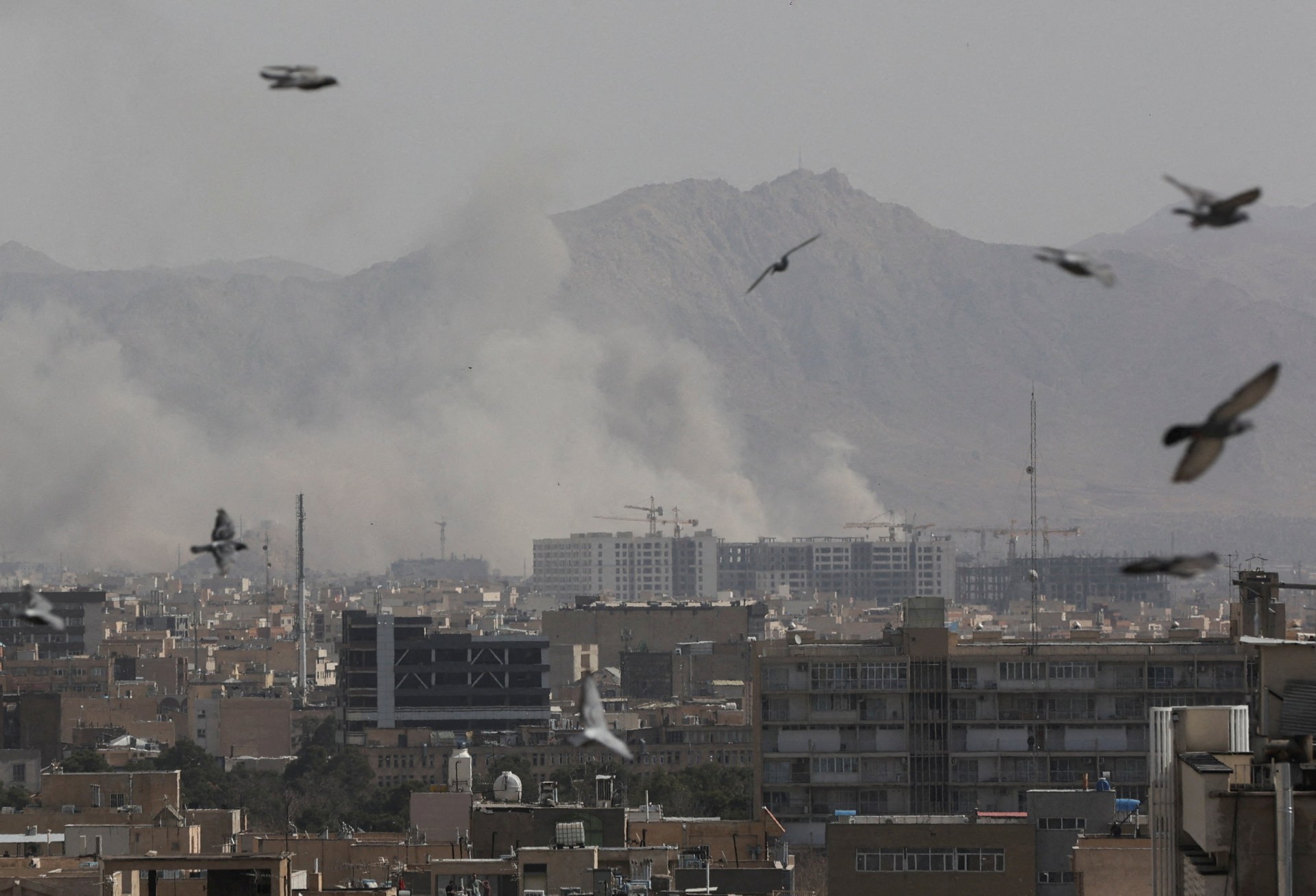
Smoke rises from an urban area as birds fly in the sky
Smoke rises following an explosion, after Israel and the United States launched strikes on Tehran, Iran, on February 28, 2026.
Majid Asgaripour/WANA (West Asia News Agency)/Reuters
Two men in clerical clothes hold religious books in their hands and wave Iranian flags.
Iranian demonstrators protest against the U.S.-Israeli strikes, in Tehran, Iran, on February 28, 2026.
Majid Asgaripour/WANA (West Asia News Agency)/Reuters
Cars lined up in traffic in an urban area.
Vehicles line up during a traffic block, after Israel and the U.S. launched strikes on Iran, in Tehran, Iran, on February 28, 2026.
Majid Asgaripour/WANA (West Asia News Agency) via Reuters
Orange smoke rises from a building at night.
Smoke from an Israeli attack rises from the Sharan Oil depot in Tehran, Iran, on June 15, 2025.
Majid Asgaripour/WANA (West Asia News Agency) via Reuters
People stand facing a ruined building at night.
Rescue and security personnel operate after missiles fired from Iran impacted a residential building in northern Israel on June 15, 2025.
Itay Cohen/Reuters
Missiles cross the night sky above a city.
Missiles launched from Iran are intercepted, as seen from the city of Ashkelon, Israel, on June 13, 2025.
Amir Cohen/Reuters

On February 28, the United States and Israel attacked Iran after weeks of military buildup and threats from President Trump. Large-scale strikes targeted Iranian military assets and the Islamic Republic’s top leadership, killing Supreme Leader Ayatollah Ali Khamenei. Tehran’s Assembly of Experts appointed Ali Khamenei’s son, Mojtaba Khamenei, to succeed him. Iran has retaliated by targeting U.S. military facilities, as well as energy and civilian infrastructure in the Gulf states. Israel has also stepped up its air strikes in Lebanon after Hezbollah fired rockets into Israel in support of Iran. More than 1,800 people have been killed so far, including 8 U.S. service members and at least 175 students who were killed by a reported U.S. strike on an Iranian elementary school. Trump has issued conflicting statements on U.S. military objectives and the trajectory of the conflict.

The attack quickly escalated into a regional war with widespread ramifications for critical supply chains and humanitarian aid. Iran’s effective closure of the Strait of Hormuz has caused a global energy shock, prompting the International Energy Agency to release four hundred million barrels from its strategic reserve.

History of Iran’s Nuclear Program

Iran has pursued a nuclear program since at least 1957, with varying degrees of success. During a war with Iraq, Iran decided to develop nuclear weapons to ensure its security in the late 1980s. Consequently, Iran pursued agreements with China and Russia to support the program’s research throughout the 1990s. In the summer of 2002, the National Council of Resistance of Iran, an umbrella organization made up of Iranian dissident groups, exposed the existence of two Iranian nuclear sites that were hidden from the IAEA.

By 2003, diplomats launched an intensive effort to halt Iran’s nuclear program. Iran agreed, insisting only on keeping its centrifuges for nuclear energy. However, it did not follow through on its commitment to transparent reporting to the IAEA and continued covert activities, leading to a June 2004 rebuke and a September 2005 finding of non-compliance by the IAEA, paving the way for a future referral to the UN Security Council (UNSC). In 2006, the UNSC adopted Resolution 1696, the first legally binding call for Iran to suspend its uranium enrichment program. Over the next few years, the UNSC adopted a series of resolutions imposing crippling economic sanctions on Iran for its failure to suspend its enrichment-related activities.

Between 2011 and 2015, the compounding effects of international sanctions led Iran’s economy to contract by 20 percent and unemployment to rise to 20 percent. In 2013, Hassan Rouhani, a noted pragmatist, won Iran’s presidential election, campaigning on a promise to lift sanctions and restore the economy. Over the next two years, the United States convened several rounds of bilateral talks and led the other P5+1 coalition members—China, France, Germany, Russia, and the United Kingdom—in negotiations with Iran’s new leadership. These efforts culminated in the adoption of the Joint Comprehensive Plan of Action (JCPOA) in 2015. Once key parties signed the agreement, the UNSC approved UN Resolution 2231, paving the way for sanctions relief.

The JCPOA required Iran to reduce its stockpile of enriched uranium by 98 percent for fifteen years, cut the number of operating centrifuges by two-thirds for ten years, and provide inspectors access to enrichment facilities within twenty-four days if the IAEA suspects violations. Moreover, if the IAEA confirmed violations, the JCPOA allowed for the immediate reinstatement of sanctions. After the JCPOA entered into force on January 16, 2016, Iran received sanctions relief totaling nearly $100 billion. However, Iran continued to develop ballistic missiles, which, according to the United States, violated UN Resolution 2231.

Iran’s Regional Proxies

Though the JCPOA limited Iran’s nuclear ambitions, its regional ambitions continued to grow. Iran persisted in arming and training Shiite militants through its Quds Force—the international arm of the Islamic Revolutionary Guard Corps (IRGC)—which has exacerbated sectarian divisions in the Middle East. Iran has provided years of military aid and training to the Palestinian militant group Hamas, which enabled its October 7, 2023, attack on Israel. The Quds Force has also provided advanced armed drones to Hezbollah in Lebanon, trained and funded more than one hundred thousand Shiite fighters in Syria, supplied ballistic missiles and drones to Yemen’s Houthis, and helped Shiite militias in Iraq build missile capabilities.

The U.S. government considers Iran to be the foremost state sponsor of terrorism, spending more than one billion dollars on terrorist financing annually. There are between 140,000 and 185,000 IRGC-Quds Force partner forces across Afghanistan, Gaza, Lebanon, Pakistan, Syria, and Yemen.

Trump’s First-Term Clash With Iran

Because the JCPOA only addressed Iran’s nuclear program—and not its revisionism or ballistic missile programs—the first Trump administration withdrew the United States from the agreement, pledging to seek a more comprehensive deal. In 2018, the Trump administration began reimposing sanctions on Iran and demanded that European countries withdraw from the JCPOA as part of a new containment strategy. U.S. sanctions sparked the worst economic crisis Iran has faced in forty years, cutting Iranian oil exports by more than half and emboldening Iranian hardliners.

While the Trump administration pursued a strategy of maximum pressure to bring Iran to the negotiating table, Iran began to contravene the JCPOA’s restrictions on its nuclear program, raising tensions. In April 2019, the United States designated the IRGC a terrorist organization. When the Trump administration received intelligence of potential Iranian attacks on U.S. troops, it deployed bombers, carriers, and additional forces to the Middle East. Over the next month, six oil tankers in or near the Strait of Hormuz were attacked, which U.S. government officials blamed on Iran.

In late June 2019, Iran downed a U.S. Global Hawk drone in the Strait of Hormuz; President Trump ordered a cyberattack and the imposition of new sanctions in response. On December 31, Trump blamed Iran for backing protests that tried to seize the U.S. Embassy in Baghdad. Days later, tensions peaked when the United States killed Qasem Soleimani, the commander of Iran’s Quds Force, in a Baghdad air strike. In response, Iran said it would no longer adhere to restrictions under the nuclear deal, and it accidentally shot down a Ukrainian passenger plane while on high alert. In late 2020, Trump continued to ratchet up sanctions, and Iran boosted uranium enrichment to levels well beyond the limits of the nuclear deal after one of its top nuclear scientists was killed.

Conflict Between Israel and Iran

The outbreak of war between Israel, a close U.S. ally, and the Palestinian Iran-backed militant group Hamas in October 2023 escalated tensions between Iran and Israel. Iran-backed proxy forces ramped up strikes in protest of Israel’s military incursion into the Gaza Strip, including more than two hundred attacks on U.S. and Israeli targets in Iraq and Syria. In response, the United States ordered air strikes on two Iran-backed facilities on October 26, 2023, and eighty-five more Iran-affiliated targets in the two countries on February 2, 2024. The Houthis in Yemen and Hezbollah in Lebanon—both actors in Iran’s axis of resistance—also launched attacks from the Red Sea and Israel’s northern border with Lebanon, spurring fears of regional spillover.

In 2024, Israel and Iran’s confrontation shifted from indirect, proxy-based hostilities to direct exchanges of strikes. On April 1, a suspected Israeli air strike against an Iranian consular building in Damascus, Syria, killed two of its generals and five military advisors. Iran retaliated by launching over three hundred drone and missile attacks, the first time Iran had directly targeted Israel.

Following Israel’s killing of the leaders of Hamas and Hezbollah, Iran launched 180 ballistic missiles against Israel in October 2024. Israel then launched its largest direct attack on Iran, targeting its air defenses and missile production facilities. Israel’s decimation of Hamas and Hezbollah leadership, coupled with the downfall of the Bashar al-Assad regime in Syria, considerably weakened Iran’s axis of resistance in 2024.

Upon returning to office in 2025, U.S. President Donald Trump restored his maximum pressure campaign against Tehran while also initiating negotiations on its nuclear program—the first direct U.S.-Iran talks since he withdrew the United States from the JCPOA nuclear deal in 2018. Israel was wholly opposed to the negotiations and has maintained an unwavering commitment to dismantling Iran’s nuclear program. Israeli officials argue that Iran’s clandestine efforts to develop nuclear weapons would fundamentally alter the regional balance of power, posing a direct danger to Israel’s survival.

On June 12, the International Atomic Energy Agency (IAEA) declared Iran was violating its non-proliferation obligations for the first time in twenty years, prompting Iran to announce it would open a secret uranium enrichment site. The next day, Israel launched a unilateral military strike against Iran, targeting nuclear facilities, missile factories, senior military officials, and nuclear scientists. Iran’s Foreign Minister Abbas Araghchi declared the attack “an act of war,” and Iran retaliated by launching waves of drones and dozens of ballistic missiles. Israeli Prime Minister Benjamin Netanyahu described the operation as a last-resort effort to prevent Iran from acquiring nuclear weapons. Although the Trump administration had recently resumed nuclear negotiations, President Trump increasingly voiced support for Israel’s objectives and signaled his openness to regime change in Tehran.

Following a week of air strikes between Israel and Iran, the United States directly intervened in the conflict, attacking three Iranian nuclear sites in Fordow, Isfahan, and Natanz on June 21. The Trump administration claimed the strikes significantly hindered Iran’s capacity to achieve weapons-grade uranium, but the head of the UN nuclear watchdog assessed the program was set back by a matter of months. Trump is the first U.S. president to attack another country’s nuclear program and the first to explicitly join Israel in an attack on an adversary. Iran retaliated on June 23, launching a missile attack on U.S. forces stationed at the Al Udeid Air Base in Qatar; no casualties were reported. Trump announced a ceasefire later that day. Although both sides accused the other of continuing strikes, the truce has largely held.

New Supreme Leader Issues Defiant Statement
March 12, 2026

Iran’s new Supreme Leader, Mojtaba Khamenei, delivered his first public statement since being appointed to the position, demanding the immediate closure of all U.S. military bases in the Middle East and warning that they would be targeted; the statement, read out on Iranian state television by a presenter, insisted the Strait of Hormuz must remain closed as leverage against enemies (CBC). State media also reported that Mojtaba Khamenei praised Hezbollah for aiding Iran (NYT). Additionally, Iran intensified its retaliatory attacks, setting fire to two tankers at an Iraqi port after the vessels were struck by suspected Iranian explosive-laden boats (Reuters). The incident prompted Iraqi authorities to suspend all oil terminal operations (NYT). This comes as the price of Brent crude oil sits at around $97.40 a barrel, after it climbed above $100 a barrel earlier in the day (BBC). Despite Trump claiming yesterday that “the straits are in great shape,” the IEA warned today that the war is causing “the largest supply disruption in the history of the global oil market” (IEA). Energy Secretary Chris Wright said the U.S. Navy is not currently ready to escort tankers through the Strait of Hormuz, adding that such an operation is more likely to happen toward the end of the month (CNBC). Meanwhile, the Israel Defense Forces announced that it recently struck the Taleghan compound near Tehran, an Iranian nuclear facility allegedly used to develop advanced explosives and conduct sensitive experiments; the site was previously hit in October 2024 and recently targeted again after Israel detected Iran had begun rebuilding it (Times of Israel).

NYT: U.S. Struck Iranian Elementary School on War’s First Day
March 11, 2026

In what appears to be one of the deadliest civilian casualty events in recent U.S. military history, the United States struck an Iranian elementary school on the first day of the war, the New York Times reported based on preliminary findings from a U.S. military investigation (NYT). At least 175 people were killed, according to Iranian state media (WaPo). Outdated targeting information appears to have led the United States to launch a Tomahawk missile at the school, multiple outlets reported (CNN). Asked for comment, the White House press secretary said the investigation was still ongoing (AP). U.S. President Donald Trump, who previously blamed Iran for the strike, said he did not know about the preliminary findings (NBC). His administration has slashed 90 percent of the Pentagon teams responsible for reducing civilian casualties in military operations (NPR). Reports suggest more than 1,300 people have died in Iran, at least 570 in Lebanon, and 15 in Israel, the World Health Organization said (WHO). At least twelve additional people have been killed across Bahrain, Kuwait, Oman, Qatar, Saudi Arabia, and the United Arab Emirates, according to officials in those countries (NYT). Meanwhile, CBS News reported that dozens of U.S. troops wounded by Iranian drones in Kuwait at the start of the war remain hospitalized with injuries such as brain trauma, shrapnel wounds, and burns (CBS). Meanwhile, Iranian military activity expanded as projectiles struck three vessels, including the Thai-flagged Mayuree Naree dry bulk carrier, near the Strait of Hormuz; in a statement carried by Tasnim News Agency, Iran’s Revolutionary Guards claimed responsibility for the attack (Reuters). At the same time, Iranian forces launched drones and missiles at targets across the Gulf, including a U.S. military base in Kuwait, while Israeli officials reported that Iran fired cluster-munition warheads toward Israel (Al Jazeera; NYT). Gulf governments responded by placing civilians on alert, with authorities in the United Arab Emirates, Bahrain, and Saudi Arabia urging residents to seek shelter as air defenses intercepted incoming attacks (CNN). Separately, after a strike damaged a building linked to one of Iran’s largest public banks in Tehran, Iranian officials warned they could target American and Israeli economic and banking interests across the region (Reuters). The UN Security Council condemned Iran’s “egregious attacks” against its neighbors and demanded they stop; it marked the body’s first resolution related to the war and passed by a vote of thirteen to zero, with Russia and China abstaining (UN). While Trump told Axios the war would end “soon,” Iranian President Masoud Pezeshkian wrote on social media it would only end by “recognizing Iran’s legitimate rights, payment of reparations, and firm [international] guarantees against future aggression” (Axios; Iranian President). An Iranian military spokesperson also cautioned that continued destabilization of regional security could push global oil prices to $200 per barrel (Reuters). Amid these threats and rising oil prices, the International Energy Agency announced that member states will release four hundred million barrels of oil from emergency reserves, the largest coordinated release in the agency’s history (WSJ).

Hegseth Warns of “Most Intense Day” for U.S. Strikes
March 10, 2026

U.S. Secretary of Defense Pete Hegseth warned that Tuesday would be the most intense day yet for U.S. strikes on Iran, pledging to deploy the greatest number of fighters and bombers of the campaign (NYT). Meanwhile, the United States deployed a Patriot air defense system to Turkey’s Malatya province, home to a key NATO radar base, as the alliance bolstered its defenses against Iranian missile threats (Reuters). Retaliatory attacks in the region as Iran fired nine ballistic missiles and thirty-five drones at the United Arab Emirates with eight missiles intercepted and one falling into the Persian Gulf; nine drones evaded air defenses and struck inside the country (Times of Israel). Due to the drone strikes, oil company ADNOC closed its Ruwais refinery in the UAE after a fire broke out (Reuters). In Israel, the Israel Defense Forces detected a ballistic missile launch from Iran targeting northern and central regions, while an earlier missile attack on central Israel produced no reported injuries or direct impacts (Times of Israel). Meanwhile, as oil and gas prices continue to rise, Iran’s Revolutionary Guard Corps spokesperson Ali Mohammad Naeini vowed to block all regional oil exports to hostile nations and their partners, dismissing Western efforts to control energy prices as temporary and futile (NYT). Moreover, Iran’s Supreme National Security Council secretary Ali Larijani responded to U.S. President Donald Trump’s threat to strike Iran “twenty times harder” over the Strait of Hormuz blockade, telling the American government to “beware, lest you are the ones who are eliminated,” dismissing the warnings as hollow threats that the Iranian people do not fear (NBC).

Global Oil Prices Rise Due to Iran Conflict
March 9, 2026

Amid an international increase in oil prices caused by the effects of Iranian military operations on shipping through the Strait of Hormuz, the G7 countries have declined to jointly tap their oil reserves to ease costs (Washington Post). The announcement came after the price-per-barrel fell slightly over the weekend in light of reporting that the body was considering such a move (Financial Times). Due to high global energy prices, Bangladesh is closing universities early for the summer; Pakistan and the Philippines both declared a four-day work week (Reuters; Indian Express). The head of Saudi Arabia’s state oil company said that although it will reroute some exports through the Red Sea, continued war would yield “drastic” effects on the world economy (Financial Times). International Monetary Fund chief Kristalina Georgieva said that every ten percent increase in energy prices over the course of 2026 is expected to increase global inflation by almost half a percent (IMF). U.S. President Donald Trump said the war could be over “soon” and that the United States had already achieved many of its military objectives in Iran (White House). However, Trump threatened to escalate if Iranian officials maintain restrictions on oil shipments through the Strait of Hormuz, which Iran has pledged to do (Reuters). A top Iranian foreign policy official said the country can keep fighting and sees no room for diplomacy (CNN). Russian President Vladimir Putin congratulated Mojtaba Khamenei on his selection as Iran's new supreme leader (Kremlin). Australia granted humanitarian visas to five Iranian female soccer players; Iranian state television announcer called the women and their teammates “wartime traitors” after they declined to sing the country’s national anthem before a match at the Asian Cup (X; The Athletic). U.S. Central Command announced it has hit more than five thousand Iranian targets and damaged or destroyed more than fifty Iranian ships in ten days of war (X). Turkey said NATO air defenses shot down an incoming Iranian missile in its airspace yesterday for the second time this month (NYT). To help protect Cyprus, which was hit by an Iranian drone last week, the French Navy will send eight frigates and two amphibious assault ships to the Middle East in addition to its current aircraft carrier in the region; the Netherlands will send a naval frigate to the Mediterranean at France’s request; and Turkey deployed six F-16 fighter jets and air defense systems to northern Cyprus (USNI; Reuters; Yahoo).

Mojtaba Khamenei Named Iran’s Supreme Leader
March 8, 2026

Iran's Assembly of Experts announced Mojtaba Khamenei, 56, as the country's new supreme leader; Khamenei succeeds his father, Ayatollah Ali Khamenei, who was killed in an Israeli airstrike coordinated with U.S. forces on February 28 (NBC). Earlier in March, U.S. President Donald Trump has called Mojtaba Khamenei an “unacceptable” choice for the new leader of Iran (Axios). While not ruling out future U.S. ground troops in Iran, Trump told reporters that the United States discouraged Kurdish armed groups from entering the war against Iran despite their offer to do so (Anadolu). Newly released footage indicates casualties at an Iranian elementary school on February 28 were caused by a U.S. airstrike targeting an adjacent naval base (NYT). Oil companies in Iraq, Kuwait, and Qatar have begun reducing oil production (WSJ). International shipping through the Strait of Hormuz remains largely halted due to Iranian military actions (WSJ). Trump argued on social media that short-term oil prices “will drop rapidly when the destruction of the Iran nuclear threat is over” (Truth Social). Trump and UK Prime Minister Kier Starmer discussed the Iran war on a phone call; Starmer offered to send British aircraft carriers to the Middle East, an offer Trump declined and criticized for coming too late in the conflict (BBC). Some U.S. aircraft have been permitted to land at UK bases in the region on the understanding they will only be used for defensive operations (The Guardian).

Iran Accues U.S., Israel of Attacks on Infrastructure
March 7, 2026

Water desalination plants were attacked in Iran and Bahrain, officials from both countries said; Iran accused the United States of targeting its infrastructure, a claim that U.S. Central Command denies (NYT). On Saturday, Israel attacked multiple oil facilities in Iran, sparking a fire that blanketed Tehran in black smoke and prompted the Iranian Red Crescent Society to warn of acid rain exposure (Financial Times).

War With Iran Expands Throughout the Middle East
March 6, 2026

The Israel Defense Forces (IDF) announced a new wave of strikes against Iranian regime targets in Tehran and Isfahan (Times of Israel). The IDF also carried out further strikes in the southern suburbs of Beirut, Lebanon (NPR). The Israeli Air Force destroyed the bunker of Iran’s former Supreme Leader Ali Khamenei, dropping approximately one hundred bombs on the bunker site (Times of Israel). Iranian state media reported that the Iranian Revolutionary Guards sent a wave of missiles and drone toward Tel Aviv, Israel (NYT). In the Gulf, both Kuwait and Bahrain reported damage from Iranian drone and missile strikes (Euronews). Saudi Arabia, the United Arab Emirates, and Qatar reported intercepting Iranian missiles and drones (CNN). Qatar's energy minister warned that Gulf states would likely shut down production, increasing global energy prices, in light of an Iranian strike that damaged Qatar's largest natural gas plant and the ongoing Iranian targeting of oil tankers traveling through the Hormuz Strait (Financial Times). Across the Middle East, at least 230,000 people have been displaced in relation to the ongoing war, according to the UN (Reuters). Iran’s daily missile launches have dropped overall since earlier in March, with U.S. and Israeli forces saying they have degraded many of Iran's missile sites; Iran's military is increasingly carrying out regional attacks using drones (WSJ). Russia is providing intelligence and information that is allowing Iran to target U.S. forces across the Middle East (Washington Post). Iran's foreign minister confirmed Russia is helping Iran's war effort but did not confirm details (NBC). U.S. defense contractors are due to meet with administration officials at the White House today to discuss ramping up weapons production (Reuters). At NATO, there has been no talk of triggering the alliance's Article V mutual defense clause following a recent Iranian attempt to target Turkey with a ballistic missile; NATO intercepted the missile and the Iran Revolutionary Guard Corps denies firing missiles at Turkish territory (Reuters). However, NATO increased its alliance-wide ballistic missile defense posture (X).

Regional Tensions Escalate as U.S., Israel Continue Strikes on Iran
March 5, 2026

The Israel Defense Forces continued to strike Iran’s ballistic missile infrastructure, while the United States and Israel moved to target Iranian defense industrial assets (ISW). Azerbaijan reported an Iranian drone strike in Nakhchivan exclave, a claim Iran denies (Axios). The U.S. embassy in Kuwait shut down operations amid missile attacks, while the United Arab Emirates, Bahrain, Iraq, and Qatar, also reported Iranian missile and drone attacks (AP). Sources report that China is in talks with Iran over oil and gas transit through the Strait of Hormuz (Reuters). U.S. President Donald Trump said he should be personally involved in choosing Iran’s next supreme leader after Ali Khamenei’s death, rejecting likely successor Mojtaba Khamenei as “unacceptable;” Iran continues to delay announcing a new supreme leader (Axios). Trump also called on the Kurdish opposition to support the U.S. war effort and offered air support for their efforts to take territory in western Iran (Washington Post). Asked if Americans should worry about Iranian strikes against the U.S. homeland, Trump told reporters "“I guess. . . . When you go to war, some people will die" (TIME). According to European and Middle Eastern officials briefed on the matter, the current Iranian regime's grip on power is secure (Washington Post). Europol warned Europeans of an increased risk for terrorist activity, cyber attacks, and online radicalization efforts as the war continues (Reuters). Iran's foreign minister told NBC his country is prepared to resist a potential U.S. ground invasion and that Iran is not currently willing to negotiate for a ceasefire (NBC). The United States and its partners in the Middle East have sought Ukraine's expertise and advice on countering Iranian drone operations, which Ukraine is now providing (Washington Post). France has authorized U.S. use of air bases in the country for operations in the Middle East (Reuters). Spain has denied U.S. requests for similar access and cooperation (The Hill). U.S. military officials believe it is likely that U.S. forces were responsible for Saturday’s strike on a girl’s school in Iran (Reuters).

NATO Intercepts Iranian Missile Near Turkey
March 4, 2026

Retaliatory strikes by Iran continued as a ballistic missile from Iran was heading towards Turkish airspace; NATO air and missile defenses shot the missile down (NYT). Though it remains unclear where the missile was intended to land, a NATO spokesperson stated that the trans-Atlantic alliance condemned Iran’s targeting of Turkey (Reuters). Iranian missile attacks also targeted three bases in Iraq that were used by Kurdish militant groups that oppose Iran; the Kurdish Freedom Party confirmed the strikes (NYT). In Washington, U.S. Secretary of Defense Pete Hegseth told reporters this morning the United States was “accelerating, not decelerating” military action and said that, alongside Israel, it aimed to gain “uncontested control” of Iranian air (NYT). General Dan Caine, the chairman of the Joint Chiefs of Staff, said that Iranian ballistic missile strikes have decreased by 86 percent compared to the first day of fighting and that drone attacks have similarly decreased by 73 percent (NYT). Separately, Hegseth announced that the U.S. military sank an Iranian warship with a torpedo off the coast of Sri Lanka (BBC). Sri Lankan authorities said they rescued thirty-two people on board and recovered multiple bodies; sources from Sri Lanka’s defense ministry and Navy say roughly a hundred others are missing (Reuters). A set of satellite images reviewed by the BBC also shows that U.S. and Israeli strikes destroyed or damaged at least eleven Iranian naval vessels; several missile bases and nuclear sites were also damaged in the attacks (BBC). Meanwhile, the Israel Defense Forces (IDF) launched a new wave of strikes targeting Iranian regime members; Kurdish media also reported the Iranian Revolutionary Guard Corps headquarters being targeted in northwest Iran (Guardian). The IDF also announced a new wave of strikes in southern Lebanon, telling residents to evacuate to the north of the Litani River (Reuters). The crisis in the Strait of Hormuz remains volatile, as at least two hundred vessels, including oil tankers and cargo ships, remain anchored (Reuters).

Iran’s Retaliation to U.S.- and Israeli-launched War Continues to Widen
March 3, 2026

Trump notified Congress in a letter this week that the operations were meant to protect the U.S. homeland and forces in the region, advance U.S. national interests, and ensure “collective self-defense of our regional allies, including Israel” (NYT). Despite U.S. officials’ arguments that an Iranian threat was imminent, the UN nuclear chief said that Iran was not days or weeks away from having a nuclear weapon (CNN). U.S. Central Command stated that the United States has struck over 1,700 targets across Iran, including naval ships, submarines, anti-ship missile sites, and command and control centers (Jerusalem Post). Iranian news agencies also reported that Mehrabad airport was struck soon after the Israel Defense Forces warned civilians near Tehran to evacuate (Reuters). Air attacks further destroyed the building of Iran’s Assembly of Experts in Qom, which is tasked with electing Iran’s new supreme leader (Reuters). The Israel Defense Forces reported that strikes also killed Daoud Ali Zadeh, the acting commander of the Lebanon Corps of the elite Quds Force, in Tehran (AP). Iran launched retaliatory attacks on the U.S. embassies in Saudi Arabia and Kuwait (AP; Kuwait MoFA). The State Department urged Americans to leave the Middle East due to “serious safety risks” (State). Despite the U.S. governments warning urging Americans to leave the region, many airports have been forced to delay or cancel flights because of the conflict (Guardian). Iran also struck energy facilities in Saudi Arabia and Qatar and fired upon ships in the Strait of Hormuz (AP). Energy markets remain volatile, with European natural gas prices surging at least 40 percent today after Qatar paused exports from a gas facility following the Iranian attack (Bloomberg). U.S. President Donald Trump announced the United States Development Finance Corporation will offer insurance “at a very reasonable price” to ensure maritime trade flows in the Gulf (Truth Social). France and the United Kingdom (UK) announced they would each deploy a warship to the Mediterranean (France 24; BBC).  Plans for new leadership in Iran also remain unclear as Trump told White House reporters that the leaders the administration had in mind are dead, and that an additional group “may be dead also” (AP).

Iran Closes Strait of Hormuz
March 2, 2026

According to Iranian media, the commander of Iran’s Revolutionary Guards announced that the Strait of Hormuz is now closed and Iran will fire upon any ship that attempts to pass through (Reuters). Meanwhile, Kuwaiti air defenses mistakenly shot down three American jets during combat operations; U.S. Central Command said in a statement that all six crew members are safe (NYT). U.S. Central Command also raised the U.S. death toll from Operation Epic Fury to four; the fourth servicemember was severely wounded in a Saturday attack on a U.S. base in Kuwait and later succumbed to injuries (CENTCOM). Despite Trump calling on Iranians this weekend to rise up against the regime, top administration officials argued that U.S. aims were focused on degrading Iran’s military capabilities—including its ballistic missiles, navy, and security infrastructure (White House; Pentagon). Defense Secretary Pete Hegseth framed the U.S.-Israeli strikes that killed Khamenei as “not a so-called regime change war,” but quickly added “the regime sure did change” (NPR). Trump and Israeli Prime Minister Benjamin Netanyahu have both encouraged Iranians to rise up against the remnants of the regime (AP).  The White House said in a statement that Trump’s “unequivocal” demand remains that Iran cannot obtain a nuclear weapon (White House). Trump wrote in a social media post last night that U.S. munitions stockpiles remain high and “Wars can be fought ‘forever’” (Truth Social). Joint Chiefs of Staff Chairman Gen. Dan Caine said the attacks had taken “months, and in some cases, years” of planning with the goal of stopping Tehran’s “ability to project power outside of its borders” (France24). Although Trump told reporters yesterday that Iran had indicated interest in resuming talks, Iran’s top national security official, Ali Larijani, wrote on social media today that Iran would not negotiate with the United States (X). Secretary of State Marco Rubio caused a stir when he told reporters that the U.S. attack on Iran was in part driven by Israel’s plans to strike Iran; because Iran would have retaliated by attacking U.S. forces, a preemptive U.S. attack was necessary, Rubio said (State). While many congressional Republicans praised the U.S. military campaign, leading Democrats condemned it as illegal and reckless and vowed to vote on a resolution restricting Trump’s war powers (NPR). The death toll continues to rise: the Iranian Red Crescent reported at least 555 people have been killed in Iran, while 11 people have been killed in Israel (AP).

Three U.S. Service Members Killed in Operation Epic Fury
March 1, 2026

U.S. Central Command announced in a statement that three U.S. service members were killed and five others were seriously wounded in yesterday’s attack on Iran; President Trump said there would “likely be more” U.S. casualties (CENTCOM; White House). Operations continued as CENTCOM stated that a large-scale U.S. strike destroyed the IRGC headquarters (CENTCOM). Satellite imagery also shows damage to Iran’s naval and air bases, while President Trump stated that the operations sank nine Iranian naval ships (NPR; Truth Social). Trump has given varying estimates of how long U.S. military engagement could last, telling different media outlets over the weekend it could be days or up to 4 to 5 weeks (NYT). Speaking to The Atlantic, Trump appeared to float an off-ramp, suggesting that he would be willing to speak with Iran’s new leadership (The Atlantic). Iran’s Foreign Minister Abbas Araghchi wrote on social media that Trump had launched the war despite a new nuclear deal being “within reach” (X). Meanwhile, Israel announced it launched another round of strikes “in the heart of Iran” (CNN). Retaliatory strikes from Iran also continued, as an Iranian missile strike in Beit Shamesh killed nine Israeli citizens (NYT). Three people were also killed in the United Arab Emirates, while Kuwait’s Health Ministry reported one death from the retaliatory strikes (Jerusalem Post). Six nearby countries condemned Iran’s retaliatory strikes across the region (Saudi Press Agency). Videos and images verified by the New York Times indicate yesterday’s bombing of an elementary school in southern Iran killed at least 175 people (NYT). Oil shipping traffic slowed to a near stop in the Strait of Hormuz, while a key international oil price jumped at least 8 percent (Bloomberg).

United States and Israel Attack Iran
February 28, 2026

The United States and Israel announced that they had initiated a large-scale military operation designed to destroy Iran’s military capabilities and bring about regime change (Axios). The commander of the U.S. Central Command said the operation began at 1:15 a.m. ET and targeted aspects of Iran’s security apparatus that posed an imminent threat (CENTCOM). The operation, named “Operation Epic Fury” by the United States, utilized Tomahawk missiles, F-18 and F-35 fighter jets, and, for the first time, single-use drones (Reuters). The combined U.S.-Israel force conducted close to nine hundred strikes, as the Israel Defense Forces claimed it had struck at least five hundred Iranian targets (ISW). Iranian state media confirmed that Iran’s Supreme Leader Ali Khamenei was killed in the attacks; Iranian Defense Minister Amir Nasirzadeh and Revolutionary Guards commander Mohammed Pakpour were also reportedly killed alongside five other senior military commanders (Reuters). Iranian state media also reported that Khamenei’s daughter, grandchild, daughter-in-law, and son-in-law were killed in the attacks (Times of Israel). The U.S.-Israel operations triggered a retaliatory campaign by Iran as Bahrain, Kuwait, Qatar, and the United Arab Emirates faced Iranian missiles, drones, and intercepts (Axios). At least one U.S. military installation in Bahrain, which headquarters the U.S. Navy’s 5th Fleet, was struck by Iranian missile fire; Iranian state media reported that missile attacks also targeted Ali al-Salem Air Base in Kuwait, al-Udeid Air Base in Qatar, and al-Dhafra Air Base in the United Arab Emirates among other non-military sites, including luxury hotels and residential buildings in Bahrain and Dubai (WaPo). UN Secretary-General António Guterres called for immediate de-escalation at an emergency Security Council meeting Saturday, condemning the United States and Israel’s strikes as unlawful (AP). Both countries argued their actions were justified given the major nature of the threat posed by Iran, while Iran said it posed no imminent threat (UN).  

U.S. Guidance on Leaving Israel
February 27, 2026

As the United States weighs a strike on Iran, it authorized non-essential government staff and family members to depart Israel, citing unspecified “safety risks” (U.S. Embassy Jerusalem). China also urged its citizens in Iran to evacuate as soon as possible (Reuters). The threat of renewed conflict comes as Israel’s stockpiles of ground-based ballistic missile interceptors and U.S. land- and sea-based antiballistic missile systems, both used extensively during the June 2025 Iran–Israel conflict, were significantly depleted, raising concerns about the sustainability of Israel’s air defense coverage in the event of another exchange (NYT). Separately, the International Atomic Energy Agency reported that some of Iran’s uranium enriched to up to 60 percent purity, near weapons grade, is stored in an underground tunnel complex at its Isfahan nuclear site, which appears largely undamaged despite U.S. and Israeli strikes that hit the facility’s entrance in June (Reuters).

Third Round of U.S.-Iran Talks
February 26, 2026

The United States and Iran held another round of indirect nuclear talks today in Geneva, with both sides threatening war if diplomacy fails (BBC). The countries are floating proposals that include limiting the amount of uranium Iran is allowed to enrich, temporarily suspending Iran’s enrichment activity, and dismantling its main nuclear sites, according to reports from multiple news outlets (Guardian). Both sides agreed to resume negotiations within a week, with additional technical-level discussions scheduled in Vienna (Reuters). The state news agency of mediator Oman said today that both sides were demonstrating “unprecedented openness to new and creative ideas and solutions” (Oman News Agency). Further, the foreign minister of Oman said the talks had achieved “significant progress,” but did not announce a breakthrough that would avert an attack (Oman FM).

Iran Optimistic on U.S. Talks as Protests Expand
February 25, 2026

Iranian President Masoud Pezeshkian said he sees a chance for a positive outcome from a third round of talks with the United States in Geneva (Reuters). Meanwhile, BBC verified footage shows additional universities joining anti-government protests across Iran (BBC). Tokyo “strongly demanded” the release of a Japanese national detained in Iran since January, following a report by RFE/RL that Iranian authorities had arrested the Tehran bureau chief of the Japanese public broadcaster NHK World; the RFE/RL report cited unnamed sources (Japan Times).

Trump Calls for Nuclear Deal in State of the Union Address
February 24, 2026

Trump said he sought a nuclear deal with Iran to thwart the country’s “sinister ambitions” to obtain nuclear weapons, but said he had yet to hear Iran commit to abandoning those ambitions; he also warned that Iran was trying to develop missiles that could reach the United States (NYT). Separately, Iranian Foreign Minister Abbas Araghchi said that a deal with the United States was only feasible if diplomacy was prioritized (Reuters). This comes as Iran nears a deal with China to purchase anti-ship cruise missiles; though no delivery date has been agreed upon, the use of the CM-302 missile would improve Iran’s strike capabilities and pose a threat to U.S. naval forces (Reuters).

Iranian Students Continue Protests as U.S.-Iran Tensions Heighten
February 23, 2026

Iranian students continued protests for a third day, as state media reported students burning flags at an all-women university, chanting anti-government slogans, and skirmishes at Amir Kabir University in Tehran (Reuters). This comes amid escalating U.S.-Iran tensions, as Iran’s Ministry of Foreign Affairs spokesman Esmaeil Baghaei stated that any U.S. attack, including preliminary strikes, would be considered an act of aggression and would prompt a response (Al Jazeera). Meanwhile, the United States began evacuating non-essential staff and eligible family members from the U.S. Embassy in Beirut amid increased concern about a military conflict with Iran (Reuters). However, U.S. Joint Chiefs of Staff chair Dan Caine has warned Trump and other officials that a military campaign against Iran could incur significant costs to U.S. forces and weapons, multiple news outlets reported, citing unnamed officials (NYT). Caine’s office said in a statement that he confidentially gives the president a range of options and associated risks (WSJ). While the White House praised Caine in a statement, Trump wrote on social media that it is “100% incorrect” that Caine is “against us going to War with Iran” (Truth Social).

Plans for More Iran Talks
February 22, 2026

Negotiations between the United States and Iran over Tehran’s nuclear program will likely continue in Geneva on Thursday, Iranian foreign minister Abbas Araghchi told CBS News (CBS). Unnamed U.S. officials also confirmed plans for the meeting to multiple news outlets, but stressed that Trump is still considering military strikes amid the large-scale U.S. deployment in the region (Axios; NYT). In Iran, meanwhile, antigovernment protests have reignited as the new school semester begins in spite of the regime’s recent brutal crackdowns (NYT).

Trump Signals Deadline for Nuclear Deal
February 19, 2026

Trump told reporters that Iran has ten or “pretty much maximum” fifteen days to reach a deal with the United States or “bad things” will happen (Bloomberg).

Araghchi Says Some Progress Made in Geneva
February 18, 2026

Iranian Foreign Minister Abbas Araghchi stated that some progress was made in Geneva by reaching an understanding on “guiding principles,” but that this progress does not indicate an imminent nuclear deal (Reuters). U.S. officials have further stated that Iran needs to draft a detailed proposal for a deal in two weeks (Axios). As negotiations continue, the U.S. military is amassing its greatest airpower buildup in the Middle East since the 2003 invasion of Iraq, the Wall Street Journal reported (WSJ). Meanwhile, satellite images show that Iran has been making repairs to and fortifying military and nuclear sites bombed by the United States and Israel (Reuters).

U.S. and Iran Pursuing Talks in Geneva
February 17, 2026

U.S.-Iran negotiations ended with a commitment to meet again, but Iran failed to acknowledge certain U.S. red lines, Vice President JD Vance told Fox News (Fox News). While Tehran has sought a narrow deal on its nuclear program as well as sanctions relief, Washington has signaled it seeks a more expansive agreement that could also address Tehran’s missile stockpile (NYT). Portions of the Strait of Hormuz were closed for “security precautions” as the Revolutionary Guards conducted military drills in the strait (Reuters). The closure included live-fire drills, a rare show of force (AP). Separately, Supreme Leader Ayatollah Ali Khamenei threatened to sink U.S. warships in the region (The Hill). Open-source flight radar data shows that dozens of U.S. fighter jets have moved to positions near Iran this week (Axios).

U.S. Heightens Military Presence in Region
February 16, 2026

The United States has increased its military deployments in the region, while Iran conducted military drills in the Strait of Hormuz (CNN). Iran’s foreign minister met with the UN nuclear chief ahead of Tuesdays talks in Geneva (AP).

Global Protests Against Iranian Regime
February 15, 2026

Hundreds of thousands of people demonstrated in cities worldwide this weekend, who gathered to protest Iran’s current regime and its recent crackdown on dissent; Reza Pahlavi, the son of the exiled late shah of Iran, had called for a global day of action (BBC).

Trump Expresses Support for Regime Change
February 13, 2026

Trump suggested that “the best thing that could happen” would be regime change in Tehran (France24).

Report on Starlink in Iran
February 12, 2026

The United States reportedly sent around six thousand of the company’s satellite internet kits to the country in recent weeks, in a secret effort to help dissidents withstand government restrictions on internet access, unnamed U.S. officials told the Wall Street Journal; the White House did not comment on the report, but had publicly said in January that Trump spoke to Starlink owner Elon Musk about ensuring connectivity in Iran (WSJ).

Iran Maintains Red Line on Missile Program
February 11, 2026

An advisor to Iran’s Supreme Leader Ayatollah Ali Khamenei stated that Iran’s missile capabilities remain a red line as Washington and Tehran consider a second round of talks to avoid further escalation (Reuters). However, Iran’s president said that the country is willing to open its nuclear sites for inspections to verify it is not building a nuclear weapon; the concession came the same day that Trump discussed Iran policy with Israeli Prime Minister Benjamin Netanyahu at the White House (FT). Trump wrote on social media that he told Netanyahu he will continue to seek a deal with Iran if possible, though he provided no further details (Truth Social).

United States Used Mobile Launchers at Al-Udeid Base
February 10, 2026

Satellite images from February 2 revealed that the United States placed missiles into truck launchers, rather than semi-static launcher stations, allowing for rapid deployment amid escalating tensions with Iran; it is unknown if the missiles remain in the truck launchers (Reuters). Trump said he was considering sending a second U.S. aircraft carrier strike group to the Middle East if talks do not progress (Axios). Before departing to meet President Trump in Washington, Israeli Prime Minister Benjamin Netanyahu told reporters his “first and foremost” goal was to press for a deal that covered more than just Iran’s nuclear program (WaPo).

Iran Expands Crackdown on Dissent, Detains Reformists
February 9, 2026

Authorities arrested Azar Mansouri, head of the Reformist Front; Ebrahim Asgharzadeh, who led students who stormed the U.S. Embassy in 1979; and former diplomat Mohsen Aminzadeh in an expansion of crackdowns on dissent (AP). Local media also reported that Javad Emam, Secretary General of Iran’s Assembly of Veterans, and Hossein Karoubi, son of reformist leader Mehdi Karoubi, were also among those detained; the detainees face charges of causing political divisions, plotting to overthrow the political system, and coordinating with enemy propaganda (NYT). The Shargh newspaper further reported that two more members of the Reform Front were asked to report to the prosecutor’s office on Tuesday (Reuters). Separately, the United States warned U.S.-flagged commercial ships to stay “as far as possible” from Iran’s territorial waters (U.S. DoT).

Iran Will Not Accept Ban on Nuclear Enrichment
February 8, 2026

Following indirect talks with the United States on Friday, Foreign Minister Abbas Araghchi added that Iran is prepared to build trust that its enrichment is for peaceful purposes (Reuters). Trump is due to discuss the results of the talks with Israeli Prime Minister Benjamin Netanyahu on Wednesday (AP). Meanwhile, Iran’s judiciary sentenced activist and Nobel Peace Prize Laureate Narges Mohammadi, who was detained in December and was reported to be on a hunger strike, to at least another seven years in prison on charges including collusion and propaganda, her lawyer wrote on social media (X).

U.S.-Iran Talks Begin in Oman
February 6, 2026

Oman mediated indirect talks today between the United States and Iran focused on “sustaining security and stability,” its foreign ministry said in a statement (Oman FM). Both sides described the talks as positive but inconclusive (Bloomberg). Omani state media footage also showed the head of U.S. Central Command participating on the U.S. side, a role he had not played in previous rounds of talks (AP). Meanwhile, the State Department announced new sanctions on actors it said illegally transported Iranian oil and indirectly funded the country’s repression at home and “terror organizations” abroad (State).

U.S-Iran Nuclear Talks Moved to Oman
February 4, 2026

The Trump administration agreed to Iran’s request to move Friday’s nuclear talks from Turkey to Oman (Axios). The change in venue comes as Iran seeks to continue previous discussion rounds held in the country and to prevent discussions from expanding to include issues such as its ballistic missile program, which Tehran has stated is a red line in negotiations (Reuters).

U.S. Shoots Down Iranian Drone
February 3, 2026

Two Iranian military provocations against U.S. assets in the Middle East underscored high tensions ahead of negotiations planned for Friday (WaPo). An Iranian drone “aggressively approached” a U.S. aircraft carrier in the Arabian Sea, prompting a fighter jet from the carrier to shoot it down, a U.S. Central Command (CENTCOM) spokesperson said (CNN). Hours later, the U.S. Navy escorted a U.S.-flagged tanker to safety after it was approached by two Iranian gunboats that threatened to board the vessel (CBS). The CENTCOM spokesperson said that Iran’s aggression increases “risks of collision, miscalculation, and regional destabilization” (The Hill). Iran’s top officials did not immediately comment on the maritime incidents; the country’s semi-official Tasnim news agency reported that communications with a drone over international waters had been lost, though the reason remained unclear (Reuters). The incidents could mean Iranian hardliners are resistant to talks, the Wall Street Journal reported (WSJ). Officials from the United States and Israel, as well as Turkey and Saudi Arabia, held separate high-level meetings in Jerusalem and Riyadh that discussed the regional stakes of the upcoming U.S.-Iran talks (Times of Israel; Asharq Al-Awsat). Turkey and the United Arab Emirates are among those urging Iran and the United States to negotiate rather than risk military conflict, a point Turkish President Recep Tayyip Erdoğan stressed during a meeting with Saudi Crown Prince Mohammed bin Salman (Reuters). U.S. envoy Steve Witkoff met with Israeli Prime Minister Benjamin Netanyahu, who said Iran could not be trusted to uphold its promises (Israeli PM). Iran has pushed for the negotiations to be moved from their planned location in Istanbul to Oman (Axios).

Plan for U.S.-Iran Talks
February 2, 2026

U.S. special envoy Steve Witkoff and Iranian Foreign Minister Abbas Araghchi are expected to meet in Istanbul on Friday to discuss a potential nuclear deal and de-escalation of bilateral tensions, news outlets reported (WaPo). The meeting will focus on negotiating a deal to prevent war amid a massive U.S. military buildup in the Gulf (Axios). This comes as Iran’s leadership is increasingly concerned that a U.S. strike would reignite protests, with top officials warning Supreme Leader Ayatollah Ali Khamenei that, in light of widespread discontent over last month’s crackdowns, fear is no longer a deterrent to protest (Reuters).

Khamenei Warns of “Regional War”
February 1, 2026

Iran’s supreme leader, Ayatollah Ali Khamenei, warned that an attack by the United States would spark a greater “regional war” in the Middle East; Khamenei’s comments are the most direct threat he has made so far regarding U.S. escalation in the region (AP).

EU Announces New Sanctions on Iran
January 29, 2026

The European Union (EU) sanctioned fifteen senior officials and six organizations in Iran for actions like surveilling and censoring online protest content (European Council). The EU also designated Irans paramilitary guard a terrorist organization, which puts its officials under travel controls and other punitive actions and aligns Brussels with others who have done the same, including the United States and Canada (X). The head of the European Parliament’s delegation for relations with Iran called the move a “long-overdue political signal that massive violence and transnational repression will no longer go unanswered,” while Iran’s top diplomat said it was a “strategic mistake” (Guardian; Iran FM). More than six thousand people are confirmed to have been killed in countrywide demonstrations since the end of December, the U.S.-based Human Rights Activists News Agency said this week (HRANA). Estimates from the Iranian government are lower, at about three thousand deaths (AP). After initially threatening military action earlier this month over the crackdown, U.S. President Donald Trump later expanded those threats and tied them to demands for a deal on Iran’s nuclear program; though the United States has deployed an aircraft carrier strike group to the Middle East, Trump told reporters he had been speaking to Tehran in recent days and that “it would be great” if military action could be avoided (White House).

Trump’s Threats to Attack Iran
January 28, 2026

Trump called on Tehran to make a deal guaranteeing Iran has no nuclear weapons, warning that the United States could attack again if it refused; Trump added the U.S. naval deployment in the Middle East was ready to act with “speed and violence, if necessary” (Truth Social). This week, both Saudi Arabia and the United Arab Emirates (UAE) publicly stated the United States could not use their airspace for an attack on Iran (Asharq Al-Awsat; Emirates News Agency).

U.S. Naval Assets Near Iran
January 26, 2026

The USS Abraham Lincoln aircraft carrier and three naval destroyers have arrived in the Middle East, U.S. Central Command (CENTCOM) announced (CENTCOM). Trump has referenced the fleet’s impending arrival in his threats to strike Iran over its response to antigovernment protests in the country during recent weeks; however, the strike group remains in the Indian Ocean, CENTCOM said—not the Arabian Sea, which borders Iran (AP).

U.S. Forces Near Iran
January 22, 2026

The United States is deploying “an armada” of warships near Iran “just in case” Iran’s response to protests becomes untenable, Trump told reporters (CNN). At the same time, he voiced an openness to talk to the Iranian government; Iran’s foreign minister has similarly expressed willingness for dialogue with the United States but said the country is ready for war in the event of U.S. military action (FT).

Toll of Iran Protests
January 21, 2026

Iran estimates that more than three thousand people have died in recent demonstrations, its government said in its first official death toll (AP). The U.S.-based Human Rights Activists News Agency said that it had verified almost five thousand deaths, though other estimates are far greater (HRANA). In recent days, the World Economic Forum in Davos rescinded its invitation to Iran’s foreign minister due to the widespread killings (Euronews).

Protest Fallout for Iranian Businesses
January 20, 2026

Firms in the country are hurting as an internet shutdown intended to stifle protests continues, with watchdog group NetBlocks estimating the blackout costs the economy more than $37 million per day; meanwhile, prosecutors in Tehran have begun filing paperwork to seize the assets of dozens of cafes they allege played a role in antigovernment protests, judicial news agency Mizan reported (AP).

Iran Denies Execution Plan
January 15, 2026

Iran’s judiciary denied today that antigovernment protester Erfan Soltani has been sentenced to death; the case had garnered international attention (Guardian). A Norway-based human rights group reported that an execution order shared with Soltani’s family has been postponed (X). Separately, the United States announced new sanctions on Iranian officials, citing their “brutal crackdown against the Iranian people” (Treasury). Gulf countries and Israel urged Trump in recent days not to strike Iran because of concerns that such actions could ignite a broader regional conflict, unnamed officials told multiple news outlets (NYT). The White House press secretary said that “all options remain on the table” regarding Iran (White House).

Iran Warns of Retaliation If Trump Strikes
January 14, 2026

A senior Iranian official said Tehran would strike U.S. military bases in the Middle East if Trump were to intervene in Iran (Reuters). Trump said that “the killing in Iran is stopping,” though he didn’t clarify what this could mean in the context of his threats to strike the country (White House). The U.S.-based Human Rights Activists News Agency said it had verified more than 2,600 deaths in the protests so far, but cautioned that an ongoing communications blackout made evidence harder to check (HRANA). As a precaution, nonessential personnel are evacuating from the Udeid Air Base in Qatar, the primary U.S. air operations hub in the region (NYT).

Trump Urges Iranians to “Keep Protesting”
January 13, 2026

Writing on Truth Social, Trump said that help was on the way—without providing details—and vowed to not meet with Iranian officials until the killing of demonstrators ends (BBC). Inside Iran, authorities allowed people to make international phone calls today, though a broader communications blackout remained in place; Iranians who were able to make calls abroad detailed heavy security force deployments in central Tehran, few people in the streets, and burned-out government buildings (AP). An unnamed Iranian official told Reuters today that an estimated two thousand people, including security agents, have been killed in the demonstrations (Reuters).

United States to Impose 25 Percent Tariffs on Countries Doing Business With Iran
January 12, 2026

The announcement came after Trump called for Iranian authorities to abstain from violence against antigovernment protesters and raised the prospect of U.S. intervention (Truth Social). He did not immediately issue an executive order imposing tariffs on goods from countries including China, India, Iraq, Russia, and Turkey; Trump did not specify whether the new tariffs would be added to or replace existing tariff rates (Guardian). China, which is Iran’s largest trading partner, criticized the measure, with a spokesperson for its U.S. embassy writing on social media that “coercion and pressure cannot solve problems” (X). The Iranian foreign minister said the country was ready for war, but seeks fair negotiations; both the United States and Iran acknowledged their communication channels remain open as the protests continue (Reuters).

Trump Reiterates Threats to Strike Iran Over Crackdown on Protests
January 11, 2026

The U.S. military is considering “some very strong options” for Iran, Trump told journalists; he said that a meeting with Iranian officials is being arranged after they voiced interest in negotiating, but added that the United States “may have to act” sooner, depending on how the protests develop (White House). Trump’s options for striking Iran include cyberattacks, military strikes, and sanctions, the Wall Street Journal reported; yet the United States currently has no aircraft carrier in the Middle East or Europe after moving its largest aircraft carrier to Latin America and would need to move assets into place (WSJ). Despite Iranian authorities maintaining an internet blackout over the weekend, the U.S.-based Human Rights Activists News Agency said it verified that more than 480 demonstrators and around 50 law enforcement officers had been killed and more than 10,600 people had been jailed since the protests began in late December (HRANA). U.S. Secretary of State Marco Rubio spoke with Israeli Prime Minister Benjamin Netanyahu about the protests during a call on Saturday, Axios reported (Axios). Meanwhile, world leaders, including UN Secretary-General António Guterres and European Commission President Ursula von der Leyen, voiced support for freedom of expression in Iran and called for restraint against protesters from the country’s authorities (X; X).

Iranian Authorities Cut Internet Access Nationwide
January 9, 2026

Iranian authorities have struggled to contain antigovernment protests that have swelled across the country (NYT). Supreme Leader Ali Khamenei said today that authorities would “not back down” in the face of protests (NYT). Khamenei has accused demonstrators of acting on behalf of Trump (NBC). Iranian opposition figure Reza Pahlavi, son of the shah ousted in the 1979 Islamic Revolution, called for nationwide demonstrations last night and tonight (X).

Trump Warns of U.S. Consequences If Iranian Authorities Kill demonstrators
January 8, 2026

Iranian security forces’ efforts to repress the demonstrations have not stopped their growth; they have now entered their twelfth day (BBC; HRANA). U.S.-based Human Rights Activists News Agency said that more than forty-two people have died and more than two thousand have been detained since demonstrations began on December 28 (HRANA). Protesters are denouncing both economic hardship—the country’s currency collapsed late last month—and political repression, with many openly calling for regime change (Bloomberg). Reformist President Masoud Pezeshkian’s administration has sought to engage with protesters and introduce economic stipends and other concessions, but Iranians have stayed on the streets (FT). Trump told the “Hugh Hewitt Show” that Washington was watching the demonstrations “very closely;” he said Iranian authorities have “been told very strongly” that they will “pay hell” if they kill demonstrators, though he characterized the deaths so far as consequences of crowd control problems (Hugh Hewitt). In a separate interview that aired on Fox News, Trump alleged that Khamenei could be looking to leave Iran (Fox News). Iraq-based Kurdish opposition parties are calling for a general strike in support of the protest movement that has spread to the Kurdish regions of western Iran (France24).

Iran Responds to Protests
January 5, 2026

The government announced a plan to give most citizens monthly payments of about $7 in response to widespread demonstrations fueled by economic hardship (NYT). The protests have become the largest in the country since 2022, when the death of Mahsa Amini in police custody sparked months of civic upheaval (AP).

Iran’s Protests Spread
January 4, 2026

Antigovernment protests and labor strikes have spread to twenty-six provinces in Iran, U.S.-based group Human Rights Activists News Agency said; at least nineteen protesters have reportedly been killed as a result of the law enforcement crackdown (HRANA). After Iran’s top leader said Saturday that “rioters must be put in their place,” Trump told reporters that if Iran starts “killing people like they have in the past, I think they’re going to get hit very hard by the United States” (AP; White House).