Conflict in Syria

Updated November 19, 2025
icon_expand
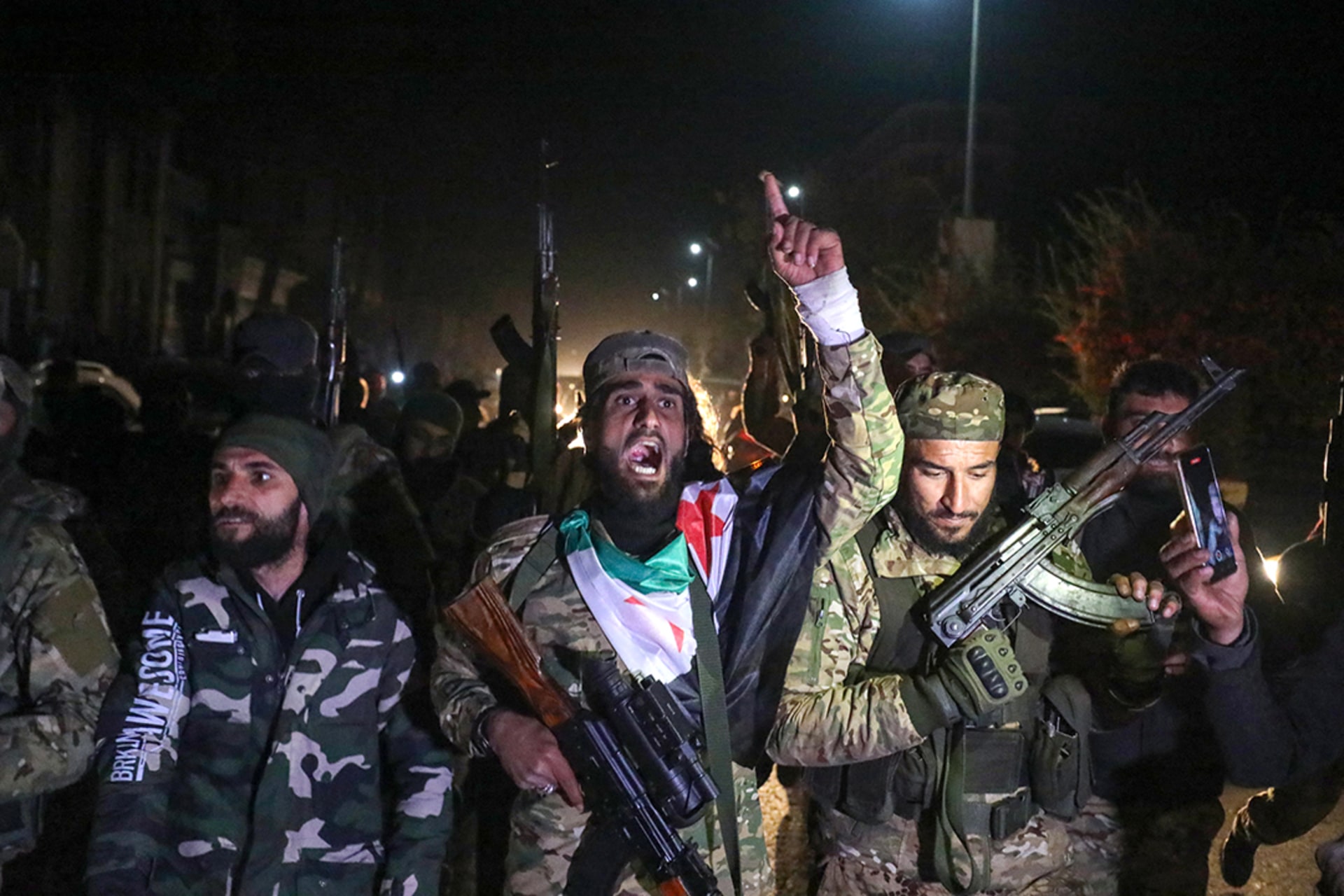
A soldier waves his fist in the air surrounded by people
Islamist-led Syrian rebel fighters celebrate in the streets of Homs in the early hours of December 8, 2024, after entering Syria's third city overnight.
Abdulaziz Ketaz/AFP via Getty Images
A woman wearing a head covering waves a flag outside.
A woman waves a Syrian opposition flag as she celebrates at Umayyad Square in Damascus on December 8, 2024.
Bakr Al Kassem/AFP via Getty Images
People stand outside a building next to a toppled statue.
People stand atop a toppled statue of Syria's late president Hafez al-Assad in Damascus on December 8, 2024.
Louai Beshara/AFP via Getty Images
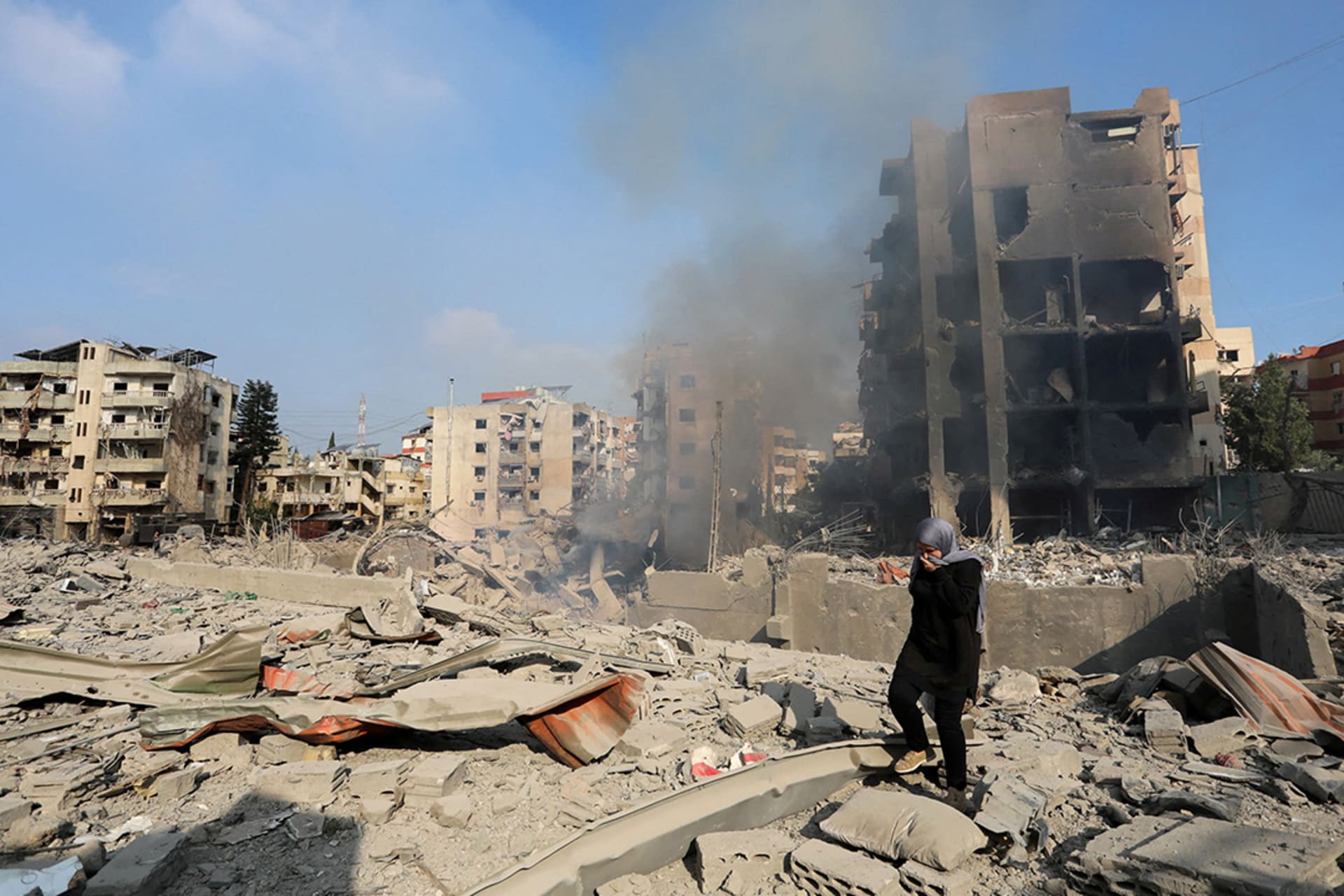
A woman in a black veil walks past a black vintage car parked in front of a demolished building.
A woman walks past a vehicle parked near damaged buildings near Douma, in the eastern suburbs of Damascus, on March 9, 2021.
Omar Sanadiki/Reuters
A fighter from the Jaish al-Islam runs to avoid sniper fire, in the village in the Tal al-Siwan area of the rebel-held stronghold of Douma, on the outskirts of Damascus, on September 5, 2016.
Sameer al-Doumy/AFP/Getty Images
A Syrian mourns as members of the Syrian civil defense volunteers, also known as the White Helmets, and people search for survivors from the rubble following reported air strikes on the rebel-held town of Saqba in Eastern Ghouta in Damascus, Syria on April 4, 2017.
Amer Almohibany/AFP/Getty Images
An explosion rocks the Syrian town of Kobani during a reported suicide car bomb attack by Islamic State militants on a People’s Protection Unit (YPG) position in the city center of Kobani, as seen from the outskirts of Suruc, on the Turkey-Syria border, on October 20, 2014.
Gokhan Sahin/Getty Images

Since the ouster of the Bashar al-Assad regime in December 2024, Syria has entered a fragile transition under Ahmed al-Sharaa, the leader of Hayat Tahrir al Sham (HTS). In the northeast, the Kurdish-led Syrian Democratic Forces (SDF) continue to clash with Turkish-backed factions and Arab tribes, while rising sectarian tensions have fueled targeted attacks on the Alawite and Druze communities in the southwest. Meanwhile, the Islamic State is exploiting the fragmented security landscape to reestablish its foothold. Israel, viewing the new regime as a threat, has launched air and ground assaults. Although the United States has eased sanctions and Arab states have pledged aid, instability, minority tensions, and weak recovery still block large-scale refugee returns, and humanitarian conditions remain dire

Syria’s Civil War (2011-24)

What began as protests against President Assad’s regime in 2011 quickly escalated into a full-scale war between the Syrian government—backed by Russia and Iran—and anti-government rebel groups—backed by the United States and a rotating number of U.S. allies, including France, Italy, Jordan, Saudi Arabia, Turkey, the United Arab Emirates (UAE), and the United Kingdom. Three campaigns drove the conflict: coalition efforts to defeat the self-proclaimed Islamic State, violence between the Syrian government and opposition forces, and military operations against Syrian Kurds by Turkish forces.

The Islamic State began seizing control of territory in Syria in 2013. After a series of terrorist attacks coordinated by the Islamic State across Europe in 2015, the United States, the United Kingdom, and France—with the support of Saudi Arabia, Turkey, and other Arab partners—expanded their air campaign in Iraq to include Syria. Together, those nations have conducted over eleven thousand air strikes against Islamic State targets in Syria, while the U.S.-led coalition has continued its support for ground operations by the SDF. Turkish troops have been involved in ground operations against the Islamic State since 2016 and have launched attacks against armed Kurdish groups in Syria.

Meanwhile, at the request of the Syrian government in September 2015, Russia began launching air strikes against what it claimed were Islamic State targets, while Syrian government forces achieved several notable victories over the Islamic State, including the reclamation of the city of Palmyra. According to the U.S.-led coalition against the Islamic State, Iraqi security forces and the SDF reclaimed 98 percent of the territory formerly held by the group in Iraq and Syria, including the cities of Raqqa and Deir al-Zour.

With Russian and Iranian support, the Syrian government steadily regained control of territory from opposition forces, including the opposition’s stronghold in Aleppo in 2016. The regime was accused of using chemical weapons numerous times over the course of the conflict, resulting in international condemnation in 20132017, and 2018. Opposition forces maintained limited control in Idlib, in northwestern Syria, and on the Iraq-Syria border. During this period, efforts to reach a diplomatic resolution were unsuccessful. Various rounds of UN-backed peace talks in Geneva failed to reach a political resolution, while a ceasefire reached in Astana, Kazakhstan, collapsed after Syrian government forces violated its terms.

During President Donald Trump’s first term, the United States largely withdrew from Syria, leaving only about four hundred U.S. troops as a contingency force. On January 16, 2019, an attack in Manbij claimed by the self-proclaimed Islamic State killed at least nineteen people, including four Americans. Before that attack, only two Americans had been killed in action in Syria since the U.S.-led campaign began. The U.S.-led international coalition continues to carry out military operations against the remnants of the Islamic State and al-Qaeda affiliates.

By 2023, the Assad regime appeared to be reemerging from years of diplomatic isolation. Iranian President Ebrahim Raisi met with Assad in Damascus to strengthen economic cooperation and the Arab League agreed to re-admit Syria after a twelve-year suspension. Rebel groups remained confined to Idlib for several years, leading most regional analysts to believe the threat to Assad had largely ended, even as sporadic Islamic State attacks and Israeli strikes on Iran-backed militias continued.

According to UN estimates, around 580,000 people were killed during the civil war, with millions either internally displaced or living as refugees in Jordan, Lebanon, Turkey, and several European states. On February 6, 2023, a 7.8 magnitude earthquake struck northwest Syria and southeastern Turkey in one of the worst natural disasters of this century. In Syria, the disaster killed an estimated 8,400 people and caused about $5.1 billion in damages, deepening the humanitarian crisis.

Overthrow of Bashar al-Assad (2024)

Battlefield dynamics in Syria shifted significantly following Hamas’s October 7, 2023, attack on Israel. Israel accelerated its airstrikes in Syria, killing multiple senior officials within Iran’s Islamic Revolutionary Guard Corps (IRGC) and weakening Iran-backed local militias. After Israel launched a ground invasion and large-scale aerial campaign against Hezbollah in Lebanon in September 2024, the group significantly scaled back its contingency presence in Syria. Likewise, the Russian invasion of Ukraine forced Russia to shift forces away from its bases in Syria.

By November 2024, the retrenchment of Assad’s foreign allies provided a military opening for Syrian rebel groups to renew their campaign against the Assad regime. In contrast to the declining influence of the regime’s allies, the rebels had continued receiving military support from Turkey, which maintained troops in northern Syria and aided the Syrian National Army (SNA), a key rebel group. As the November offensive began, Assad’s forces fought back with minimal firepower. After capturing Aleppo, rebel forces seized Hama on December 5, Daraa on December 6, and Homs on December 7, before overpowering Assad’s fleeing forces in Damascus on December 8. Throughout their offensive, the rebels freed thousands of political prisoners held by the Assad regime. The offensive’s speed surprised many observers, including analysts, Syrians, and even the rebels themselves.

Transition Under Ahmed al-Sharaa (2024-Present)

As Assad fled to Moscow and many Syrians celebrated the rebels’ announcement of victory on state television, a new interim administration emerged under Hayat Tahrir al-Sham (HTS) leader Ahmed al-Sharaa, then known by his nom de guerre, Abu Muhammad al-Jolani. Al-Sharaa founded HTS as a successor group to Jabhat al-Nusra, which was al-Qaeda’s Syria affiliate before breaking off in mid-2016. Those ties to al-Qaeda prompted the United States to designate Al-Sharaa as a terrorist. Still, the United States and many European governments cautiously welcomed the change in government, calling for the new regime to implement an inclusive political solution aligned with UN resolutions.

Since then, the Sharaa regime’s record has been mixed. His government has suggested it is committed to a secular state with equality among Syria’s diverse population, but many minority communities feel sidelined and fearful of the new regime. Women and minorities won only a few seats in recent parliamentary elections held in October, while its new interim constitution risks centralizing power without credible institutional guarantees for civil and political rights.

In March, the Sharaa regime signed an agreement with the SDF to integrate the Kurdish population into government structures. However, clashes restarted after the deal failed to materialize. Turkey’s interest in preventing Kurdish autonomy has further complicated the process, as Ankara continues to threaten military escalation.

Although the regime promised to avoid retribution against the Alawite minority, which Assad’s rule had favored, it struggled to contain a vigilante assault that killed an estimated 1,400 members of the community, predominantly civilians, in March 2025. A Reuters investigation traced much of the violence to units integrated into the new government’s security apparatus. In southern Syria, meanwhile, the Druze population accused Damascus of backing Bedouin tribes in deadly clashes over the summer of 2025, which killed at least 1,000 people.

In May 2025, President Trump announced that the United States would suspend all sanctions targeting the Syrian regime, following a more limited U.S. waiver in January 2025. Nonetheless, ongoing security threats, weak government institutions, and lingering international sanctions have limited economic recovery, keeping humanitarian conditions bleak. This has prevented most refugees from returning home, although the UN reported in September 2025 that around 1 million had returned, along with 1.8 million internally displaced individuals.

Throughout this period, Israel has continued striking regime targets. After the Israeli government declared the UN-sponsored 1974 Disengagement of Forces Agreement void, it initiated a ground invasion on December 8, 2024. Israel coupled the invasion with an aerial campaign targeting weapons caches throughout the country, aiming to prevent the new Islamist regime from amassing significant military power. Israel intensified this campaign during the July 2025 Druze-Bedouin clashes, striking several key government targets, including the Defense Ministry and an area adjacent to the Presidential Palace, as it echoed Druze accusations of regime support for the Bedouin tribes. Despite these clashes, Israel and Syria have maintained talks aimed at restoring the UN-backed 1974 agreement and achieving a broader regional security arrangement.

Landmark UN Security Council Visit to Syria
December 4, 2025

All fifteen members of the Security Council traveled to Damascus for the council’s first-ever visit to Syria, signaling international re-engagement following Assad’s ouster last year; the delegation met with Syrian President Ahmad al-Sharaa and civil society figures to discuss accountability, reconstruction, and national reconciliation (AP). Additionally, Visa will begin operating in Syria as the country’s economic reconstruction progresses, the company and Syrian central bank governor Abdulkader Husrieh announced; Husrieh said Damascus aimed to make Syria a financial hub for the region (Reuters). The International Monetary Fund pledged to assist with building out its financial system following a staff visit to the country last month (Reuters).

EU Revises Asylum Policy for Syrians
December 3, 2025

The new guidance reflects changes inside Syria, concluding that some former risk groups may no longer face persecution while warning that minorities and former regime affiliates remain vulnerable; the revision could affect asylum outcomes for more than 100,000 pending cases (AP). Syria’s Central Bank head said that the return of refugees has helped economic activity rebound at a faster pace than international forecasts; he also discussed plans to introduce a redesigned Syrian currency and overhaul deficit financing as part of reintegration into the global financial system (Reuters).

Netanyahu Signals Openness to Arrangement With Syria
December 2, 2025

Israeli Prime Minister Benjamin Netanyahu indicated that an understanding would require the creation of a broad demilitarized belt extending toward Mount Hermon; his remarks follow public concerns from the Trump administration that Israel’s continued military activity inside Syria is undermining the country’s economic and political rehabilitation (Reuters).

Joint U.S.-Syrian Operations Against the Islamic State
November 30, 2025

The U.S. military said the operations eliminated multiple arms depots linked to the self-proclaimed Islamic State around Damascus, as Washington signals continued security cooperation with the Sharaa administration and weighs further sanctions repeals (Reuters).

Amnesty International Calls for Further Reforms in Syria
November 29, 2025

The group’s secretary-general said that the Sharaa regime has taken initial steps toward accountability and legal reform but has not yet established meaningful democratic structures; she also urged foreign governments to investigate recent abuses, warning that Syria’s transition risks stalling without outside backing (AP).

Clashes in Alawite Latakia
November 25, 2025

Hundreds from the Alawite community gathered in a rare protest to demand a more decentralized political system and the release of detainees, prompting government supporters to hold a counter-protest that escalated into gunfire in one of the city’s main squares; Syrian security forces fired warning shots in response (Jerusalem Post).

Sectarian Clashes in Homs
November 23, 2025

Members of the Bani Khaled tribe attacked an Alawite-majority neighborhood following the killing of a Bedouin husband and wife in the village of Zaidal, injuring multiple people and killing at least two; security forces later imposed a curfew and initiated investigations (AP).

Netanyahu Visits Israeli-Occupied Syrian Territory
November 20, 2025

Damascus blasted Israeli Prime Minister Benjamin Netanyahu’s visit to troops stationed in southern Syria, calling it a breach of sovereignty after Israel expanded its positions there following Assad’s fall; Syrian officials said the move signaled Israel’s refusal to reverse recent territorial gains, as sources report that U.S.-mediated talks on a limited security arrangement have stalled (Reuters). An Israeli news report had suggested that Jerusalem was conditioning a withdrawal of its troops in Syria on complete normalization of bilateral ties, which Damascus has rebuffed (Times of Israel). In Raqqa, meanwhile, two Syrian army soldiers were killed in clashes with the Syrian Democratic Forces, as talks to implement the March deal between the two sides continue to falter (Al Arabiya).

Syrian Trial Over March Coastal Killings
November 18, 2025

Syria opened its first court proceedings related to the March massacres of Alawite civilians, trying a dozen defendants from both government-affiliated forces and pro-Assad insurgents in a public session in Aleppo; officials framed the case as an effort to demonstrate accountability in the post-Assad era, though activists and Alawite groups questioned the judiciary’s independence (Reuters). Meanwhile, senior Syrian and Russian defense officials conducted a joint visit to southern Syria following the arrival of a Russian delegation to the country; Damascus is seeking renewed Russian military support to deter expanding Israeli operations, despite continued Syrian aversion to Moscow for its support of the former Bashar al-Assad regime (The National).

Syria Detains Security Forces Over July Sweida Clashes
November 17, 2025

Damascus announced that an unspecified number of Syrian security forces and soldiers were arrested as part of the investigation into the clashes, which occurred between the Druze minority and Bedouin militias aided by government-affiliated forces (Jerusalem Post). The situation in Sweida remains tense following an exchange of fire between Druze and Syrian government units late last week (AP).

EU-Syria Meeting in Damascus
November 15, 2025

Syrian civil society groups, transitional authorities, and European Union (EU) officials held their first joint discussions inside Syria since the collapse of the Bashar al-Assad regime, addressing communal strains and unresolved cases of missing individuals; EU officials said the event marked a step toward more inclusive political engagement (AP).

Fighting Resurfaces in Sweida
November 14, 2025

Druze armed groups and Syrian government units blamed each other for breaching a months-old ceasefire after renewed clashes around al-Majdal, which involved drone strikes and heavy weapons but caused no reported deaths; local officials warned the flare-up risks reigniting the large-scale violence that devastated Sweida earlier this year (AP). In Damascus, unknown assailants fired rockets in the Mezzeh district, injuring a civilian; explosions in Damascus have been relatively rare since the fall of the Bashar al-Assad regime (Al Jazeera).

Syria Reopens London Embassy
November 13, 2025

Syrian Foreign Minister Asaad al-Shibani visited the United Kingdom and formally reopened the embassy more than ten years after its closure; al-Shibani said his talks with UK officials were constructive (AP). Meanwhile, U.S. special envoy Tom Barrack said Damascus will support U.S. efforts to counter Iran, Hamas, and Hezbollah, following Syria’s entry into the coalition against the self-proclaimed Islamic State; along with U.S. Secretary of State Marco Rubio, Barrack also also met Turkish and Syrian officials to discuss integrating the Kurdish-led Syrian Democratic Forces into the Syrian state (Times of Israel/AFP).

Counterterror Operations in Syria
November 12, 2025

The U.S. military announced that between October 1 and November 6, U.S. forces facilitated at least twenty-two operations targeting militants from the self-proclaimed Islamic State (IS); the operations killed at least five fighters and captured another nineteen (Reuters). Syria formally joined the anti-IS coalition earlier this week, although a Syrian official suggested on Wednesday that Syrian participation is currently limited to political rather than military cooperation (AP).

Sharaa at the White House
November 10, 2025

Ahmed al-Sharaa became the first Syrian president to visit the White House since 1946, eleven months after his rebel alliance ousted former leader Bashar al-Assad (WaPo). Sharaa has called for the suspension of remaining U.S. sanctions on Syria (Reuters). Following the meeting, U.S. President Donald Trump praised Sharaa and promised the United States would “do everything we can to make Syria successful,” while also minimizing the implications of Sharaa’s past ties to terror organizations (Al Jazeera). Separately, Syrian officials said security forces thwarted two plots from the self-proclaimed group to assassinate al-Sharaa in recent months, underscoring its continued activity in the country (Reuters).

Syrian Counterterrorism Operations
November 8, 2025

The Syrian Interior Ministry announced that its forces executed sixty-one nationwide operations against militants from the self-proclaimed Islamic State, arresting seventy-one fighters and seizing several weapons, as Syria prepares to join the U.S.-led coalition against the terror group (Reuters).

Britain Lifts Sanctions on Sharaa
November 7, 2025

The removal of sanctions on Syrian President Ahmed al-Sharaa follows a UN Security Council decision to remove similar restrictions ahead of Sharaa’s planned meeting with U.S. President Donald Trump; the European Union confirmed it will also lift its measures, though other arms and security restrictions on Syria will remain (Reuters). Meanwhile, the UN reported that nearly 100 individuals have been abducted in Syria since January 2025, causing worry of continued political violence even after the fall of the Bashar al-Assad regime last year (UN). Separately, the Syrian Foreign Ministry denied a Reuters report that the United States was planning to establish a military presence in Damascus, while the Interior Ministry suggested Russia could play a role in developing the Syrian military and other security forces (New Arab).

UN Repeals Sanctions on Sharaa
November 6, 2025

Fourteen members backed a recently proposed U.S.-drafted resolution removing Syrian President Ahmed al-Sharaa and his interior minister from an international sanctions list, clearing asset freezes and an arms embargo as talks with U.S. President Donald Trump approach; China abstained from the vote (Al Arabiya). Separately, Sipan Hamo, a senior commander in the Syrian Democratic Forces (SDF), said negotiations on integrating his group into state structures have stalled over disagreements on decentralization and the force’s status; he added the SDF is preparing for potential conflict even as it seeks to uphold a March agreement with Damascus (Al Arabiya).  

Military Presence in Damascus
November 5, 2025

Sources told Reuters that Washington is planning to station personnel at a Damascus airbase to support an anticipated U.S.-brokered security deal between Syria and Israel, though Syrian officials publicly denied the report; the move would follow reconnaissance missions confirming the runway’s readiness as talks accelerate ahead of U.S. President Donald Trump’s meeting with Syrian President Ahmed al-Sharaa (Reuters).

U.S. Proposal to Lift UN Sanctions on Syria
November 4, 2025

A U.S.-drafted Security Council resolution would remove sanctions on Syrian President Ahmed al-Sharaa and Interior Minister Anas Khattab as Washington pushes to ease measures in anticipation of an official Syrian visit to the United States; Sharaa is already receiving travel exemptions, allowing his planned visit even if the resolution stalls (Reuters). U.S. officials are simultaneously pushing to repeal the 2019 Caesar Act, which has strained Syrian economic reconstruction, ahead of the trip (WSJ).

Lebanon-Syria Talks in Bahrain
November 2, 2025

Syria’s foreign ministry said it sought to improve both political and security ties; the countries have a history of strained relations, as Syria occupied Lebanon from 1976 to 2005 and Hezbollah fighters participated in Syria’s civil war (The National). With relatively new governments in place in both countries, their leaders have pledged to improve bilateral relations (AP). Separately, Syrian President Ahmed al-Sharaa will visit Washington sometime around November 10, per a White House official, marking the first official visit from a Syrian president to Washington; U.S. Special Envoy for Syria Tom Barrack first announced the visit on November 1, with Syrian Foreign Minister Asad al-Shibani confirming the visit the following day (Reuters). Ahead of the visit, al-Shibani said negotiations to merge Kurdish institutions into the state remain stalled despite U.S. mediation, a stance that contrasts with Washington’s more positive assessments (Al Monitor). Meanwhile, in Damascus, the Syrian Ministry of Interior said a months-long review of forty-two alleged kidnappings of Alawite women confirmed only one abduction, concluding that allegations of minority abuses from human rights groups were false; no independent investigations have corroborated the ministry’s claim (AP).

Syrian Corruption Crackdown
October 31, 2025

Syrian President Ahmed al-Sharaa has reportedly been warning loyalists against profiteering, ordering investigations into civil servants with luxury assets, and even shutting down a brother’s business office over concerns of influence-peddling, demonstrating an attempt to root out corruption under the new Syrian regime (Reuters).

Syrian Diplomatic Advances
October 30, 2025

A high-level Syrian delegation met with Lebanese security officials in Beirut, agreeing to boost bilateral cooperation on combating smuggling, crime, and terrorism, in the latest thaw in Lebanese-Syrian ties (New Arab). German Foreign Minister Johann Wadephul met with Syrian President Ahmed Al-Sharaa in Damascus to discuss a range of concerns affecting Syrian reconstruction efforts (Arab News).

Israel and Syria Nearing Security Deal
October 29, 2025

An Israeli official told media outlets that talks on joint security arrangements with Syria were advancing, with the possibility of a joint presence backed by U.S. forces at strategic points; several core issues remain unresolved, although the official reiterated that the agreement would resemble the UN-backed 1974 Disengagement of Forces Agreement (i24NEWS).

Sharaa in Saudi Arabia
October 28, 2025

Syrian President Ahmed al-Sharaa arrived in Riyadh to attend the Future Investment Initiative and hold talks with senior Saudi officials, including Crown Prince Mohammed bin Salman and Foreign Minister Faisal bin Farhan Al-Saud, as Damascus seeks foreign capital to revive its economy (New Arab). Meanwhile, Russia has resumed military flights between its air bases in Syria and Libya, following a five-month suspension; the resumption comes after a recent meeting between Sharaa and Russian President Vladimir Putin in Moscow (Libya Observer).

White House Presses Syria Sanctions Repeal
October 24, 2025

The Trump administration is urging lawmakers to repeal the Caesar Act to facilitate foreign investment, warning that executive waivers will not reassure companies; any potential repeal would likely be included in the annual defense bill, although senior Israeli officials are pushing to preserve the sanctions (Al-Monitor).

Syrian Military Officers in Turkey and Saudi Arabia
October 23, 2025

Syria’s defense minister said a group of army cadets has begun studying at military academies in Turkey and Saudi Arabia, calling the move part of efforts to modernize the Syrian army and expand defense cooperation with both countries (New Arab). Meanwhile, Social Affairs Minister Hind Qabwat met with European Union officials to discuss Syria’s plans for its transitional phase and request support for reconstruction, as a UN official advocated for increased international aid at a Security Council session on Wednesday (UN; X).

Gunmen Kill Druze Syrians
October 22, 2025

Unidentified gunmen targeted a van in the Druze village of Kafr Maris in Idlib, killing three civilians in what local residents called a deliberate sectarian attack that heightened local tensions; officials said they are boosting security measures to address targeted violence (AP). The Wall Street Journal reported that the Islamic State has been exploiting the security vacuum that has emerged following the fall of the Assad regime, carrying out 117 attacks in northeast Syria through August, up from seventy-three in all of 2024, as U.S. forces began withdrawing hundreds of troops and transferring several bases to the Syrian Democratic Forces (WSJ).

UK Delists Hayat Tahrir al-Sham
October 21, 2025

The removal of the terror designation aims to facilitate engagement with Syria’s new government, which is led by former Hayat Tahrir Al Sham chief Ahmed al-Sharaa, and to coordinate on dismantling Assad’s remaining chemical weapons program (UK Government). Syrian Economy Minister Mohammad Nidal al-Shaar reiterated his country’s desire for increased foreign recognition, including through a formal congressional repeal of U.S. sanctions (Reuters).

Turkey and Syria Cooperate Against Kurds
October 17, 2025

Ankara has agreed to send military vehicles, drones, and air defenses to the Syrian government in return for permission to expand military operations against Kurdish militias near the border; Turkish and Syrian officials are also discussing broader security coordination and limits on Kurdish control of oil fields (Jerusalem Post/Reuters).

Bus Explosion in Deir ez-Zor
October 16, 2025

An explosive device struck a Syrian Energy Ministry bus traveling between Deir ez-Zor and al-Mayadin, killing four security personnel and injuring nine others, according to state media, in an area that witnessed heavy clashes during the civil war; the slain personnel were guards at the Teim oilfield (Al Jazeera).

Sharaa in Moscow
October 15, 2025

Syria will honor past deals with Russia, Interim Syrian President Ahmed al-Sharaa told Russian President Vladimir Putin; Russia has sought to retain control of its military bases in Syria following the ouster of its ally, Bashar al-Assad (Reuters). Sharaa’s visit was particularly sensitive given that Russia is harboring Assad; the two leaders also discussed potential energy and infrastructure projects (NYT).

Mass Graves Found in Damascus
October 14, 2025

A Reuters investigation revealed that from 2019 to 2021, Bashar al-Assad’s regime conducted a covert operation to transfer tens of thousands of bodies from the Qutayfah mass grave near Damascus to a secret site in the Dhumair desert, aiming to erase evidence of war crimes; satellite imagery and testimonies suggest the new site included at least thirty-four trenches and spanned two kilometers, making it one of Syria’s largest mass graves (Reuters).

UN Weighs Syria Sanctions Repeal
October 13, 2025

The UN Security Council is reviewing a U.S.-proposed resolution to remove Syrian President Ahmad al-Sharaa and Interior Minister Anas Khattab from the UN sanctions list, easing restrictions on financial flows to Damascus and permitting limited arms transfers for demining and chemical weapons disposal; China has reportedly shown support, marking a rare consensus among major powers (The National). Syrian Democratic Forces (SDF) Commander Mazloum Abdi confirmed he has reached a preliminary deal with Syrian President Ahmad al-Sharaa to integrate SDF forces into the central government’s Defense and Interior Ministries, building on the U.S.-brokered March 10 agreement (Al Jazeera). Following the announcement, an SDF security delegation arrived in Damascus to discuss the deal’s implementation, as control of oil infrastructure and Turkey’s role in the talks remain uncertain (AFP)

Syrian Foreign Minister in Lebanon
October 10, 2025

Syrian Foreign Minister Asaad al-Shibani met Lebanese leaders in Beirut in the first high-level visit since the fall of Bashar al-Assad, as both countries work to reset relations after decades of tension; the two sides agreed to suspend the long-inactive Lebanese-Syrian Higher Council and handle bilateral issues through formal diplomatic channels while advancing talks on border demarcation, detainees, and refugee returns (AP). Meanwhile, the U.S. Senate approved a repeal of the 2019 Caesar Act, which imposed sweeping sanctions on the former Assad regime; lawmakers cited the act’s punitive effects on post-war reconstruction, with the bill now heading to the House of Representatives before final presidential approval (New Arab).

Government and SDF Reach Truce in Part of Aleppo Following Armed Clashes
October 7, 2025

Each side blamed the other for the fighting that cast doubt on a U.S.-brokered March deal to integrate the SDF into Syrian state institutions (Reuters). The United States partnered with the SDF to fight the Islamic State group during Syria’s civil war, but is currently withdrawing its forces (Al Arabiya).

Results of Syria’s First Parliamentary Election Since Fall of Bashar al-Assad
October 6, 2025

The election determined about half of Syria’s new legislature; interim President Ahmed al-Sharaa is due to appoint some remaining members, while others will be chosen in future elections that were delayed due to logistical challenges (Reuters). Many Syrians remain displaced after more than thirteen years of war (Al Jazeera). Seats largely went to men from the Sunni Muslim majority, with few women or religious minorities elected; elections were delayed in Kurdish-held territory in northeast Syria, where militia fighters clashed with government forces in recent days (NYT). Meanwhile, U.S. Special Envoy Tom Barrack and CENTCOM commander Admiral Brad Cooper met Syrian Democratic Forces chief Mazloum Abdi as friction grows between the Kurdish-led group and Damascus; talks focused on political integration and the fight against the self-proclaimed Islamic State (Al Arabiya).

Syria Holds First Parliamentary Elections Since Fall of Bashar al-Assad
October 5, 2025

A limited group of electoral college members from across the country voted for representatives that will account for two-thirds of the legislature, while the interim government will directly appoint the remaining third (AP). Areas not controlled by the government did not participate in the vote, nor did some minority groups; many Syrians remain displaced and lack identity documents after years of civil war (NYT).

Trump Extends Syria State of Emergency
October 2, 2025

President Donald Trump extended the national emergency on Syria for another year under Executive Order 13894, citing the ongoing threat to U.S. national security; the order, which was further expanded in subsequent executive orders, seeks to address ongoing threats from the self-proclaimed Islamic State and achieve accountability for abuses linked to the regime of former President Bashar al-Assad (U.S. Federal Register).

Erdoğan Backs Centralized Syrian State
October 1, 2025

Turkish President Recep Tayyip Erdoğan warned that Ankara will not permit Syria’s territorial breakup or the emergence of a Kurdish-led entity if ongoing diplomacy to integrate the Syrian Democratic Forces into Damascus’s state apparatus fails (Reuters). Meanwhile, local leaders in Sweida have formed a de facto administration and “National Guard” militia, with some calling for secession, in response to the attacks against the Druze community last summer; Druze officials also remain in contact with counterparts in Israel, as the community continues pushing for closer ties with the state (AP).

Israel-Syria Security Talks Stall Over Aid Corridor Demand
September 26, 2025

Israel revived a rejected proposal to open a “humanitarian corridor” to Syria’s Druze-majority Sweida province, prompting Damascus to halt U.S.-brokered negotiations on a broader de-escalation pact meant to end Israeli strikes and demilitarize southern Syria, sources tell Reuters (Reuters).

Trump Promises “Major Announcement” on Syria
September 25, 2025

U.S. President Donald Trump made the statement at the White House but provided no further details, noting that he had previously eased sanctions to give the country “room to breathe” (Reuters).

Syrian President Presses United States to Repeal Sanctions
September 22, 2025

President Ahmed al-Sharaa, in New York for the UN General Assembly, urged Washington to formally repeal the Caesar Act sanctions, arguing they unfairly target Syrians; Al-Sharaa met U.S. Secretary of State Marco Rubio to discuss sanctions relief, counterterrorism cooperation, missing Americans, and Israel-Syria relations (Al Jazeera).

U.S. and Israel Report Progress in Syria Talks
September 21, 2025

Israeli Prime Minister Benjamin Netanyahu told ministers that talks with Syria had advanced toward a potential security agreement, while a senior U.S. official said the deal is 99 percent complete; the official suggested an announcement may occur within two weeks (Times of Israel). Meanwhile, Syria reported it will hold its first parliamentary elections since Bashar al-Assad’s ouster on October 5, with a third of the 210 seats appointed by President Ahmed al-Sharaa and the rest chosen by local committees; the new assembly is tasked with approving reforms and treaties, though critics warn the system excludes marginalized communities (Al Jazeera).

Joint Security Operation Kills Islamic State Leader in Syria
September 19, 2025

The Iraqi Counterterrorism Service announced that a joint operation with the U.S.-led international coalition killed a commander of the self-proclaimed Islamic State accused of leading multiple attacks in foreign countries, including the Iranian Embassy in Lebanon (Reuters).

Syria’s Foreign Minister Visits Washington in First Official Trip in Twenty-Five Years
September 18, 2025

Syrian Foreign Minister Asaad al-Shibani arrived in Washington on Thursday for talks with U.S. officials, marking the first official visit by a Damascus official in twenty-five years (AP). Meanwhile, UN Envoy to Syria Geir Pedersen announced he will step down after more than six years of failed mediation efforts and continued turmoil (Reuters).

Syria’s President Says Security Talks With Israel Could Yield Results Soon
September 17, 2025

Syrian President Ahmed al-Sharaa said negotiations with Israel on a security pact could produce results “in the coming days,” although he stressed any finalized agreement must end Israeli strikes and respect Syrian sovereignty (Al Jazeera).

Syria Announces Druze Security Deal With Jordan and United States
September 16, 2025

Damascus announced a roadmap for stabilizing the Druze-majority As-Suwayda province that includes U.S.-brokered security understandings with Israel; Jordan is supporting the effort (AP).

Syria Confirms Talks With Israel on Restoring 1974 Disengagement Agreement
September 14, 2025

President Ahmed al-Sharaa said negotiations are underway to reinstate the security terms established after the 1973 war, while Damascus calls for UNDOF forces to return to the disengagement zone amid outreach to the United States, Russia, and regional powers (Jerusalem Post).