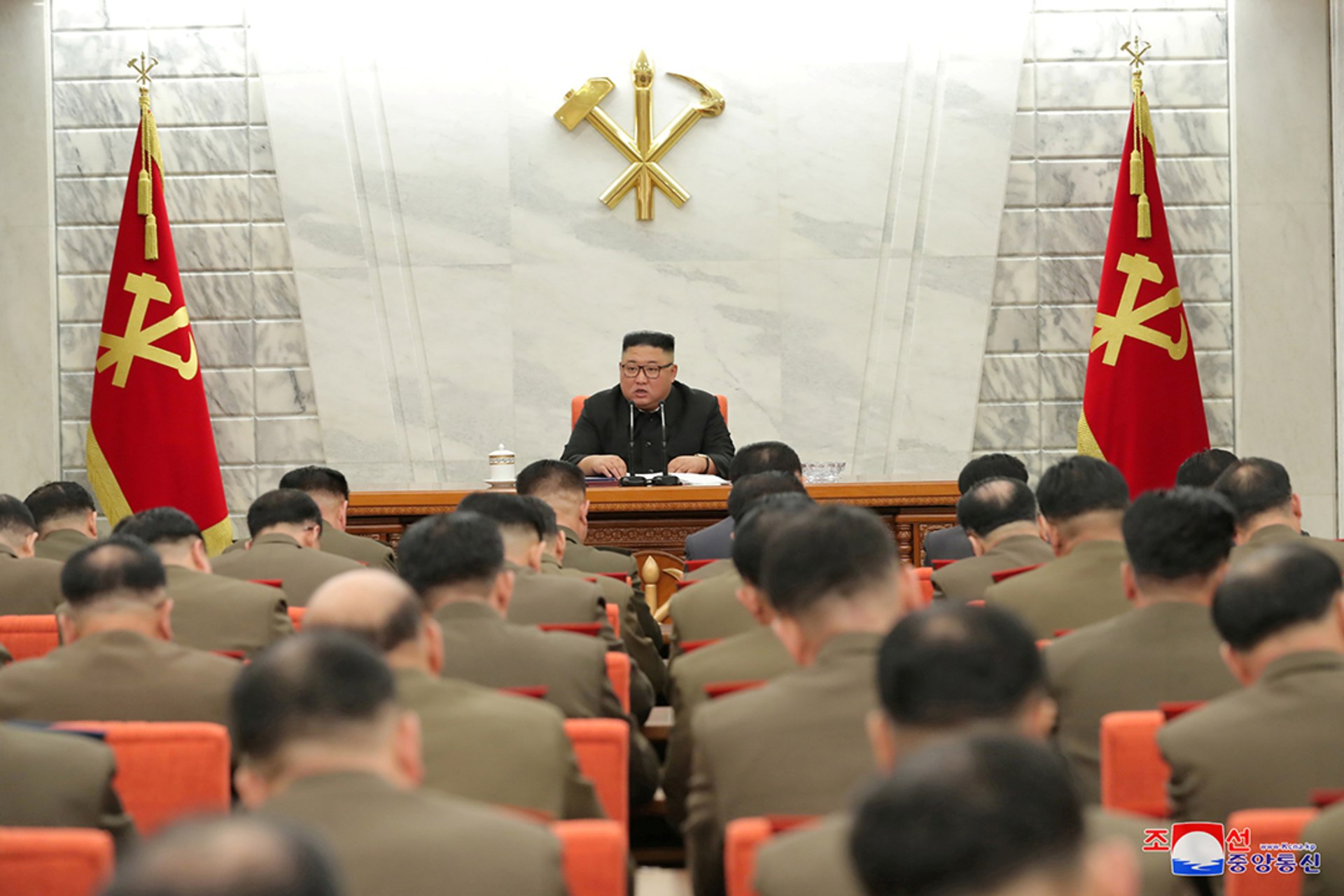
North Korean leader Kim Jong-un speaks during the first enlarged meeting of the 7th Central Military Commission of the Workers’ Party of Korea (WPK) in this undated photo released on May 18, 2018.Korean Central News Agency via Reuters
TYPE
Interstate War
IMPACT ON U.S.
High
STATUS
Developing
Related
North Korea
South Korea
Updated September 10, 2026
RelatedNorth Korea•South Korea
Updated September 10, 2026
Overview
Under leader Kim Jong-un, North Korea has pursued nuclear weapons and ballistic missiles to guarantee regime survival, posing an acute threat to South Korea and Japan—both key U.S. allies. Kim has deepened ties with Russia, providing artillery and troops for the war in Ukraine, while silencing domestic opposition through mass detention and political purges.
North Korean leader Kim Jong-un speaks during the first enlarged meeting of the 7th Central Military Commission of the Workers’ Party of Korea (WPK) in this undated photo released on May 18, 2018.Korean Central News Agency via Reuters
South Korean President Urges Washington to Trade Sanctions Relief for Nuclear Freeze
President Lee Jae Myung told the New York Times that the United States should seek a freeze rather than the immediate elimination of North Korea’s nuclear program and offer sanctions relief in exchange (NYT).
Lee separately told the Associated Press he wants a practical, phased approach to dismantling North Korea’s nuclear weapons rather than an all-at-once demand (AP).
South Korean Soldiers Injured in DMZ Explosion
The South Korean military said that three soldiers were injured during an operation in the heavily mined Demilitarized Zone (DMZ) south of the border (AFP/SCMP).
North Korea Conducts Multiweapon Drill After Allied Exercises
North Korea announced it conducted a live-fire drill on Saturday during which it simultaneously tested several different weapons systems, including attack drones, tactical ballistic and cruise missiles, and large-calibre multiple rocket launchers (Reuters).
The drill followed the completion of the annual trilateral military exercise, Freedom Edge, between the United States, Japan, and South Korea (AP).
North Korea, Russia Open First Road Bridge
The bridge, which spans the Tumen river, can support the passage of up to three hundred vehicles per day and will be used to transport cargo and, by the end of the year, passenger traffic, according to Russian Prime Minister Mikhail Mishustin (Reuters).
North Korean media claimed the bridge is solely for tourism and trade, while Ukrainian analysts warned it was designed as a military logistics corridor to support Russia’s war in Ukraine (BBC).
Kim Commissions Destroyer, Vows Nuclear Retaliatory Capability at Sea
North Korean leader Kim Jong Un commissioned the country’s second naval destroyer, declaring it part of North Korea’s nuclear response system and warning that the time has come to exercise its sovereignty “at sea and underwater”(Reuters).
Background
North Korea (officially called the Democratic People’s Republic of Korea) is isolated, impoverished, and a proclaimed enemy of its southern neighbor, South Korea (officially called the Republic of Korea)—an important U.S. ally. Kim Jong Un, who inherited the title of supreme leader from his father and grandfather, regularly threatens Japan, South Korea, and the United States with missile strikes. At home, Kim has silenced all opposition by detaining between 80,000 and 120,000 political prisoners, purging high-ranking officials, and likely ordering the assassination of his half-brother.
U.S. military involvement in the Korean peninsula has its roots in the Korean War of the early 1950s during the early stages of the Cold War, in which the United States supported forces in the southern part of the peninsula against communist forces in the north, who were aided militarily by China and the Soviet Union. Today, the United States is committed to defending South Korea under the terms of a mutual defense treaty [PDF]. The United States has nearly 29,000 troops deployed in the Korean peninsula for that purpose. In addition to U.S. troops, many of South Korea’s 630,000 troops and North Korea’s 1.2 million troops are stationed near the Demilitarized Zone (DMZ), making it one of the most heavily armed borders in the world.
In violation of UN Security Council resolutions, North Korea continues overt nuclear enrichment and long-range missile development efforts. Although the scale of North Korea’s uranium enrichment program remains uncertain, U.S. intelligence agencies estimate [PDF] that it has enough plutonium to produce at least six nuclear weapons, and possibly up to sixty. Decades of negotiations have so far failed to curb North Korea’s nuclear weapons program; see CFR’s timeline for a detailed history of the talks.
In September 2017, North Korea conducted its sixth nuclear weapons test, its most powerful test to date. It also claimed to have developed a hydrogen, or thermonuclear, bomb, which would represent further advancements in the nuclear program and the ability to build more powerful, higher-yield nuclear weapons. In the same year, the country conducted its first successful test of an intercontinental ballistic missile (ICBM), and U.S. intelligence agencies determined that North Korea could miniaturize its nuclear weapons to fit inside a missile. However, North Korea has not yet demonstrated that its nuclear warheads can withstand reentry into Earth’s atmosphere.
In response to the increasing frequency of missile tests, the United States has deployed an anti-missile system in South Korea. The Terminal High Altitude Area Defense (THAAD) system is located in the Seongju region of South Korea, one hundred and fifty-five miles from the northern border. Additionally, Japan, South Korea, and the United States maintain unilateral sanctions on North Korea, and the UN Security Council has passed harsh multilateral sanctions. In 2017, the United States placed North Korea back on a list of state sponsors of terrorism, a move that allowed additional sanctions.
In 2018, North and South Korea began a diplomatic rapprochement, and North Korean officials attended the Opening Ceremony of the Winter Olympics in Pyeongchang, South Korea. Kim announced a freeze on weapons testing, attended three summits with South Korean President Moon Jae-in, and met three times with Donald Trump, who became the first U.S. president to step foot in North Korea. At their summits, Kim and Moon signed statements pledging to work toward denuclearization of the Korean peninsula and an official end to war between the two countries. Ultimately, though, nuclear negotiations with the United States reached a deadlock, and North Korea restarted weapons testing in 2019. In 2020, North Korea blew up a North-South liaison office, and Kim announced a new phase in relations, labeling South Korea an enemy.
In 2020, at the start of the pandemic, North Korea implemented one of the world’s strictest border closures, further depressing the country’s economy and exacerbating hunger. However, North Korea did not report any COVID-19 cases for months and in 2021 rejected foreign vaccines. Entry restrictions extended to foreign dignitaries, isolating North Korea almost completely.
Concerns
North Korea is a nuclear power with a complex relationship with China, and preventing both an interstate Korean war and a North Korean internal collapse are critical U.S. national security interests. Along with continued weapons and missile tests, small-scale military and cyber provocations by North Korea pose significant risks as each incident carries with it the potential for further and potentially uncontrollable escalation. Outright threats from North Korean Supreme Leader Kim Jong-un are also cause for concern, as he claims that North Korean weapons can now reach U.S. territories and even the U.S. mainland.
Recent Developments
In 2022, after a two-year lull in testing, North Korea launched a record number of missiles. Frequent tests have continued into 2023 and included its first solid-fuel ICMB, the Hwasong-18, which requires less time to launch and is easier to hide. If successfully developed, it would decrease the probability of success of a pre-emptive strike on North Korea’s arsenal. It also lobbed a missile over Japan for the first time since 2017 and tested a record twenty-three missiles in a single day in November 2022. In July 2023, Kim received high-level Chinese and Russian delegations for the first time in years and vowed to strengthen bilateral relations with each.
In an initial 2021 policy review, the Joe Biden administration outlined a middle-ground approach to North Korea, combining diplomacy and deterrence. In line with that policy, in July 2023, U.S. National Security Advisor Jake Sullivan said the administration was prepared for talks “without preconditions;” days later, South Korean President Yoon Suk Yeol boarded a U.S. nuclear-capable ballistic missile submarine visiting Busan, South Korea.
Yoon has adopted a more hardline stance on North Korea than his predecessor. He called for a reorientation of the unification ministry and has boosted military cooperation with the United States, including by moving the THAAD missile defense system toward full operability. Yoon also committed to improving ties with Japan, and Japanese Prime Minister Fumio Kishida has reciprocated. Biden, Kishida, and Yoon will meet for the first standalone trilateral summit in August 2023 to strengthen strategic cooperation.
Overall, in the last year, both North and South Korea have taken a less compromising position, shored up alliances, and ramped up military provocations and readiness.