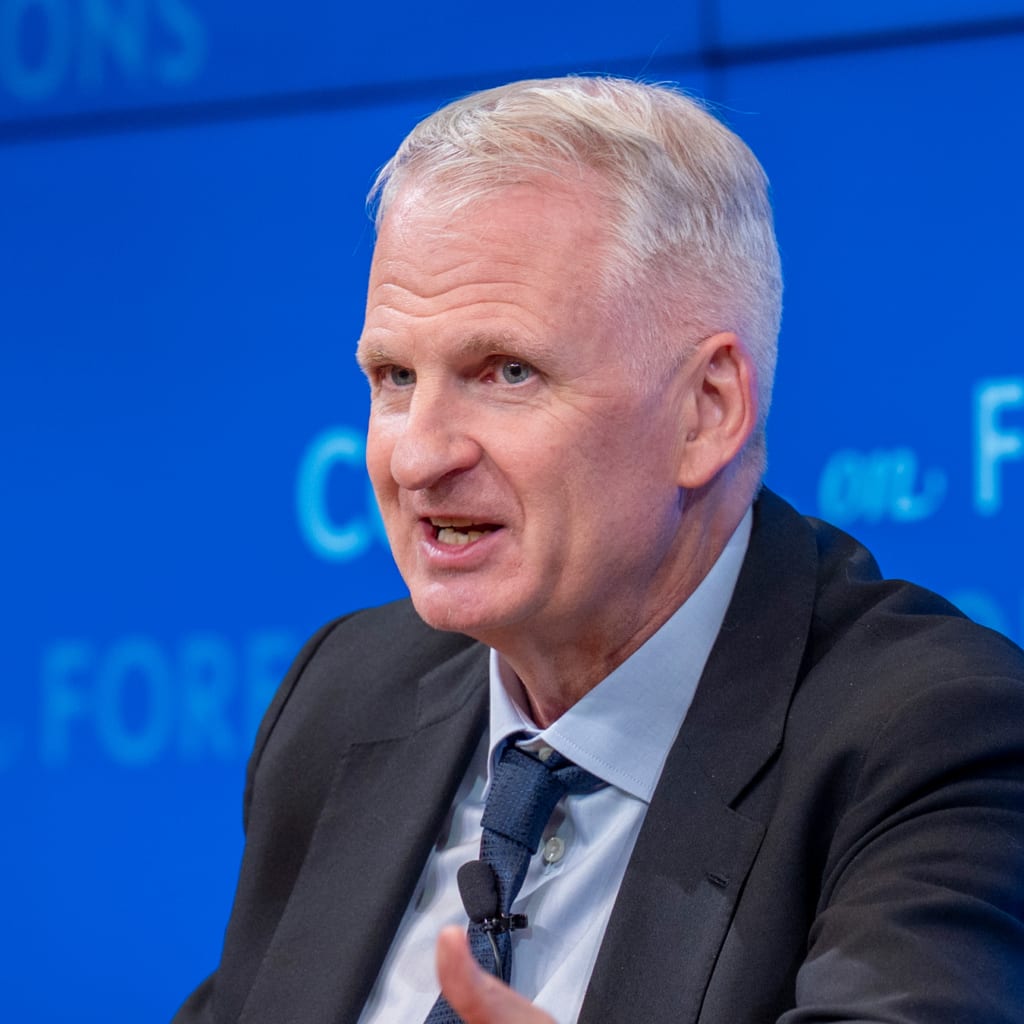
Can the United States Win the Biotech Race?
Event date
HAMBURG: OK. Welcome. Are we ready to begin? Apologies for being a little bit late, but the senator had some other important work to do. But we’re delighted that he is now with us, and we really have an outstanding panel. This is the Malcolm and Carolyn Wiener Annual Lecture on Science and Technology, being done in a panel format.
And I’m Peggy Hamburg, among a few things, former commissioner of the U.S. Food and Drug Administration and I’m also a member of the Board of Directors of the Council on Foreign Relations. And I’ll be presiding over today’s session. And I’m so delighted that we have this opportunity.
Today’s meeting, which, as I mentioned, is the Malcolm and Carolyn Wiener Annual Lecture on Science and Technology, is possible because of their generosity, having endowed this lecture series in perpetuity. And it really is quite unique. The lectureship addresses issues at the intersection of science, technology, and foreign policy. And really, I think, gets to the heart of why the Council on Foreign Relations is such an appropriate place for us to be discussing this set of issues, and hopefully driving greater understanding and ultimately important action that’s needed for our shared futures.
I’d like to extend a special welcome to the members of the Wiener family who are joining us today on Zoom, hopefully they are out there, and really thank them for making this evening possible. I also want to acknowledge that this lecture has a special meaning to me, not just because of the importance of the topic but because my parents were actually very close friends and great admirers of Malcolm and Carolyn. And my daughter is also friends with their daughter. And I learned today that they’ve recently become grandparents to twins. So congrats on that.
Our topic is a little more sobering than the topic of grandchildren, though. Can the United States Win the Biotech Race? And we’re really fortunate to have three just outstanding leaders who bring complementary perspectives from government, innovation policy, industry, and national security—Alicia Jackson, Akhila Kosaraju, and Senator Todd Young. And I’ll introduce them in a little bit more detail in a moment. But first, I just want to offer a little context, brief, but for our discussion.
Over many decades the U.S. has been preeminent in the world with respect to biomedical research and innovation, really beginning soon after World War II. So it has been about eight decades. The model developed early on has brought together government, academia, and industry as key pillars and partners in the research and development ecosystem, and has proved immensely valuable and effective. It has, frankly, been the envy of the world. And with the advance of science and technology, we’ve seen the biotechnology sector flourish and move to the center of productivity, economic competitiveness, and national security.
Despite this success, and the promise for more, we have to recognize, though, that the U.S. scientific enterprise today is under real strain. Funding cuts and instability, policy shocks, and global competition have brought us to a place that seems like a really critical juncture. From the perspective of science, opportunity, and need, there’s probably never been a better time than now to advance biomedical research and innovation. But America’s scientific leadership position is no longer guaranteed. Other nations are investing heavily in cutting-edge research, talent, and manufacturing capacity. And they’re thinking strategically about how biotech underpins critical advances in many critical domains, including health, agriculture, energy, and materials, how it drives economic productivity and strength, and supports national security.
So clearly there are a lot of really complex and interesting issues for us to dig into this evening. When we ask, can the United States win the biotech race, as the title of the session does, we’re really asking a lot of related questions. Not only the obvious one, concerning how the United States can maintain leadership in discovery and innovation, but hopefully also how we translate that leadership into resilient systems, meaningful benefits, sustained activity, and a safer world. And I suppose, more fundamentally, we have to ask, what is the race? Is it to deliver the fruits of science to people wherever and whoever they are, as swiftly and surely as we can? Or is it a race to advance U.S. interests and capacities in competition with others? Is it a little bit of a lot of things?
I know that our distinguished panelists have views on these questions, and much more. I suspect that we will gain a lot of insights from this discussion. I suspect that China, among other things, may be an important focus. So let me begin our discussions. I’ll briefly introduce the panelists. I’ll ask a few opening questions. And then we’ll around 7:00—well, now a little bit after 7:00 since we started late, open it up to questions from the floor and from those joining us on Zoom. So it really is a pleasure to have these three distinguished guests.
First, Senator Todd Young, who represents Indiana in the U.S. Senate, where he serves on the Intelligence, Finance, Commerce, and Small Business Committees—keeps him busy—and also has chaired the National Security Commission on Emerging Biotechnology. A graduate of the U.S. Naval Academy and former Marine Corps officer, he’s developed a reputation as a conservative problem solver and a really good guy, and has been a leading voice on how emerging technologies, including biotechnology, shape U.S. economic and national security.
At the far end we have Dr. Alicia Jackson, director of the Advanced Research Projects Agency for Health, or ARPA-H as it’s fondly known, where she leads a portfolio of high-risk, high-reward projects aimed at transforming health and medicine. She previously served as deputy director of DARPA’s Biological Technologies Office, and has founded and advised multiple biotech and health startups, bringing deep experience across biodefense, novel therapeutics, and biomanufacturing.
And finally, Dr. Akhila Kosaraju, CEO and president of Phare Bio, and a member of the Council on Foreign Relations, whose company uses generative AI and deep learning to discover entirely new classes of antibiotics. She’s led multiple companies at the intersection of infectious disease and computational biology, as well as overseeing major defense and global health programs at the Pentagon. So I think you can see we really have the right set of people to be discussing these important issues.
So I’d like to turn to Senator Young to really kick us off. He recently completed a rather comprehensive report on the bipartisan—from the bipartisan National Security Commission on Emerging Biotechnology. And it offered a pretty sobering conclusion, that China is quickly ascending to biotechnology dominance, having made biotechnology a strategic priority for about twenty years now, and that to remain competitive, the report asserts, the United States must take swift action in the next three years, and, to quote, “otherwise, we risk falling behind, a setback from which we may never recover.” So I thought you might want to talk about some of your findings in that report and what it means for what our country needs to do.
YOUNG: Well, thank you so much. Thank you to the Council on Foreign Relations. And thanks to all of you for being here, to the Wiener family. And it’s really a privilege to be up here to be with these very talented panelists. And it’s been a privilege over the last couple of years to chair this commission. We have one of the commissioners present right now, Dov Zakheim. I see at least one, probably multiple, members of our senior staff there as well. And we worked very hard on this report, consulted with the leading experts in national security, biotech, academia, foreign leaders who have quite a bit of experience in this realm, people around the country, about how we can optimize our biotechnology ecosystem to make sure that, from a national security standpoint, we’re doing everything that we can to protect the American people, to still stay best in class as it relates to our biotech businesses, our innovation enterprise, and in harden ourselves against the many vulnerabilities associated with having an open society, at least as it relates to biotech.
So it was—it was a fairly broad mandate. And we, I think, covered in our report, which we issued a number of months ago, which is available online at biotech.senate.gov, I think we did a very comprehensive job of addressing the many issues that need to be addressed. Number one, China. As you indicated in your lead-in to your question for me, China has prioritized this issue. They have treated their biotech sector as a strategic asset for decades now. They’ve invested in it through their system of brute force economics. They’ve become quite good, not just at replicating our technologies and stealing our technologies, but creating their own; training their own workforce; and applying their many biotech innovations. Are we OK? Can you hear me? OK? I was just getting a signal from—at training their biotech workforce, and taking their many biotech innovations and applying those not just to consumer needs and selling around the world, but also applying the latest biotech technologies to bio-industrial applications, which have very direct implications for our war fighter.
We need a plan. We need a plan, it turns out, even in a country that doesn’t plan a lot as it relates to its economies. We don’t need to. It’s one of the benefits of our system. But historically, there’s been a system in which academia has worked closely with government. Of course, work closely with the private sector. And I think we’ve overlooked some of the government actions that need to occur. We need someone in the White House who takes charge of biotech within the White House, so that our innovators don’t have to deal with three different regulatory regimes—USDA, EPA, and an FDA—on day one, sometimes much further into their business creation. So improved regulatory environment.
We need to recognize there are certain things that our war fighters will need that aren’t going to be demanded by the private sector, certain products. And we already have the ability, with the heavy demand signal of DOD, to start procuring more biotech products. In fact, McKinsey tells us that today 70 percent of the things that are made through conventional manufacturing means can be grown in tanks through the wonder of biotech. So that creates real opportunities for our biotech enterprise to start to fulfill many of the needs of DOD, and start producing super light, super resilient materials that can be of use to our war fighters.
We need to start to create biotech data as a strategic asset. We need to genetically sequence a lot more living things, develop a large database of AI-usable data to train new models so that we can come up with all sorts of new innovations. We need to require many of those who benefit from federal research dollars in their grant process to assure us that they will—when they conduct their experiments, that they will take that data and make it available to other researchers, and in an AI-readable fashion. So these are the types of recommendations we have made.
Twenty-five of our recommendations—twenty-five of the fifty recommendations were focused on how the U.S. can go faster as it relates to the race, if you will. Another twenty-five came down to slowing down our primary adversary and countries that might, from time to time, partner with our adversary. So put simply, twenty-five of them were to slow China down. Half of our recommendations, about equally divided, are already through the process either in law or in moving vehicles working their way through Congress right now. Which is—for these types of commissions, it’s really quite impressive. And we’re doing the necessary spadework to keep us ahead.
The bottom line is, if we don’t continue to take these recommendations and operationalize them, we will fall behind. We will fall behind the Chinese because of their level of innovation, because of the quality of their scholarship and research, and because they have been—they’ve become quite good at their own system, which is not our system. We should not adopt their system of brute force economics. But let us not underestimate its ability, in some key strategic areas, to outflank us. And so that’s our overall message.
HAMBURG: Well, thank you. Rather comprehensive.
YOUNG: Yes.
HAMBURG: And, you know, I must say that you have clearly become extremely sophisticated on many issues that we went to medical school and years of study to learn about. So kudos to you.
YOUNG: Oh. (Laughs.) Thank you.
HAMBURG: We’re going to talk more about some of the issues you raised, but I do want to now go to Director Johnson (sic; Jackson) and sort of get your perspective—you’re now working in government—your perspective on where U.S. science is, and the role of government particularly in funding and catalyzing important areas of research. And maybe say a little bit about ARPA-H, because it’s kind of a unique, new—relatively new enterprise in our biomedical research constellation.
JACKSON: So, first, I, again, want to thank the Council on Foreign Relations for holding this. Typically, when we talk about national security people don’t think biotech. But biotech is right up there with the top technologies at this point. I think five years ago you might not have thought so, but it really is a five-alarm fire right now. And I really have to thank Senator Young for all of his work he’s done in really highlighting the severity of the issue today.
For those of you who aren’t familiar with ARPA-H, it’s the exact same model as DARPA, where I spent over five years. And so you might be familiar with it, but DARPA is unlike any other thing you’ve ever seen in government. And it was formed by President Eisenhower in response to Sputnik because, for the very first time—in a similar moment like this, where you think you have supremacy in an area. We thought we had supremacy in space. We were completely outflanked, outdone, despite the fact that we did have the services labs—the Air Force labs, the Naval research labs. And Eisenhower said, all of you have programs. And we’ve been completely blown away. What happened?
And he realized that those research labs were parochial. They had their own interests. They had their own labs. And it was—you know, just from the fact that we were in a crisis, ARPA-H (sic; DARPA) was formed. And everyone fought against it. You know, this crazy agency that was going to go take moonshots and not have the bureaucracy. It’s very—it’s a tiny agency. Same thing with ARPA. Very lean agency, less than 200 feds. Big budget. DARPA today is three billion (dollars). ARPA-H has typically gotten 1.5 billion (dollars) every year so far in its existence, roughly on average. The PMs, the program managers, are the ones who come up with the bold ideas, the real visionaries. And they say, how do I take a vision to reality? And they only come for three years at a time. This is not a place where you come to build a bureaucracy or an empire.
What that forces is really focused thinking and the ability to go after major problems. With focused funding, we don’t send things through committee. There’s no committee. It’s the program manager and then it’s the director’s office who decides what gets put forward. And we don’t fund initiated investigative research, necessarily. What we say is, here’s a big goal. Who across academia, industry, startup, nonprofit, wherever you might be, can come meet this goal and work together? There’s nothing else like it. But that is how you get things like ARPANET, which became the internet, GPS, stealth technology, first check into Moderna when I was there that created the first RNA vaccines for COVID. That’s the only way you get those type of breakthroughs, because you have to basically make these bold bets that a lot of people aren’t going to believe in.
And so when I got the call to come run ARPA-H, I picked up the phone and said, absolutely. I’m there. ARPA-H was only put into legislation, I think, in 2022. The agency of less than four years old and has been built from scratch. I thank God every day that I built two startup companies before this, so I was prepared to understand how you build an agency from scratch, where do you go from there. But my number one priority when I showed up was, how do we win this biotech race against China? That’s what I said when I entered the door.
Some of you might be wondering what’s going on, why are we so concerned? Last year, nearly half of all novel molecules for therapies, new therapeutics, new discoveries, were licensed by Western pharma out of China. They’re no longer content to just be a manufacturing source or be a developer of key starting materials or API’s. And we can come back to those and talk about those. They’re not just making generics. They are making advanced therapeutics at this point. They are running more clinical trials in oncology than the U.S. is. They are running phase two trials. So they’re running more and more sophisticated trials, and they’re doing cell and gene therapies as well which are the most advanced therapeutics that we have.
And so our whole job here when we come in is to look at that and say, how do we win, right? They’re going to beat us on cost every day of the week. They’re going to beat us on cost because we don’t have the same government, you know, broad state support going directly into industry. Thank God we have a very vibrant financial system and set of financial investors here. We’re not, you know, going to be able to play the same game as them. So we have to change the game board. That’s the first thing, you know, you have to do, is we can’t play the same game. We’re not going to win that same game.
One of the best things about the U.S. is obviously the innovation that occurs here, the fact that we don’t do this on a state level, the fact that you can go against dogma, and the fact that you can go test crazy ideas. I came from Silicon Valley. There’s a lot of bad ideas, but there’s a lot of great ideas that come out of there as well. And what’s amazing here is our ability to go think about, OK, if I look to this process, all the way from discovery to a drug reaching a patient, today in the U.S. that is fifteen years. A lot of that time is, you know, spent, you know, doing tons of research, doing preclinical animal studies, trying to get any humans through the FDA, through a process that was built decades ago. Maybe you’ll make it to the end, but that’s fifteen years. And right now in China, getting into clinical trials is two to five times faster and half the price. Why wouldn’t you go there? Now, granted, they do this through going through things like the PLA, which I don’t think we would agree to.
But you’re fighting, you know, an unfair battle. But that’s life. All battles are typically unfair here. So how do we—how do we tip the scales in our favor? And so we think a lot about, how are we going to win? Well, that means speed and predictability, because most drugs fail. Most things fail. But if we can predict up front what’s going to work through some of the incredible AI tools that we now have, if we can think about new models, whether being able to predict if a drug is safe up front, but at the same time think about building platform therapeutics that can get approved as a class and then tuned to each individual or each disease, that’s the kind of scope we’re looking after. I can go deeper into all of those, but I’ll wrap here.
HAMBURG: Well, great. Thank you. That was a good overview of ARPA-H and how it works, and also a little bit about the ecosystem in which you work, and where you can help to drive real change. I do think the industry perspective is very important. And we’re very fortunate to have Dr. Kosaraju with us. You are an ARPA-H grantee, I also understand. But, you know, your perspective on sort of the state of play now for industry as a hub of innovation, you know, such an important player in our system, and so your sense of how it feels right now in terms of the opportunities and the pressures, and where you see the possibility of doing new things because of the advance of science and technology.
KOSARAJU: So thank you so much for having me on this incredible panel. I have tremendous respect for everyone I get to speak with here, and the service that you all have committed to our nation. Thank you to the Council on Foreign Relations. And a fantastic question. I just want to highlight how much energy and convergence there is currently in biotechnology. And while we have these tremendous headwinds, what I see is decades of work now coming together at these—one of these key historic inflection points. And that’s because of the emergence of AI and now generative AI. And I just want to give you one example of that.
So in our own work, we’ve been—we launched on the backs of the first ever discovery of a novel antibiotic using AI. This was our academic partners at MIT. We built our company around that. And we doubled down on this idea that we can use predictive AI to scale and add precision to our work. This was back in 2020, so predating COVID, predating this whole wave of AI taking over, you know, every industry. And as the technology started to evolve, and as we had this, you know, just, I would say, light switch of everything turning into AI, possibility, we were able to take that convergence of predictive moving into generative AI to power our own platforms. And in doing so, and I think this gets to your question of what’s the point of all of this, we now are able to, we predict, cut timeframes by more than half. So it should no longer take fifteen years. We think it should take five years or less.
Why is that? That’s because with generative AI you can actually precisely target the exact characteristics of your drug that you’re looking for. We think antibiotics are a great, first of all, use case in terms of moving the technology forward, but even more importantly it’s a foundational technology of our healthcare system. So we can get to the point, which we think is readily within reach, where you can start to define the efficacy, the toxicity, the solubility, the formulation, so that you’re not just developing drugs that are based on what comes out of your discovery platform, but you’re deliberately designing for what patients actually need. You can increase efficiency and targetability, while at the same time reducing some of these, you know, very catastrophic numbers we hear, which are discoveries of one in a thousand success rate. So coming out of a platform, that’s what we currently accept.
I think ARPA and other, you know, groups that we talk with, and are lucky enough to partner with, don’t accept that. And I think at Phare Bio and other companies like ours, where we see this tremendous excitement right now it’s because we finally think it’s within reach to reframe the risk-reward, so that it’s no longer one in a thousand. It’s one in ten. So that what you are—what comes out of your platform is virtually identical to what goes into at clinical trials. So this is the laborious, slow, sort of non-heroic work of preclinical development that I think surprises funders and partners that it takes eight years to go from discovery to clinical trials. And not only that, it takes $8-12 million. Cutting by half should be just the beginning entry point for what we can do now.
And I would say, you know, I love what the senator said about data as national infrastructure. We very much believe that. And we’re trying to really live that out in our work with ARPA, where, you know, initially, when we proposed our grant to ARPA we were partially planning to open access our data. And that was not something that ARPA was interested in. It was an entire open access, thankfully, working with our brilliant program manager, Paul Sheehan. And that was the right approach, because why can’t we share training data to power, not just antibiotic discovery and development, but to have a positive ripple effect across AI for drug discovery? Biotechnology typically does not share compound structures and generally share a lot of broader information. But now we can, because training data is two degrees of separation from what is actually proprietary, from the structures coming out of your models.
And if you have strong models, what is trained—what your models are trained on should be fairly dissimilar from what comes out of your models. So we think that this is a core aspect of not just treating patients faster with more precise drugs, but also our national security, our national interest, and then winning this race, like you mentioned. You know, in our case we’re trying to win a race against antibacterial resistance, but we hope that we can serve some kind of positive role in ensuring that the talent and the infrastructure is very much made in America. I mean, I think that that’s a fundamental priority.
We saw this with—I’ll give one example and then I promise I’ll stop talking. But with amoxicillin in 2022. There was a shortage. You know, there was COVID, RSV, flu, all of them converged and there was a massive shortage. And we realized that from the API all the way to manufacturing it was not being conducted in America. And I think that that’s starting to change in a positive direction. But we very much feel that there is an ecosystem that is strong, but needs to continue to be supported at the earliest stages. So I’m a techno-optimist. I’m an optimist for where we’re heading in charting a new future. But I do think that many of the things that you both highlighted are big headwinds that we have to be very deliberate about.
HAMBURG: Well, do you think that we need a national strategy to actually capture all of the opportunity and excitement in science and technology today, but to make sure that we actually have the vibrant, robust ecosystem to make it possible? Because we know that it’s not just the quality of the science or the tools. It is, you know, the issues around protection of intellectual property, and it’s economic policy, it’s investments in research, it’s the context for enabling research to go forward, including workforce, it’s the regulatory, it’s the reimbursement, and it’s the access. I mean, it is a whole complicated ecosystem where the different parts aren’t always aligned. And, Senator, you sort of indicated that that we need to move fast and we need a national plan. This is happening at a moment when there is, I think we have to recognize, some disarray in this ecosystem, and uncertainty. So I’m just wondering, you know, you sit in a unique position. We’re really looking to you for leadership to help us think about how to enter this next important chapter.
YOUNG: Well, thank you. I do think we need a national plan. I think the National Security Commission’s report is what I would characterize as a first draft of that plan. And then we need an entity within the White House who owns biotech across different agencies and who, on an ongoing basis, can write the next chapter of the plan to ensure that everyone is implementing with fidelity in important priorities across the vast federal government, and is collaborating with other entities—academic, private sector, other governmental entities. So we need that. And we need that because nothing more efficiently allocates scarce resources than the private sector. It’s amazing how human beings can respond, giving their capital, giving their time and attention, giving great thought to solving hard problems, but only if the incentives are properly aligned.
There are some problems that are not individualized in nature, that are collective in nature. Chief amongst them is national security. And the truth is, we’ve become best in class in almost every area of biotech over the years through our system, which is very different than, say, China’s system, right? And I discussed that earlier. But unfortunately, we’ve relied on that to meet consumer needs and broader public health needs. And now it’s time to optimize that system, not just so that we can enjoy more breakthroughs, although that needs to happen. Not just so that we can continue to grow our biotech sector and become wealthier, although that needs to happen. But also, we need to think more intently and directly about supply chain resiliency and economic security. We address that in our report.
We need to think about how we can leverage some of the wonders of biotech to give our war fighters, say, shelf-stable blood, reducing the tail of our fighting force and also protecting our Marines out in the field during that critical golden hour in which they require blood that meets their needs. We need to figure out how we can produce all sorts of creative new material. We need to know that our adversaries are prepared to do certain things with biotech that would probably make us uncomfortable. And there’s a classified version of our report, but suffice it to say that China will do things to their people to prepare them for war that that we would not. But there again, oftentimes by setting the standards—if we continue to lead in the area of biotech, we set global standards, it’s going to be much more challenging for China to scale globally their industry and to be able to afford the sort of biotech advancements that have direct national security implications that are important.
So it all really comes down to what I think most of my neighbors would regard as boring, regulatory, and tax, and procurement issues, and some organizational management in the White House and across other agencies. And this is what we lay out. This is the hard stuff of government that leads to continued innovation in the private sector and great work here in the public sector, across a number of fronts from healthcare to USDA to DOD.
HAMBURG: And in your list of things let’s not forget investments in biomedical research. But—
YOUNG: You know what? I thought I covered everything in that answer. (Laughter.) That was the one thing I did not. But, yes. That is very important.
HAMBURG: I think, you know, unfortunately we started late and we have a shorter time for our program. I have a whole list of follow up questions and other questions, but I think let’s turn to the audience for a few questions.
YOUNG: I’m sorry if I went overly long.
HAMBURG: And I see Gigi. You put your head up first. So a longtime practitioner in this domain.
Q: Thank you, Peggy. Gigi Gronvall, Johns Hopkins University School of Public Health.
I want you all to succeed beyond your wildest dreams in your aims here, but I am concerned about the pipeline. We are not able to train very many graduate students. We have had to really reduce who we can accept. I see the beginnings of a brain drain, where young—especially young investigators are taking offers overseas because of the funding environment. And I wondered if you could address that.
YOUNG: I’m happy to. I felt like I just offered a very, how do I put charitably, generous response to some previous questions. But I’m happy to handle it directly. We need to make sure that we have not only sufficient, and I think probably robust, funding at the higher ed level, we need to figure out—and this is part of our report as well—how to excite more young people. I mean, if you’re waiting until college to get people excited in biotech, and if that’s your funding priority, I think you’ve kind of missed the boat.
Pre-K through twelve we need to be investing in formal biotech-related education, sponsoring more competitions so our brightest, most curious minds can get excited about biotech. That’s going to be part of the workforce pipeline as well. And then, lest anyone who’s watching might think this an elite conversation, we need to be investing in education at places like Ivy Tech Community College in the state of Indiana, where at the technician level there’s been incredible training programs put together. Doesn’t require that much more than a high school education to work in the biotech realm, to earn a good wage. We need to get good at biomanufacturing. So that’s important, too.
Research. You, I think, alluded to this. I’m not uncomfortable discussing it. I think we need to invest more, not less, in federal research. Not just in biotech, by the way, in almost every discipline, certainly in the physical sciences. Many of those breakthroughs, incidentally, in this world will inform and influence biotech innovation. So I think it’s really important. It’s not particularly fashionable to fixate on that these days, but I’ve sort of revealed myself with my CHIPS and Science Act work where we propose doubling federal investments in NSF research, doubling, if I recall, DOE. So I just think this is so important. And it’s part of the American system.
The administration, I do want to give them credit because the administration has been trying to figure out how we can make more effective many of our research dollars, allow them to go further, by targeting nationally important—national security-relevant areas for research. And also by harnessing the wonders of AI, which I could not articulate in a more captivating way than you did, Doctor. But harnessing all those goodies to ensure that we can carry out more efficient research. So I think there’s an opportunity. And I choose to be optimistic that what replaces the current research ecosystem is a lot more efficient and effective, at least vis-à-vis our national security, than what we had, you know, before, a year and a half ago. But in the interim, there’s anxiety. I get it.
HAMBURG: Well, I think, you know, with the indulgence of the audience and the Council on Foreign Relations, we’ll do a couple more questions. Quick questions, and maybe take advantage also of our two other panelists in terms of focus of questions, although it’s a unique opportunity to pick the brain of Senator Young.
YOUNG: (Laughs.) And these brilliant public servants and scholars and entrepreneurs.
Q: Patricia Wu with Access Partnership.
I wanted to continue on this theme of research and development. And I think the question is for all the panelists. All of you touched in some way on AI. And AI is so much based on high-quality data and high-quality inputs. And you also talked about the unique American system versus not trying to replicate other systems that have, you know, certain benefits but also certain faults. And I think one of the benefits of our system is something that this administration has talked about, gold standard science and having high-quality research, research where we can have retractions, where we can have a version of record, where we can have peer review, et cetera. So I’d be curious, as you’re looking at kind of these tumultuous changes that we’re seeing, especially with the president’s recent budget and new approaches in thinking about AI, data, the quality of data, our system versus other systems, where are you thinking is our competitive advantage? Where are things that we need to lean into when it comes to AI and, again, the quality inputs that continue to create high-quality research?
HAMBURG: And I do ask quick answers, because we are over time. Thank you.
JACKSON: All right. I can start. It’s something we look at really deeply. Like, the U.S. is still a world leader in AI and foundational models. And every single big AI company, plus many associated with them, are telling you they’ve already, you know, discovered how we can discover drugs already, and they’re definitely going to get through FDA, no matter what. And it’s probably a lot of marketing, but we are world leaders in AI. I think you hit on it, which is really thinking about—it’s all about the data you feed into it. Is it high quality? Is it annotated correctly?
And something we talk a lot about, within DARPA, which is—or, within ARPA-H. Excuse me. Which is really thinking about the fact that there’s a lot of very exciting new robotic systems to be able to generate very high-quality data at a scale that we’ve never been able to do before in the wet lab attached to the super-compute, essentially, that we also have. And we’re running some of those experiments. Paul has some experiments set up there on that front. I think we can—we should be doing much more of this, because we—again, it’s not just the foundational kind of model AI. It’s also the embodied AI in those kind of experiments, and being able to collect data at a level that we’ve never been able to before, and giant multifactorial data. And I think—I think you can talk to this specifically.
KOSARAJU: Absolutely. I mean, just kind of dovetailing on Dr. Jackson’s points. So, for us, we comb the universe of available data, whether it’s on admit, toxicology, all the fundamental drug-like properties that I was mentioning before—efficacy against particular bacteria. And as you start to aggregate that data and build your data lake, there’s a tremendous amount of batch effects that you have to deal with. So to be able to start from scratch, use the latest in robotics, to deliberately design your datasets for precision for the type of model that you’re trying to change train and the type of outcome that you’re trying to, you know, be precise for, I think is invaluable at this stage. So even though a lot of small biotechs worry that big pharma will, you know, just kind of clobber all of us in this race, I actually think that the smaller companies that have these bespoke datasets that are developed and designed for AI could have a significant role to play.
And I think nationally, when you think about all of these different players that are building our own datasets, the connectivity of the government or some of these, you know, coalitions to bring that all together in these federated sort of, you know, more—you know, where the individual groups can keep their own data and not have to give away some of the structures, if there’s concern, there’s a tremendous amount of value in doing that. And I think we’re at a moment where there’s a bit more ingenuity, I think, needed. And I think—I do think ARPA has played an amazing role in that process. And I think other groups could as well across the government. But data generated for AI models that’s not retroactively annotated is, I would say, exponentially more valuable than, you know, sort of that retrograde approach.
HAMBURG: Thank you. Am I getting the signal that we need to wrap up? It’s unfortunate that we’ve run out of time. This was a lightning session, shorter than the normal, on a topic that is bigger and more important in many ways than the normal. But I hope that we’ve been able to stimulate interest and ideas. And I hope that this is a topic that we’ll continue to come back to here at the Council on Foreign Relations, and in so many other places as well. And I hope that we, as a nation, will continue to make progress to really harness the opportunities in science and technology today to make the lives of our citizens better, and also to make the world a safer place. So thank you all so much. Thank you for your attention and your patience. And have a good night. (Applause.)
(END)
This is an uncorrected transcript.
Speakers
- Todd Christopher YoungU.S. Senator from Indiana (R); Chair, National Security Commission on Emerging Biotechnology
- Akhila KosarajuChief Executive Officer and President, Phare Bio; CFR Member
- Alicia JacksonDirector, Advanced Research Projects Agency for Health
Presider
- Margaret (Peggy) HamburgFormer Foreign Secretary, National Academy of Medicine; Member, Board of Directors, Council on Foreign Relations