Conflict With Hezbollah in Lebanon

Updated March 26, 2026
icon_expand
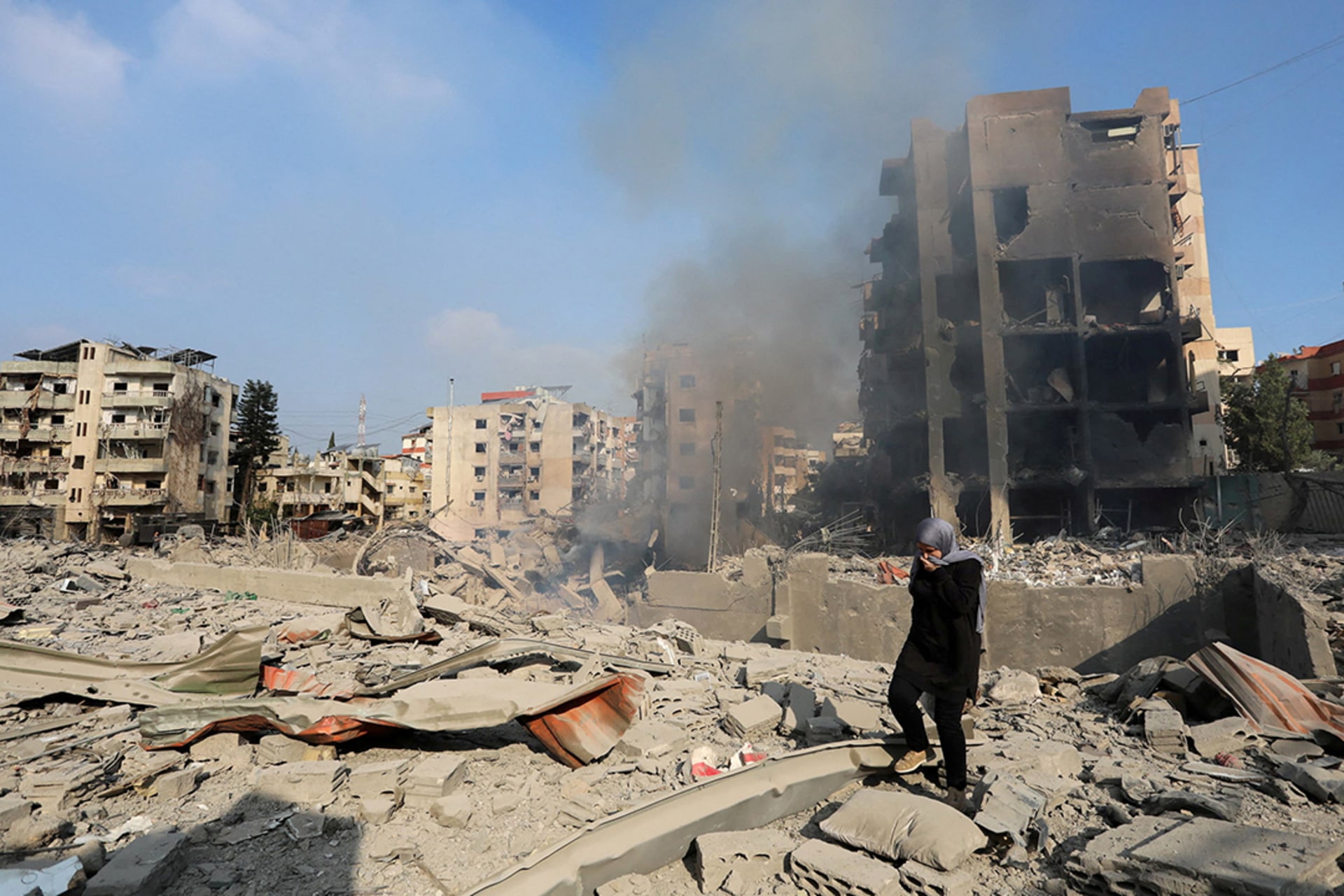
A woman wearing blacks walks on the rubble of bombed buildings while smoke rises.
A woman walks on the rubble of a damaged site in the aftermath of Israeli strikes in Choueifat amid the ongoing hostilities between Hezbollah and Israeli forces in Lebanon on October 6, 2024.
TPX Images of the Day via Reuters
A young person wears black clothing and a black balaclava holding green and yellow flags
Demonstrators protest to condemn the assassination of Hamas leader Ismail Haniyeh in Iran, in Sidon, Lebanon, on July 31, 2024.
Alkis Konstantinidis/TPX Images of the Day via Reuters
Soldiers stand on a gravel road while smoke billows in the background.
Israeli border police officers attend the scene where a rocket, fired from Lebanon, landed in Israel, amid cross-border hostilities between Hezbollah and Israel, in Maalot, northern Israel, on October 7, 2024.
Avi Ohayon/Reuters
Smoke billows from a building
Smoke billows amid the ongoing hostilities between Hezbollah and Israeli forces, as seen from Tyre, southern Lebanon, on October 7, 2024.
Aziz Taher/Reuters
A man walks past a demolished building.
A member of the Lebanese army walks past the rubble at the site of the blast in Beirut's port area on August 7, 2020.
Mohamed Azakir/Reuters
A crowd of people marches carrying yellow flags.
Supporters of Lebanon's Hezbollah movement attend the funeral of one of their members on October 15, 2021.
Ibrahim Amro/AFP via Getty Images

In response to U.S.-Israeli strikes that killed Iranian Supreme Leader Ali Khamenei, Hezbollah launched rockets and drones toward Israel on March 2, entering the broader regional escalation stemming from the war with Iran. The attack was likely acting on direction from the Islamic Revolutionary Guard Corps (IRGC), and marked the first time Hezbollah had fired at Israel since the U.S.-brokered ceasefire came into effect in November 2024. Continued cross-border salvos have since followed, and Israel has responded with intensified airstrikes throughout Lebanon, particularly targeting Hezbollah strongholds in Beirut’s southern suburbs. On March 24, Israel’s Defense Minister announced that Israel would occupy southern Lebanon up to the Litani River. According to Lebanon’s Ministry of Public Health, Israeli strikes have killed at least 1,070 people and wounded an additional 2,966. More than one million people—roughly one-fifth of the country’s population—have been displaced, precipitating a significant humanitarian crisis.

Background

After gaining independence in 1943, Lebanon’s new political leaders created a system of governance that would allow for the proportional representation of the country’s three major religious groups: Maronite Christians (represented by the president), Shiite Muslims (represented by the speaker of parliament), and Sunni Muslims (represented by the prime minister). However, unresolved sectarian differences eventually devolved into a civil war that lasted from 1975 to 1990, in which both Israeli and Syrian forces intervened—and more than one hundred thousand people died. Syrian forces withdrew from Lebanon in 2005 following the assassination of Lebanese Prime Minister Rafiq Hariri, but a war between Israel and Hezbollah quickly followed in 2006. 

Since these hostilities, sectarian tensions between Hezbollah and other religious sects have increased, particularly among Sunnis and Maronite Christians. The unique balance of power within the country has made it increasingly difficult for all stakeholders to come to political agreements, especially when it comes to filling the presidency. In addition to a two-and-a-half-year leadership gap from 2014 to 2016, Lebanon is currently without a president after the conclusion of Michel Aoun’s contentious term in October 2022. Furthermore, Lebanese politics has become a proxy battleground for Iran, which provides support for Hezbollah; and Saudi Arabia, which backed former Prime Minister Saad Hariri and other Sunni politicians. 

Lebanon’s tenuous political situation can largely be attributed to political gridlock but has also occurred because of spillover from the Syrian civil war. In addition to hosting more than 1.5 million refugees (over 800,000 of whom are Syrian), the nearly thirteen-year conflict in Syria has affected cross-border trade and dampened Lebanon’s tourism industry. In addition to the world’s third-highest ratio of debt to gross domestic product, Lebanon also maintains one of the largest refugee populations per capita. 

Despite Lebanon’s dissociation policy, Hezbollah’s armed component has also been involved in the Syrian civil war and the Israeli-Palestinian conflict. This has exacerbated relations between Hezbollah and Israel along the shared (and disputed) Israel-Lebanon border and has led to increasingly hostile rhetorical exchanges between Hezbollah and Israel over Israeli air strikes in Syria. Hezbollah has allegedly supported Syrian President Bashar al-Assad since the start of the Syrian war in 2011. 

In October 2019, widespread protests erupted throughout Lebanon as a result of endemic corruption and a complete stagnation of the economy. Protestors—coming from all religious sects—called for the establishment of a new political regime, which did away with the sectarian divides that had plagued the country since its independence. This rare unity among the citizens resulted in the resignation of the Cabinet of Ministers and put into motion the reshuffling of the government. However, the COVID-19 pandemic put an effective end to any change that had been culminating. 

Tensions between the government and its citizens reached an all-time high once again following an explosion at the Port of Beirut in August 2020, which cost an estimated $15 billion in damages and left more than 300,000 homeless. The explosion—which many attributed to years of government negligence—reignited widespread protests and saw the entire cabinet resign, with the government staying on only in a caretaker capacity. The domestic investigation into the explosion has become a highly politicized affair as the Shia-majority political parties, Amal and Hezbollah, have moved to obstruct the investigation by shielding politicians and threatening the presiding judge. 

Recent Developments

The culmination of several factors, including widespread government corruption, the COVID-19 pandemic, and the Beirut port explosion, have led to the worst financial crisis in the small country’s history. After Prime Minister Najib Mikati announced that Lebanon would default on its Eurobond debt for the first time, the Lebanese currency began to plummet in valuation, leading to hyperinflation. In April 2023, Lebanese inflation hit a high at almost 270 percent, reducing to 254 percent in June 2023. Despite being pegged to the United States Dollar at a rate of £L1507.5 per dollar since 1997, the Lebanese pound reached a new low of more than £L100,000 per dollar in March 2023. 

In 2022, the Lebanese government and the IMF came to a staff-level agreement that would provide billions in economic assistance. The deal, however, is contingent on implementing several complex economic reforms that would increase financial and political transparency in Lebanon. While the government has been slow to implement reforms, more than 80 percent of the population lives in multidimensional poverty. Following the conclusion of President Michel Aoun’s term, the government has been unable to elect a new president, leaving the country in a political and economic vacuum. In June 2023, protests aimed at banks and politicians erupted after lawmakers failed in their twelfth attempt to elect a president. As of February 2024, the presidency remains vacant, with no indication of when the seat will be filled.  

In early October 2023, tensions along the Lebanon-Israel border spiked in the wake of Hamas’ attack on Israel from Gaza and Israel’s subsequent military campaign against the militant group. Though separate entities, Hezbollah and Hamas have long been united in their shared objective of armed resistance against Israel. Hezbollah not only voiced support for the attack but also fired artillery and rockets in solidarity with Palestinians across Israel’s northern border, raising fears that another front would be opened leading to a broader conflict in the Middle East. Within the first few days of the war, at least three of Hezbollah’s members were killed during an Israeli bombardment of southern Lebanon.”

To send a message of deterrence to Iran and Hezbollah, the United States quickly deployed two of the Navy’s most powerful carrier strike groups to the eastern Mediterranean Sea. Despite its posturing, the Biden administration made it clear that the carriers and their accompanying weaponry were not there to engage in combat activities on behalf of Israel. This move by the United States did little to deter Hezbollah – in November 2023, the party’s leader, Sayyed Hassan Nasrallah, pledged that the front against its enemy would remain indefinitely active.

As of February 2024, fighting between Hezbollah and the Israeli military along the southern Lebanese border continues to escalate, having displaced over 90,000 individuals from south Lebanon. Since October 7, 2023, more than 1,700 rockets have been fired from Lebanon toward Israel, killing 15 Israelis, and injuring more than 150 people, according to the Israeli military. Approximately 158 Lebanese people have been killed in the ongoing violence including at least 25 civilians, and 686 people have been wounded. On October 13, a Reuters journalist was killed and six other journalists were wounded in shelling by Israeli forces while they were reporting at the border. Fueled by concerns about journalists being potentially targeted in Gaza and south Lebanon, human rights organizations have called for an investigation into the attack. On November 5, an Israeli air strike on a car between the southern Lebanese villages of Aynata and Aitaroun killed three girls between the ages of ten and fourteen and their grandmother, sparking outrage throughout the country.

On January 2, 2024, Israel launched a drone strike on a Hamas office in Dahiyeb, a southern suburb of Beirut, killing seven people. Though the Israeli military and intelligence service have historically conducted assassinations on Palestinian leaders in Lebanon, this strike was the first in the country’s capital since 2006. Among those killed were Saleh al-Arouri, the deputy chief of the Hamas political bureau, and two senior commanders of the Qassam Brigades. In response, Hezbollah’s Nasrallah pledged to retaliate, while Lebanon filed a complaint to the United Nations Security Council over the assassination. As of February 2024, the border remains volatile, with near-daily exchanges of fire, driving fears of regional spillover of the Gaza conflict.

Israel to Establish New Defensive Lines in Lebanon
April 3, 2026

The Israeli military stated that it will soon establish new defensive lines in Lebanon to prevent attacks on communities in northern Israel (AP). Meanwhile, Lebanon’s National News Agency reported that four were killed and fifteen others were injured in airstrikes across southern Lebanon and the Bekaa Valley (Anadolu Agency).

Israel Katz Issues Threat to Naim Qassem
April 2, 2026

The Israeli military said it detected a barrage of rockets fired by Hezbollah (NYT). Meanwhile, Israeli Defense Minister Israel Katz threatened Hezbollah leader Naim Qassem, stating that he would “pay a very heavy price” for rocket fire on Israel (Times of Israel). Amid continued escalations, Lebanese Prime Minister Nawaf Salam said that the war shows no signs of ending (Reuters).

Israel Kills Hezbollah Commander
April 1, 2026

The Israeli military announced that it killed Yusuf Ishmail Hashem, the commander of Hezbollah’s Southern front, the day before; while it is unknown which strike killed Hashem, Lebanon’s Health Ministry reported that an overnight strike killed seven and injured twenty-six in Beirut (NYT). Meanwhile, Lebanon’s army said that it was forced to redeploy and reposition some of its troops due to an increase in “Israeli aggression” (NYT). Retaliatory rocket fire by Hezbollah continued, striking a home in Kiryat Shmona; no injuries were reported in the attack (Times of Israel).

Israel Outlines Plan to Occupy Southern Lebanon After Ground Offensive
March 31, 2026

Israel’s defense minister, Israel Katz, announced plans to indefinitely occupy much of southern Lebanon up to the Litani River, roughly twenty miles from the Israeli border, even after its ground offensive concludes; he added that Lebanese border towns would be demolished and over six hundred thousand displaced residents would be barred from returning until the safety of northern Israelis is guaranteed (NYT). Katz said Israel planned to use the same tactics in Lebanese border towns that it used in parts of Gaza (Reuters). Separately, the Israel Defense Forces announced that four soldiers were killed, and three others were wounded in a clash with Hezbollah (Times of Israel). As strikes on Lebanon continue, the Lebanese Health Ministry also reported that more than 1,260 people have been killed and 3,750 wounded since the start of the war between Israel and Hezbollah (NYT). Ten European countries and the European Union (EU) jointly called for a ceasefire and for Lebanon’s territorial integrity to be respected (France MoFA).

Iranian Ambassador to Remain in Beirut
March 30, 2026

Iran stated that its ambassador to Lebanon would remain in Beirut, defying the Lebanese Foreign Ministry, which had asked him to leave and declared him persona non grata (Reuters). Meanwhile, two UN peacekeepers were killed when a convoy was struck by “an explosion of undetermined origin” (NYT). Hezbollah rocket attacks continued as the group fired a barrage of five rockets from Lebanon towards Haifa; no injuries were reported in the attack (Times of Israel).

Israel to Further Expand Security Zone in Southern Lebanon
March 29, 2026

Israeli Prime Minister Benjamin Netanyahu announced Sunday that he has ordered the Israeli military to expand its security zone in southern Lebanon, citing the need to counter ongoing Hezbollah rocket fire and push anti-tank missile threats away from the border; his office provided no further details, and the security cabinet has not yet been briefed on the decision (Reuters). Meanwhile, three Israeli soldiers were severely wounded and several others moderately injured in Hezbollah attacks and other incidents in southern Lebanon (Times of Israel).

Three Lebanese Journalists Killed in Southern Lebanon
March 28, 2026

The Israel Defense Forces killed three Lebanese journalists in southern Lebanon in an airstrike that the IDF said targeted one of them; a follow-up strike that targeted rescue workers who were sent to assist them killed several others (Reuters). The IDF stated the strikes targeted a correspondent for Al-Manar, a news network owned by Hezbollah, who they accused of being an intelligence operative for the militant group (NYT). Meanwhile, the World Health Organization stated that nine paramedics were killed, and five others were wounded in strikes on healthcare facilities in southern Lebanon (Reuters). This comes as the IDF has repeatedly accused Hezbollah of using medical facilities and ambulances for military purposes (Times of Israel). Meanwhile, Hezbollah retaliatory attacks continued as an Israeli military official reported that close to 250 projectiles were launched by the group towards southern Lebanon; 23 of them crossed the border, while northern Israel experienced continued warning sirens (AP).

Continued Strikes and Rocket Attacks
March 27, 2026

The Lebanese Ministry of Health announced two people were killed in an Israeli strike on Beirut’s southern suburb of Tahwitat al-Ghadir (AP). Hezbollah retaliatory attacks continued as several rockets were fired toward Western Galilee; the Israel Defense Forces say the rockets struck open areas with no reported injuries (Times of Israel). Meanwhile, UN officials reported that over 370,000 children have been forcibly displaced from their homes amid mass evacuation orders and intensifying Israeli strikes (Reuters).

IDF Expands Ground Operations in Lebanon
March 26, 2026

Maj. Gen. Rafi Milo, the commander of the Israel Defense Forces’ Northern Command, told troops that the IDF has expanded ground operations in Lebanon “one step further” (NYT). Meanwhile, the Israeli military reported that two Israeli soldiers were killed in combat operations in southern Lebanon amid ongoing border clashes with Hezbollah (Reuters).

Continued Israeli Strikes and Hezbollah Rocket Attacks
March 25, 2026

The Israeli military continued strikes on southern Lebanon while also continuing to target gas stations it says are tied to Hezbollah’s financial network (NYT). Retaliatory rocket fire from Hezbollah continued, lightly wounding two men in Israel’s northern city of Karmiel (Times of Israel). Meanwhile, the Lebanese Health Ministry says Israeli airstrikes killed at least twelve and injured dozens more; strikes were reported in the Bint Jbeil district, the Marjayoun district, Nabatieh, the Sidon district, and Tyre (Anadolu Agency).

Israeli Defense Minister Says Israel to Occupy Southern Lebanon
March 24, 2026

Israeli Defense Minister Israel Katz announced that Israel will occupy southern Lebanon as far as the Litani River; his statement marks the first formal confirmation of Israel’s intent to seize a “defensive buffer” spanning nearly ten percent of Lebanese territory (Reuters). Meanwhile, the Israeli military said it conducted a second wave of strikes targeting gas stations it says are used by Hezbollah in Lebanon; Israel stated the gas stations were run by Amana, a company that was sanctioned in 2020 by the U.S. Treasury Department for its alleged ties to Hezbollah (WSJ). Hezbollah continued retaliatory attacks, as a rocket barrage launched by Hezbollah towards northern Israel injured three, one critically, in Mahanayim Junction (Times of Israel). Amid mounting tensions, Lebanon ordered the Iranian ambassador to depart the country by Sunday and declared him persona non grata (WSJ).

Israel Defense Forces Strike Dallafa Bridge
March 23, 2026

The Israeli Defense Forces struck the Dallafa bridge in southern Lebanon, claiming that Hezbollah used the bridge to send weapons and fighters to Israel; however, the bridge was also used by Lebanese citizens to escape fighting in southern Lebanon amid heavy bombardment (NYT). Meanwhile, retaliatory attacks continued as a Hezbollah rocket that struck Kiryat Shmona wounded one (Times of Israel). Separately, the United Nations Interim Force in Lebanon said that its headquarters in Naqoura was struck by a projectile fired by a non-state actor (AP).  

Israel Defense Forces Destroy Qasmiyeh Bridge
March 22, 2026

Israel Katz, the Israeli defense minister, said he ordered the military to intensify its destruction of homes and bridges across southern Lebanon; his statement heightened fears of Israel’s efforts to entrench a military-controlled buffer zone in the region (NYT). Following Katz’s statement, the Israeli army announced that it destroyed the Qasmiyeh Bridge over the Litani River; it claimed that the bridge was used to transfer fighters, weapons, and rockets across the river (Anadolu Agency). Meanwhile, Hezbollah claimed an attack that it said was targeting Israeli soldiers in Misgav Am; the attack killed at least one person (Al Jazeera).

Israeli Strikes Continue Amid Hezbollah Border Clashes
March 21, 2026

Israel carried out strikes across Lebanon targeting Hezbollah leadership and infrastructure; meanwhile, Hezbollah announced in a statement that it had been clashing with Israeli forces in Khiam, Naqoura, and other border towns (NYT). Meanwhile, the Islamic Revolutionary Guard Corps reportedly restructured and rebuilt Hezbollah’s military command after it was heavily degraded in 2024; sources familiar with the matter say that the IRGC sent officers to retrain and rearm fighters, and to reshape command structures that were exposed by Israeli intelligence (Reuters; ISW). As heavy airstrikes continue, Lebanese authorities report that the total human toll since March 2 has risen to 1,024 dead and 2,740 injured (Anadolu Agency).

Hezbollah Claims Nine Attacks
March 20, 2026

Sirens sounded in Western Galilee amid a Hezbollah attack while nearby towns were alerted of potential rocket fire and drone incursions (Times of Israel). Hezbollah released a statement saying it conducted nine attacks using loitering drones and rockets against six Israeli sites and settlements  (Anadolu Agency). Meanwhile, security officials in the United Arab Emirates reported dismantling a terrorist network that was operated and funded by Hezbollah; the network operated under a false commercial cover and was involved in terror finance and money laundering (Reuters).

Hezbollah Rockets Persist as Israeli Strikes Damage Infrastructure
March 19, 2026

Hezbollah continued rocket attacks on Israeli towns and IDF positions in northern and southern Israel (ISW).  Meanwhile, as Israeli strikes continued, Lebanese state electricity companies reported that Israeli strikes in southern Lebanon early in the day damaged an energy station in Bint Jbeil, affecting energy provision in the city (Times of Israel). Separately, a correspondent for RT, a Russian state broadcaster, and his cameraman were slightly injured in an Israeli strike in southern Lebanon (NYT). Russian foreign ministry spokeswoman Maria Zakharova accused Israel of deliberately targeting the crew; the Israeli military stated that the area was under evacuation warnings (Times of Israel). Amid intensifying Israeli strikes, the Lebanese Ministry of Public Health reported that 1,001 people were killed in Lebanon since March 2 (Al Jazeera). As casualties rise, Lebanese Prime Minister Nawaf Salam made an urgent appeal to U.S. President Donald Trump for direct talks with Israel and a ceasefire (CNN). Meanwhile, following his visit to Beirut, France’s Foreign Minister Jean-Noel Barrot said that France would double its aid to Lebanon, amounting to seventeen million euros (Reuters).

Israel Intensifies Strikes Across Lebanon
March 18, 2026

Israel intensified strikes across Lebanon, striking central Beirut neighborhoods including Basta and Zuqaq al-Blat as ground troops simultaneously pushed deeper into southern Lebanon targeting Hezbollah militants (NYT). Lebanon’s Health Ministry stated that the strikes killed ten and injured twenty-seven (AP). Meanwhile, the Israel Defense Forces announced that strikes on Sunday killed Wissam Mustafa Hussein Taha, a senior Hamas fundraiser, in the coastal city of Sidon (Times of Israel).

Israel Announces New Ground Operations in Southern Lebanon
March 16, 2026

Israeli Defense Minister Israel Katz stated that displaced Lebanese citizens driven away from their homes due to the ongoing military operations would not be able to return until the safety of Israeli civilians living near the border was ensured (Reuters). This comes as the Israel Defense Forces announced a “limited and targeted” ground operation in southern Lebanon (ABC).

UN Peacekeepers Come Under Fire By Non-State Actors
March 15, 2026

The UN Interim Force in Lebanon stated that its peacekeepers came under fire by non-state armed groups in Yatar, Dayr Kifa, and Qallawiyah in southern Lebanon; no injuries were reported (Times of Israel). Meanwhile, the Israel Defense Forces is planning to deploy additional troops to southern Lebanon to expand its buffer zone and push Hezbollah away from the border (Times of Israel). According to the Lebanese Health Ministry and state-run media, the strikes in southern Lebanon reportedly killed at least four (Al Jazeera).

Continued Israeli Airstrikes on Beirut
March 14, 2026

The Israel Defense Forces continued strikes on Beirut while expanding airstrikes to areas not under immediate Hezbollah control; one of the strikes hit an apartment building in the Bourj Hammoud district, killing one and wounding four (NYT). Separately, Director-General of the World Health Organization Tedros Adhanom Ghebreyesus verified that twelve doctors, nurses, and paramedics were killed in a strike on the Bourj Qalaouiyeh primary healthcare center in Lebanon (Reuters). As Israel continues to target Hezbollah leadership and infrastructure, Israel and Lebanon are expected to hold direct talks in the coming days, reflecting a major diplomatic milestone (Reuters).

Israel to Expand Ground Operations
March 13, 2026

Israel is preparing to significantly expand its ground operation in Lebanon, with plans to seize territory south of the Litani River and dismantle Hezbollah’s military infrastructure, according to Israeli and U.S. officials; if carried out, the move would mark Israel’s largest ground invasion of Lebanon since 2006 (Axios). This came as Israel struck a bridge over the Litani River and dropped leaflets over Beirut warning of Gaza-level destruction as airstrikes intensified; Hezbollah leader Naim Qassem dismissed the Israeli threats and said the group was prepared for a prolonged conflict (Reuters). Meanwhile, amid rising humanitarian concerns, the United Nations sought out a flash appeal for $308 million to assist Lebanon with the consequences of the ongoing war (Reuters).

Israel Issues New Evacuation Orders in Lebanon
March 12, 2026

Israeli strikes struck Beirut’s southern suburbs and Lebanon’s southern borderlands overnight, displacing thousands and prompting warnings of a humanitarian crisis (WaPo). Lebanese health officials say one of the strikes killed seven and wounded at least twenty-one in the Beirut neighborhood of Ramlet al Baida (NYT). The Israel Defense Forces also issued new evacuation orders in southern Lebanon, effectively doubling the zone it has said residents should leave (Reuters). Separately, as Hezbollah fired dozens of rockets and drones towards Israel, Israeli Defense Minister Israel Katz warned that Israel would seize Lebanese territory if the attacks did not stop (Times of Israel).

Israel Expands Strikes in Lebanon
March 11, 2026

Israel launched new waves of airstrikes overnight Tuesday into Wednesday, targeting Hezbollah command centers and weapon storage sites in Beirut’s southern suburbs while ramping up its troop presence in northern Israel (Times of Israel). The Israel Defense Forces also warned civilians in six villages in southern Lebanon to evacuate (NBC). Lebanese authorities reported a strike on an apartment building in central Beirut, widening the scope of Israeli attacks (Reuters). Amid continued escalations, European Commission President Ursula von der Leyen announced Wednesday that the EU plans to provide a hundred million euros in humanitarian aid to Lebanon following a call with Lebanese President Joseph Aoun (Reuters).

Continued Strikes and Retaliation
March 10, 2026

The Israel Defense Forces says it launched a new wave of airstrikes against Hezbollah in Beirut’s southern suburbs (Times of Israel). Two air attacks struck the city of Tyre in southern Lebanon shortly after the IDF urged residents to evacuate amid impending strikes on Tyre and Sidon (Al-Jazeera). Airstrikes targeted Hezbollah-linked financial institutions across Lebanon, and the IDF reported killing several Hezbollah operatives in ground operations; meanwhile, Hezbollah launched dozens of rockets into northern Israel’s Galilee region with no reported injuries (Times of Israel).

Conflict Escalates With Ground Incursions, Airstrikes, and Retaliatory Missile Fire
March 9, 2026

Israeli forces pushed into southern Lebanon to expand a military buffer zone while simultaneously launching one of their heaviest airstrikes yet on Beirut’s southern suburbs; earlier in the day, Israel had threatened to strike sites linked to Al-Qard Al-Hasan, Hezbollah’s de facto bank, as part of its escalating campaign against the Iran-backed group (NYT). Amid escalating strikes, Lebanon proposed direct peace negotiations with Israel via the Trump administration, but both Israel and the U.S. responded with skepticism; five sources familiar with the matter confirmed the cooling reception to Beirut’s overture (Axios). Lebanon’s parliament also voted to extend its term by two years, citing the escalating regional conflict (AP). Retaliatory attacks by Hezbollah on Israel continued as a missile barrage on central Israel wounded 16 people and damaged a daycare in Ramle; the group claimed to have targeted the Israel Defense Force’s Home Front Command headquarters and a satellite communications station, though the station was a civilian site operated by European company SES (Times of Israel). Separately, Human Rights Watch accused the Israeli military of unlawfully deploying white phosphorus artillery over a residential area of Yohmor, southern Lebanon, on March 3, 2026 (HRW).

Israel-Hezbollah Fighting Continues
March 8, 2026

Fighting between Israel and Hezbollah continued in Lebanon, where almost four hundred people have been killed over the past week and more than half a million displaced, Lebanese officials said (Al Jazeera).

Israel–Hezbollah Fighting Intensifies as Death Toll Rises in Lebanon
March 6, 2026

Israeli strikes continued in Beirut overnight and on Friday as Israel warned its citizens in Lebanon to evacuate (Reuters). The Israel Defense Forces reported that strikes hit a key fundraiser for Hamas (Times of Israel). Eight Israeli soldiers were wounded in a Hezbollah rocket attack that struck an army position near the Lebanese border (Times of Israel). Shortly after Israel issued evacuation orders for Beirut’s southern suburbs, Hezbollah warned Israeli residents to evacuate towns near the Israel-Lebanon border via a Hebrew message on Telegram (Reuters). Lebanon’s health ministry reported that the death toll of the renewed conflict has surpassed two hundred, with close to eight hundred wounded (AP). Lebanese Prime Minister Nawaf Salam warned that a humanitarian disaster is looming due to mass displacement from the fighting and called on the international community to help stop Israeli attacks (AP). UN human rights chief Volker Turk warned that Israel’s large-scale evacuation orders for southern Lebanon and Beirut’s southern suburbs raise serious concerns under international humanitarian law due to the risk of forced displacement (Reuters).

Israel Strikes Beirut Suburbs as Hezbollah Deploys Fighters in Southern Lebanon
March 5, 2026

Israeli airstrikes struck Beirut’s southern suburbs, collapsing buildings and prompting residents to flee as Israel said it was targeting Hezbollah infrastructure in Dahiyeh (NYT). Before the strikes, Israel warned residents to evacuate Beirut’s southern suburbs, including Hezbollah-controlled areas, triggering a mass departure from the district (Reuters). In response, Hezbollah redeployed elite Radwan force fighters to southern Lebanon to confront Israeli troops; fighters were reportedly ordered to block Israeli tank advances in border towns including Khiyam (Reuters). Two Israeli service members were injured during combat with Hezbollah in southern Lebanon as Israel continued its air campaign (Times of Israel). Meanwhile, Israeli officials reported that several dozen Iranian Islamic Revolutionary Guard Corps officers advising Hezbollah have fled Beirut in the past two days (Axios). French President Emmanuel Macron announced France would provide armed vehicles and humanitarian aid to Lebanon and appealed to Israel and Hezbollah to stand down (X).

Hezbollah, Israel Continue Exchanging Fire
March 4, 2026

The Israel Defense Forces announced a new wave of strikes in southern Lebanon, telling residents to evacuate towards the north of the Litani River (Reuters). A Lebanese state news agency reported that several people were killed in earlier strikes on a residential building in eastern Lebanon (Times of Israel). Meanwhile, Hezbollah has continued retaliation strikes at the same time as Iranian strikes, with Hezbollah’s military media confirming six attacks on Israel (Reuters). The retaliatory strikes come as an Israeli army spokesperson confirmed that Israel has struck over 250 Hezbollah targets over the past two days (AP).

Hezbollah, Israel Continue Exchanging Fire
March 3, 2026

Hezbollah continued launching missiles at Israel while Israel continued with waves of airstrikes and deployed troops in southern Lebanon (Reuters). Israeli Defense Minister Israel Katz said the move to deploy troops to the south of Lebanon was to prevent direct fire on neighboring Israeli communities (Times of Israel)Meanwhile, the Israel Defense Forces reported that strikes also killed Daoud Ali Zadeh, the acting commander of the Lebanon Corps of the elite Qods Force, in Tehran (AP). Al-Jama’a al-Islamiyya, a Hezbollah ally, also stated that its command center was targeted by the IDF (Times of Israel). Haneen Sayed, Lebanon’s minister of social affairs, said that forty people were killed and over two-hundred injured in Israeli strikes since Monday (NYT). This figure includes three paramedics who were killed, and six others who were wounded while recovering victims from an airstrike in the Tyre district of Lebanon (NBC). As tensions rise, the U.S. Department of State announced that it closed the U.S. embassy in Beirut (State).

IDF Begins Strikes in Lebanon
March 2, 2026

After Hezbollah announced that it launched drones and rockets at the Israeli city of Haifa to avenge the killing of Iranian Supreme Leader Ali Khamenei, the Israel Defense Forces (IDF) stated it struck Hezbollah targets in Lebanon (BBC). Residents near Beirut reported sounds of explosions as Israeli airstrikes targeted the residential center of Dahiya, which is also a Hezbollah stronghold (NYT). The IDF confirmed that the strikes killed Hussein Makled, who it described as the head of Hezbollah’s intelligence wing (Times of Israel). The Lebanese Health Ministry stated that 31 people were killed and another 139 were wounded in the Israeli operations (NPR). Thousands of people have fled southern Lebanon (NYT). Amid the strikes, Lebanese Prime Minister Nawaf Salam announced that Lebanon would ban military activities by Hezbollah; the announcement is likely to fuel additional internal division as Hezbollah faces a new Israeli offensive campaign (Reuters).

Hezbollah Launches Missiles Into Israel
March 1, 2026

The Israel Defense Forces stated that Hezbollah fired several missiles from Lebanon into Israel; Hezbollah claimed responsibility for the attack, stating it was a retaliatory strike in response to the killing of Iran’s Supreme Leader Ali Khamenei (Axios).

U.S.: No Israeli Escalation in Lebanon If Hezbollah Stands Down
February 28, 2026

Following U.S. and Israeli strikes on Iran, the U.S. Ambassador told the Lebanese presidency that Israel would not escalate against Lebanon as long as no hostile acts were taken from the Lebanese side; this comes as Hezbollah expressed solidarity with Iran but stopped short of announcing whether the group would join the fighting (Reuters). Israel previously warned Beirut that if Hezbollah became involved in a U.S.-Iran war, it would strike Lebanon hard, including civilian infrastructure (Reuters).

Lebanon Urges Hezbollah to Stay Out of Any U.S.-Iran Conflict
February 24, 2026

Lebanese Foreign Minister Youssef Rajji urged Hezbollah not to get involved in any conflict between Iran and the United States; this comes as Israel warned Lebanese officials that another Israel-Hezbollah war would trigger strikes against civilian infrastructure across Lebanon more intense than the previous round of fighting (AP).

United States Pulling Out Non-Essential Staff Amid Iran Tensions
February 23, 2026

A senior State Department official stated that the U.S. Embassy in Beirut would be removing non-essential staff and eligible family members amid concerns about escalating tensions with Iran; fifty people were reportedly evacuated, including thirty-two who flew out of Beirut airport on Monday (Reuters).

Israeli Strikes Kill Ten
February 21, 2026

Lebanese officials stated that Israeli airstrikes in eastern Lebanon killed at least ten; Hezbollah confirmed that eight members, including one senior field commander, were killed (BBC).

IDF Targets Hezbollah Weapons Dept
February 19, 2026

The Israel Defense Forces announced that it struck Hezbollah targets in Southern Lebanon, including missile launchers, weapons storage facilities, and military sites used to conduct attacks (Times of Israel).

Hezbollah Rejects Disarmament Plan
February 17, 2026

Hezbollah rejected the Lebanese government’s plan to allow its army to begin its second phase of a national disarmament plan, stating the group would not accept what it deems as a move that benefits Israel (Reuters).

Israels Strikes Hezbollah Official and Seizes Hamas Ally
February 9, 2026

The Israel Defense Forces stated it struck Hezbollah artillery official Ahmad Salami, as Lebanon’s National News Agency reported that an Israeli drone strike killed three civilians; separately, the IDF seized an unnamed ally of Hamas and brought him to Israel for questioning (AP).

Weapons Used in Mezzeh Airport Attacks Traced to Hezbollah
February 1, 2026

Syria arrested the group behind the recent Mezzeh Airport attacks, and investigators traced the weapons to Hezbollah; Hezbollah denied the allegations and stated it had no ties to Syria (Reuters). Separately, the Israel Defense Forces struck engineering vehicles it says were used by Hezbollah in southern Lebanon (Times of Israel).

Israeli Air Force Strikes Hezbollah Operative
January 30, 2026

The Israeli Air Force struck a Hezbollah operative in Seddiqine, southern Lebanon (Times of Israel).

Hezbollah Warns of Regional War Over U.S. Threats to Iran
January 26, 2026

Hezbollah leader Naim Qassem said the group is preparing to confront potential U.S. action against Iran, including any threat to Supreme Leader Ali Khamenei; he further warned that a war on Iran could ignite the entire region and said Hezbollah is not neutral and will decide in due course whether to intervene (Reuters).

Israel Expands Airstrikes on Hezbollah Sites Across Lebanon
January 25, 2026

The Israel Defense Forces said it launched a new wave of airstrikes on Hezbollah military sites across several areas in Lebanon; this follows earlier strikes that hit a Hezbollah-run weapons manufacturing facility in southern Lebanon and additional Hezbollah infrastructure in the Beqaa valley (Times of Israel).

Lebanon Seeks New International Force After UNFIL Withdrawal
January 24, 2026

Lebanese Prime Minister Nawaf Salam said Lebanon will need a new international force after the United Nations Interim Force in Lebanon withdraws in 2027, citing continued Israeli operations in southern Lebanon and ongoing tensions with Hezbollah (Arab News).

Israel Targets Hezbollah Smuggling Routes on Syria-Lebanon Border
January 21, 2026

Israel struck four crossings along the Syria-Lebanon border that it said Hezbollah uses to smuggle weapons; the IDF carried out additional strikes on Hezbollah-linked infrastructure in southern Lebanon that wounded nineteen people (Reuters).

Israel Launches Strikes on Hezbollah Positions
January 15, 2026

Israel said it is striking Hezbollah targets in multiple areas of Lebanon in response to what it described as repeated violations of a U.S.-brokered ceasefire; the Israeli military also issued warnings to residents in specific buildings in the village of Sohmor ahead of the attacks (Reuters).

U.S. Designates Muslim Brotherhood Chapter as Terrorist Organization
January 13, 2026

The Trump administration designated the group’s chapters in Egypt, Jordan, and Lebanon as terrorist organizations (Treasury). The moves were “the opening actions” in efforts to counter the group’s “violence and destabilization,” Rubio said in a statement (State). Muslim Brotherhood leaders claim to renounce violence, though Trump wrote last year that the Lebanese chapter launched rockets against Israel (AP; White House).

Army Reasserts Control of Southern Region Once Dominated by Hezbollah
January 8, 2026

The operations were pledged as part of a U.S.-brokered ceasefire between Israel and Lebanon in late 2024, which required Hezbollah’s disarmament; Israeli Prime Minister Benjamin Netanyahu’s office said Lebanon’s efforts were “an encouraging beginning,” but insufficient (Reuters).