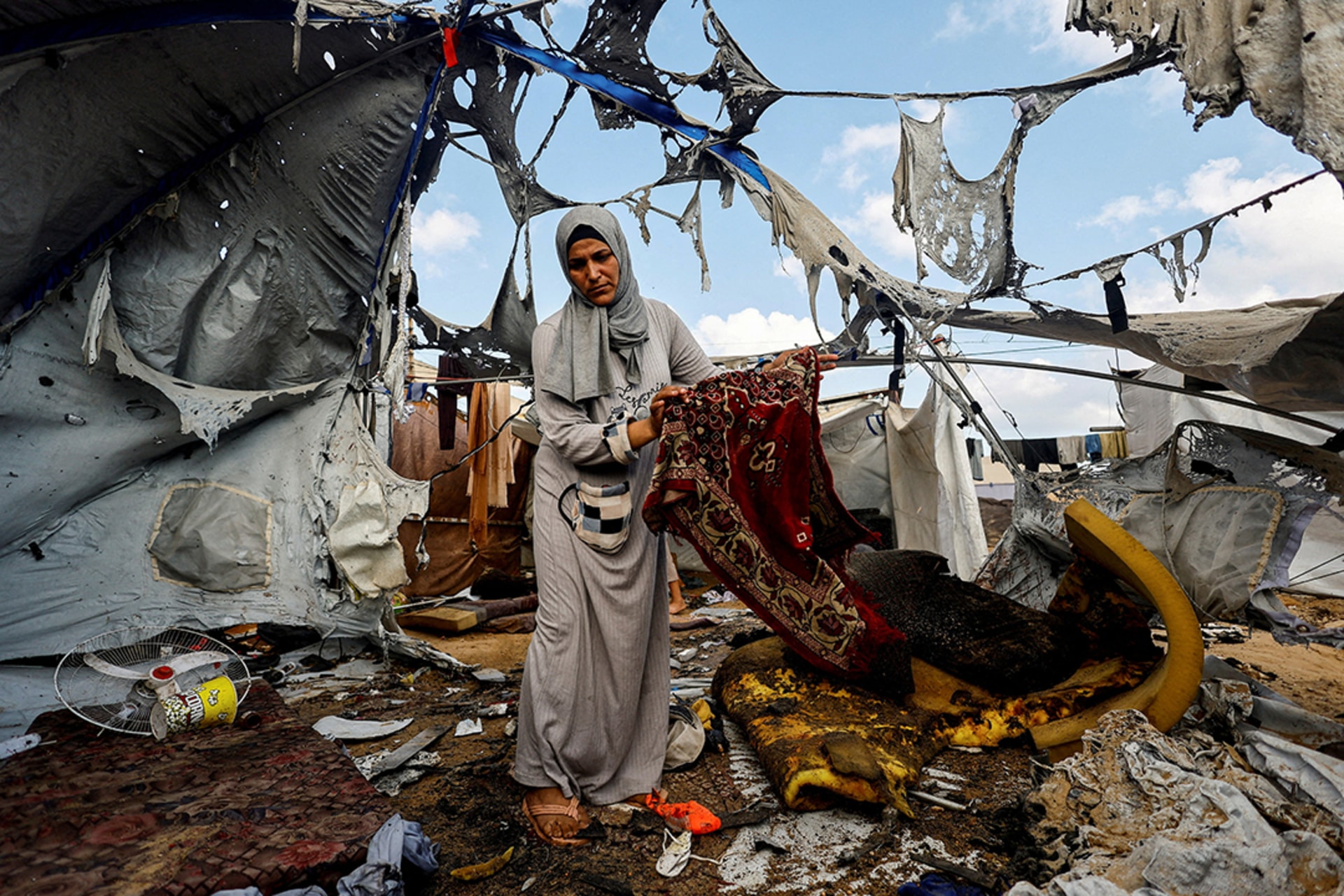
A Palestinian woman carries a prayer mat at the site of an overnight Israeli strike on a tent in Gaza City, on September 8, 2025.Mahmoud Issa/Reuters
TYPE
Territorial Dispute
Terrorism
IMPACT ON U.S.
Medium
STATUS
Unchanging
Related
Gaza Strip
Israel
West Bank
Updated October 19, 2026
RelatedGaza Strip•Israel•West Bank
Updated October 19, 2026
Overview
Hamas’s October 7, 2023, assault on Israel—killing over 1,200 people and taking 251 hostages—triggered an Israeli military campaign that killed over 70,000 Palestinian civilians and fighters and displaced nearly the entire population of Gaza. An October 2025 ceasefire secured the release of all remaining hostages and established a technocratic Palestinian governing committee. Hamas has dissolved its Gaza government but refused to disarm, citing ongoing Israeli strikes.
A Palestinian woman carries a prayer mat at the site of an overnight Israeli strike on a tent in Gaza City, on September 8, 2025.Mahmoud Issa/Reuters
Shooting in Hebron Kills Four, Prompts Major Israeli Response
Two Palestinian men attacked Israeli forces at a checkpoint in Hebron; the exchange of gunfire killed both men and two Israeli soldiers and injured another three. Israeli forces say the checkpoint stop thwarted a terrorist attack targeting civilians (AP).
In response to the shooting, Israeli Prime Minister Benjamin Netanyahu ordered a lockdown of the city and the demolition of homes in the area (Reuters).
Israeli Forces Strike Gaza City
Palestinian medical authorities reported that Israeli forces conducted a drone strike in Gaza City, killing two people and injuring others (Al Jazeera).
Israeli Forces Detain Six Palestinians in the West Bank
Israeli forces detained six Palestinians around Bethlehem in the West Bank (Al Jazeera).
Palestinian medical authorities reported that Israeli forces killed three people during operations in the Gaza Strip (Reuters)
Israeli Forces Detain Eighty Volunteers in the West Bank
Eighty volunteers from the United States, Israel, and United Kingdom were detained by Israeli forces while harvesting olives in the West Bank (Guardian).
Brad Lander, a Democratic candidate for the U.S. House of Representatives, was among the group (NBC).
Israeli Forces Kill Four People During Operations in Gaza City
Palestinian medical authorities reported that Israeli forces conducted a strike on an apartment building in Gaza City, killing a married couple; Israeli forces also shot and killed two people in separate incidents (Reuters).
Background on the Israeli-Palestinian Conflict
The movement for a Jewish state gained traction in the nineteenth century, as Jews increasingly migrated to Ottoman Palestine to escape antisemitism in Europe and return to a land intimately linked to Jewish religion, culture, and history. That trend developed new urgency in the 1930s due to Nazi persecution and after the Holocaust during World War II, in which Nazi Germany killed six million Jews. In 1947, the United Nations adopted Resolution 181, known as the Partition Plan, which sought to divide what had become British-controlled Palestine into Arab and Jewish states, with areas of religious significance in Jerusalem remaining under international control. The Jewish Agency accepted Resolution 181, but the Arab League and Palestinian leaders rejected it. Leaders of the Jewish community in Palestine declared the State of Israel’s independence on May 14, 1948. A day later, Israel was attacked by five Arab states, sparking the first Arab-Israeli War. The war ended in 1949 with Israel’s victory and 750,000 Palestinians displaced, in what is referred to as the Nakba, meaning “the catastrophe” in Arabic. Egypt maintained control of the Gaza Strip, Jordan took over the West Bank and East Jerusalem, and roughly 750,000 Jews from across the region were forced out of their own countries and moved to Israel.
Over the following years, tensions rose in the region, particularly between Israel and Egypt, Jordan, and Syria. In the years following the 1956 Suez Crisis and Britain, France, and Israel’s joint invasion of the Sinai Peninsula, Egypt, Jordan, and Syria signed mutual defense pacts in anticipation of a possible mobilization of Israeli troops. After Egyptian President Abdel Gamal Nasser ordered the withdrawal of UN peacekeepers from the Sinai Peninsula, closed the Strait of Tiran to Israeli shipping, and threatened war, Israel preemptively attacked Egyptian and Syrian air forces, starting the Six Day War in June 1967. Israel gained territorial control over the Sinai Peninsula and the Gaza Strip from Egypt, the West Bank and East Jerusalem from Jordan, and the Golan Heights from Syria. Later that year, the UN Security Council passed Resolution 242, calling for the withdrawal of Israeli forces from territories occupied during the war and affirming the sovereignty, territorial integrity, and political independence of every state in the region, referring primarily to Egypt, Jordan, and Syria. Although the resolution was never fully implemented, the land-for-peace principle became the basis for later efforts to resolve the Arab-Israeli conflict.
Six years later, in what is referred to as the Yom Kippur War or the October War, Egypt and Syria launched a surprise two-front attack on Israel to regain their lost territory. The conflict did not result in significant gains for Egypt, Israel, or Syria. Still, Egyptian President Anwar al-Sadat declared the war a victory, as it enabled Egypt and Syria to negotiate over previously lost territory. In 1979, following a series of ceasefires and peace negotiations, representatives from Egypt and Israel signed the U.S.-brokered Camp David Accords, which culminated in a peace treaty that ended the thirty-year conflict between the two countries.
Although the peace treaty between Egypt and Israel was intended to initiate negotiations over Palestinian autonomy in the West Bank and Gaza Strip, the question of Palestinian self-determination and self-governance remained unresolved. In 1987, tens of thousands of Palestinians living in the West Bank and Gaza Strip rose up against the Israeli government in what is now commonly called the first intifada or “uprising.” The 1993 Oslo I Accords established the Palestinian Authority (PA), setting up a framework for the Palestinians to govern themselves in the West Bank and Gaza, and also enabled mutual recognition between the Palestine Liberation Organization and the Israeli government. In 1995, the Oslo II Accords expanded on the first agreement, adding provisions that mandated the complete withdrawal of Israel from six cities and four hundred fifty towns in the West Bank.
In September 2000, fueled in part by the collapse of U.S. President Bill Clinton’s effort to reach a final political resolution of the conflict, Palestinian grievances over Israel’s control of the West Bank, and former Israeli Prime Minister Ariel Sharon’s visit to the al-Aqsa mosque—the third-holiest site in Islam—Palestinians launched the second intifada, which lasted until 2005. The second intifada was characterized by an escalation in terrorist attacks, including suicide bombings carried out by Hamas and other Palestinian militant groups targeting Israeli civilians. In response, the Israeli government approved the construction of a barrier wall around the West Bank in 2002, despite opposition from the International Court of Justice and the International Criminal Court. Israel unilaterally withdrew from the Gaza Strip in 2005.
Factionalism among the Palestinians intensified when Hamas won the PA’s parliamentary elections in 2006, gaining a plurality over Fatah, the political party that had dominated the PA since its establishment. The United States and European Union, among others, refused to work with Hamas after its electoral victory, as Western governments designated the group a terrorist organization in the late 1990s. Violence broke out between Hamas and Fatah after their leaders failed to establish a joint governing arrangement. The primary disagreements stemmed from the groups’ stances toward Israel and their competing claims to lead the Palestinian national movement. Fatah recognizes the State of Israel, whereas Hamas’s 1988 covenant calls for the destruction of Israel and rejects a negotiated settlement to the conflict. Hamas violently seized control of Gaza in June 2007, and Israel and Egypt subsequently placed a blockade on the territory.
A cycle of escalatory violence between Hamas and Israel ensued in the following years, leading to worsening humanitarian conditions in Gaza. After Hamas refused to renew a six-month ceasefire and increased rocket fire toward southern Israel, the Israel Defense Forces (IDF) launched a three-week ground invasion of Gaza in December 2008. The operation marked Israel’s first military engagement in Gaza since its 2005 withdrawal. Sparked by an increase in rocket fire, an anti-tank missile attack on an Israeli patrol, and Israel’s targeted killing of Hamas military chief Ahmad al-Jabari, Israel launched intensive air strikes in Gaza in 2012.
In the summer of 2014, Hamas kidnapped and murdered three Israeli teenagers in the West Bank, setting off clashes between Palestinians and Israeli police. Hamas then fired nearly three thousand rockets at Israel, and Israel retaliated with a major offensive in Gaza; 2,251 Palestinians and 73 Israelis were killed. In March of 2018, Israeli troops killed 183 Palestinians and wounded 6,000 others after some demonstrators breached the perimeter fence between the Gaza Strip and Israel and threw rocks during an otherwise peaceful protest. Just months later, Hamas militants fired more than one hundred rockets into Israel, and Israel responded with strikes on more than fifty targets in Gaza during a twenty-four-hour flare-up.
The Trump administration helped broker the 2020 Abraham Accords, under which Bahrain and the United Arab Emirates normalized relations with Israel, becoming only the third and fourth countries in the region—following Egypt in 1979 and Jordan in 1994—to do so. Morocco [PDF] later joined. PA leader Mahmoud Abbas of Fatah rejected the accords because they did not condition regional normalization on progress toward Palestinian statehood. Hamas also condemned the accords.
In early May 2021, after a court ruled in favor of the eviction of several Palestinian families from East Jerusalem properties, protests erupted, with Israeli police employing force against demonstrators. After several consecutive days of violence, Hamas and other Palestinian militant groups launched hundreds of rockets into Israeli territory, including Jerusalem, and Israel responded with artillery bombardments and air strikes. The fighting killed more than 250 Palestinians and at least 13 Israelis, wounded nearly 2,000 others, and displaced 72,000 Palestinians.
Clashes in the West Bank
In late December 2022, a coalition government including three far-right parties led by then-opposition leader Benjamin “Bibi” Netanyahu was inaugurated. The coalition government has prioritized expanding and developing Israeli settlements in the West Bank, fueling violence between Israeli settlers and Palestinians. The United Nations estimated that in the first fourteen months of the Israel-Hamas war, there were at least 1,860 recorded incidents of violence in the West Bank, mostly concentrated in Nablus, Ramallah, and Hebron. In January, Israel launched Operation Iron Wall, a major military action employing air strikes and ground force operations against militant groups in the northern West Bank. The United Nations reported that the operation has caused the longest and largest displacement crisis in the West Bank since 1967, with 30,000 Palestinians displaced and 126 killed.
Israel-Hamas War in Gaza
On October 7, 2023, Iran-backed Hamas fighters fired rockets into Israel and stormed southern Israeli communities across the border of the Gaza Strip in a surprise attack, killing more than 1,300 people, injuring 3,300, and taking hundreds of hostages. One day after the attack, the Israeli cabinet formally declared war against Hamas, followed by a directive from the defense minister to the IDF to carry out a “complete siege” of Gaza. It has been the most significant escalation of the Israeli-Palestinian conflict in several decades.
Israel launched a full-scale invasion of the Gaza Strip on October 27 to return all the hostages and dismantle Hamas. A weeklong ceasefire agreement was reached in late November 2023, during which Israel and Hamas exchanged hostages and prisoners. Israeli forces then launched a ground offensive targeting Hamas in the city of Khan Younis, which ultimately became a siege. Israel launched an offensive in Rafah from May to July 2024 to gain control of the Philadelphi Corridor along the Egyptian border, further isolating Gaza. Israel’s next major offensive was in October 2024 in northern Gaza, specifically in the Jabalia refugee camp and Beit Lahiya, where Israel imposed a siege to establish a deeper security buffer along the northern border. Israeli forces expanded their operations to Beit Hanoun in November 2024.
Israel has cited military successes, including the June 2024 rescue of four living hostages in central Gaza and the elimination of Hamas’s top leadership, including the group’s leaders Ismail Haniyeh and Yahya Sinwar, military chief Mohammed Deif, and Deif’s deputy Marwan Issa. In January 2025, the United States, Egypt, and Qatar announced that they had mediated a ceasefire between Israel and Hamas. Israel later broke the ceasefire, citing Hamas’s refusal to release more hostages, and renewed its offensive in March 2025, launching a major military campaign across the territory, including in Gaza City, Khan Younis, and Rafah.
The war has led to more than seventy thousand Gazan deaths, according to the Hamas-controlled Gaza Health Ministry. Israel has argued in many cases that its actions were necessary because Hamas’s guerrilla warfare tactics often involve fighters embedding themselves in civilian areas. Since the start of Israeli operations in 2023, numerous reports have documented the targeting of journalists, schools, and Israeli-designated humanitarian zones. Israel maintains that Hamas continues to use civilian buildings, notably hospitals, for military purposes, including storing weapons and accessing its extensive, miles-long tunnel network. At least 94 percent of Gaza’s hospitals are damaged or destroyed, and there are only two thousand available hospital beds across the Gaza Strip. Similarly, Israel’s two-month total blockade of humanitarian aid, justified by Israeli officials as necessary to prevent Hamas from controlling its distribution, has led to famine-like conditions and a deepening humanitarian crisis in Gaza, according to the United Nations. In August 2025, 1.9 million Gazans—about 90 percent of Gaza’s population—were displaced and facing acute or catastrophic food shortages.
In October 2025, U.S. President Donald Trump announced that Israel and Hamas had agreed to a ceasefire agreement as part of a broader twenty-point peace framework that aims to end the war, disarm Hamas, and reconstruct Gaza under a new civilian government. As part of the truce, Hamas agreed to release all Israeli hostages still held in Gaza within three days, though it has yet to return the bodies of several slain hostages. Israel, meanwhile, eased restrictions on aid convoys entering the strip, leading to a surge in humanitarian deliveries. Since Trump’s announcement, both Israel and Hamas have traded accusations of ceasefire violations, causing skirmishes that have led to over two hundred casualties. Despite periodic flare-ups, the ceasefire has largely held.
Since the start of the ceasefire, mediators, including the United States, Qatar, Saudi Arabia, and Turkey, have pushed for talks on implementing the second phase of the twenty-point framework to bring a formal end to the war and address postwar reconstruction. In early November, Turkey convened several Muslim-majority states to discuss a draft UN resolution that would grant the United States and partner countries a mandate to govern Gaza and provide security through an international force. Following the expiration of the mandate in 2027, the draft resolution proposes granting a reformed Palestinian Authority control over Gaza.
The conflict has exacerbated regional tensions across the Middle East. The IDF launched a ground invasion of Lebanon following months of cross-border skirmishes with Hezbollah, which began striking northern Israel following Hamas’s October 7 attack. Yemen’s Houthi rebels have fired missiles at Israel, and commercial ships in the Red Sea, and other Iran-backed groups have launched dozens of attacks on U.S. military positions in Iraq and Syria. Iran’s support for Hamas and other regional militant groups threatening Israel, combined with concerns over the regime’s nuclear program, culminated in Israel’s decision to preemptively strike Iran in June 2025, initiating a twelve-day conflict that also led to the United States bombing the most hardened Iranian nuclear facilities. (For more on the direct confrontation between Israel and Hezbollah, visit the “Conflict With Hezbollah in Lebanon” page. For more on Iran, visit the “Iran’s Conflict With Israel and the United States” page.)