Combatants Exchange Drone Strikes, Killing Twenty
- Unattributed drone strikes in Khartoum killed three children; the Sudanese military conducted a drone strike against RSF targets in Nyala, killing seventeen and injuring twenty-three (Al Jazeera).
Published by CFR's Wachenheim Center for Peace and Security
Updated August 17, 2026
Overview
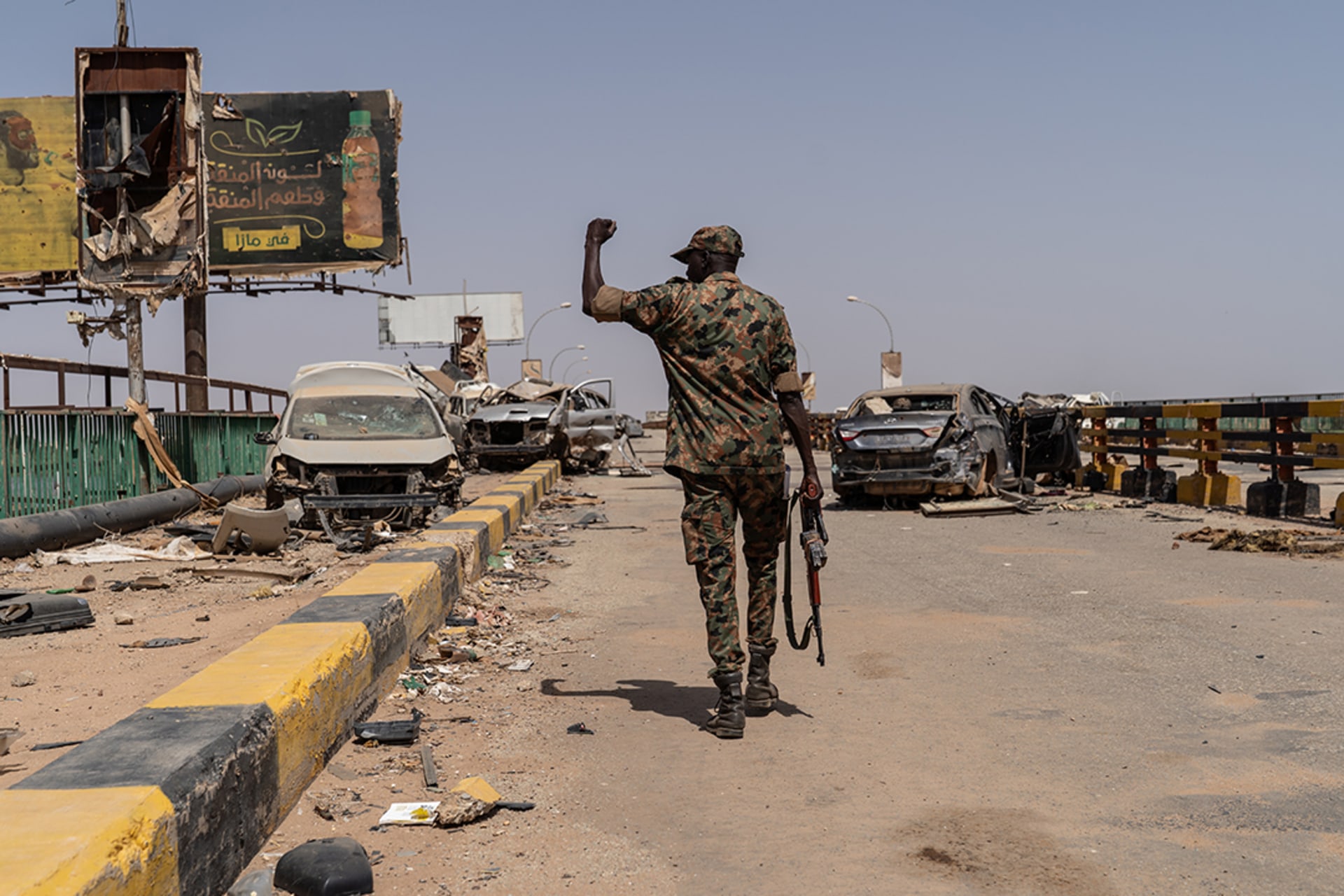
What began in April 2023 as a power struggle between the Sudanese Armed Forces (SAF) and the paramilitary Rapid Support Forces (RSF) has become the world’s worst humanitarian disaster. The SAF has recaptured Khartoum, but the RSF controls much of Darfur—where attacks on non-Arab ethnic groups have drawn genocide accusations—and has besieged El-Obeid, whose fall would open a direct corridor to the capital.
For the first half of the twentieth century, Sudan was a joint protectorate of Egypt and the United Kingdom, known as the Anglo-Egyptian Condominium. Egypt and the United Kingdom signed a treaty relinquishing sovereignty to the independent Republic of Sudan in 1956. The stark internal divide between the country’s wealthier northern region, which was majority Arab and Muslim, and its less-developed southern region, which was majority Christian or animist, sparked two civil wars, the second of which would see the country split into two states in 2011. The second Sudanese civil war from 1983 to 2005 killed an estimated two million people, with widespread documentation of famine and atrocities. In July 2011, Sudan’s southern territory seceded and formed a new state: the Republic of South Sudan.
The dictatorship of Omar al-Bashir defined Sudan’s post-colonial period. Bashir seized power in a 1989 coup after serving in the Egyptian military during condominium rule and later as an officer in the Sudanese Armed Forces (SAF). As president, he oversaw the Second Sudanese Civil War, the secession of South Sudan, and the conflict in Darfur. The Darfur war, which broke out in 2003, was later condemned by the International Criminal Court (ICC) as a genocide targeting non-Arab populations, including the Fur, Zaghawa, and Masalit peoples in western Sudan. During his regime, Bashir enforced a strict interpretation of sharia, employed private militias and morality police to enforce his decrees, and persecuted Christianity, Sunni apostasy, Shiism, and other minority religious activities. Bashir’s regime survived until 2019. By the final decade of his presidency, Bashir faced increasing popular protests calling for democracy, access to essential services, and a new system of governance. The revolution culminated in an April 2019 coup, which was carried out jointly by the SAF—led by General Abdel Fattah al-Burhan—and the Rapid Security Forces (RSF), a militia led by Mohamed Hamdan “Hemedti” Dagalo.
The RSF is the most powerful paramilitary group to emerge from the Bashir era. The RSF evolved from the Janjaweed militia, an Arab-majority armed group funded by Bashir to suppress southern Sudanese rebels and fight in the Darfur War. The group committed brutal attacks and crimes across the Darfur region, including mass displacement, sexual violence, and kidnapping. The first two years of the conflict in Darfur claimed over two hundred thousand lives, with over one hundred thousand more since 2005.
With Bashir’s support, the loosely coordinated Janjaweed was formally organized under the RSF banner in 2013. Since then, the RSF has been employed as a border guard force, a source of mercenaries for the Saudi coalition in the Yemeni war, and a hired security force to repress popular uprisings. RSF leader Hemedti became one of Sudan’s wealthiest men by seizing control of gold mines.
Before 2019, Bashir hired the RSF to protect him from coups and assassination attempts. Despite this, the RSF ultimately joined forces with the SAF in the 2019 coup to oust Bashir and establish a transitional government and a new constitution. Burhan led the Transitional Sovereignty Council with Hemedti as his deputy, alongside other military leaders and several civilians.
Among the civilian members, the council chose Abdalla Hamdok, an economist and development expert, as prime minister. During his brief tenure, he attempted to mitigate Sudan’s extreme economic turmoil and project stability to the outside world. However, the SAF and RSF orchestrated a coup against Hamdok in October 2021 and suspended the constitution. In response, international institutions such as the World Bank and the International Monetary Fund paused badly needed debt relief and other aid to Sudan. Mass demonstrations demanding a return to civilian control intensified in Khartoum.
Hamdok was briefly reinstated as prime minister in November 2021 after agreeing to concede certain governing powers to Burhan and Hemedti. However, he ultimately resigned in January 2022, as Sudanese protestors were dissatisfied with the terms of his reinstatement and the violent actions of security forces, who had repeatedly beaten and killed protestors. Since Hamdok’s resignation, Sudan has had no effective civilian leadership, with Burhan operating as de facto head of state. By early 2022, Burhan and Hemedti were left at the helm of the government, with the power to direct its democratic transition.
Negotiations throughout 2022 over the future of Sudanese governance culminated in a December 2022 deal laying the groundwork for a two-year transition to civilian leadership and national elections. Many citizens rejected the plan due to the contested time frame, the security sector retaining some post-transition state powers, and the failure to hold Burhan, Hemedti, and other security sector figures accountable for violence. Unrest broke out again and persisted from December into the spring, leading to more violent crackdowns on protestors.
Major sticking points emerged as the transitional government began to negotiate a plan. Foremost was the role of Hemedti and the RSF; the agreement elevated Hemedti to Burhan’s equal, promoting him from general’s deputy. The deal also called for the eventual integration of the RSF into Sudan’s legitimate armed forces under civilian leadership. However, the deal did not specify a deadline for the RSF’s integration into the SAF due to disagreement between Burhan and Hemedti. The two leaders missed an early 2023 deadline to determine conditions for the agreement’s implementation, indicating tension over the RSF-SAF relationship and the future of both forces as subordinates of an elected government.
As the months passed, the power struggle between Burhan’s SAF and Hemedti’s RSF continued to stall the country’s transition efforts. By early April, SAF troops lined the streets of Khartoum, and RSF soldiers were deployed throughout Sudan. On April 15, a series of explosions shook Khartoum, along with heavy gunfire. SAF and RSF leadership both accused each other of firing first. The involvement of the Wagner Group and foreign military influence, notably from the United Arab Emirates (UAE), has deepened the rivalry at the core of Sudan’s crisis.
The fighting in Khartoum has persisted, and incidents of violence across the country continued to rise, including in Darfur. The assassination of West Darfur’s governor Khamis Abakar in June 2023, likely by RSF militants, marked an escalation; Abakar had accused the RSF of renewed genocidal attacks against minorities in Darfur. In June 2024, an NGO report stated that over 235 fires had been set in villages across Sudan, with a majority set by militias in Darfur, since fighting erupted in mid-April 2023.
Several NGOs, including Human Rights Watch, have documented evidence of numerous mass atrocities committed throughout the conflict, prompting accusations of ethnic cleansing and war crimes. In early November, RSF forces and allied militias killed more than 800 people in a multi-day rampage in Ardamata, a town in western Darfur. This attack reflected a new surge of ethnically driven killings targeting the Masalit in West Darfur. The UN High Commissioner for Refugees (UNCHR) Filippo Grandi warned that current violence is emblematic of the U.S.-recognized genocide in Darfur that killed an estimated 300,000 people between 2003 and 2005. A statement made by the UN in January indicated that between ten thousand and fifteen thousand people were killed in 2023 due to ethnic violence by the RSF and its allies in West Darfur. In April 2024, U.S. Ambassador to the United Nations Linda Thomas-Greenfield highlighted evidence indicating that women and girls as young as fourteen years old have been victims of sexual violence perpetrated by the RSF.
Humanitarian access remains a crucial concern for many international actors, including the United States, which called on the UN Security Council to authorize aid deliveries through Chad. Conditions in the country were already poor before April 2023 and have worsened since. Over six hundred people died in the first month of fighting, and attacks have destroyed hospitals and other vital infrastructure. In August 2023, the United Nations stated that the conflict in Sudan was “spiraling out of control” as refugees continued to flee the country and the health system collapsed, raising fears of disease outbreaks. The displacement crisis is especially concerning given the instability of its bordering countries. In consequence, the UN Humanitarian and Emergency Relief chief dubbed Sudan “one of the worst humanitarian nightmares in recent history.”
On March 8, 2024, the UN Security Council (UNSC) passed a resolution calling for an immediate cessation of violence in Sudan. A few days later, the SAF agreed to indirect negotiations with the RSF, mediated by Libya and Turkey. However, the talks broke down on March 11 after a top SAF general rejected the proposal for a ceasefire unless RSF forces withdrew from civilian sites. The statement came after the SAF made significant advances toward recapturing Khartoum. Iranian armed drones partially contributed to the SAF’s successes.
In the latter half of 2024, the SAF launched a coordinated offensive around the three metropolitan cities of Khartoum, Omdurman, and Bahri, catching RSF forces off guard. The SAF seized significant territory in the capital for the first time since the RSF took control at the onset of the war. As 2025 began, fighting in Khartoum state intensified, with the SAF retaking key areas around the capital. In January, the SAF drove RSF forces out of Omdurman, recaptured a vital oil refinery just north of Khartoum, and regained near-total control of Bahri. Additionally, in February 2025, SAF forces ended the RSF’s two-year siege of Obeid, a strategic city with railway connections to Khartoum.
In February 2025, RSF leadership and its allies gathered in Nairobi, Kenya, to advance their plan to create a parallel government. They signed a charter outlining key aspects of a post-war government, including secularism, democracy, a decentralized structure, and a unified national army. In early March, the RSF signed a new constitution, signaling its intent to garner diplomatic leverage and legitimacy. That same month, the Sudanese government filed a complaint to the International Court of Justice, accusing the UAE of complicity in genocide due to its arms support for the RSF.
The RSF has continued its attacks on local rebel forces, SAF personnel, and civilians to consolidate its control of Darfur in western Sudan. The RSF captured El Fasher, the capital of North Darfur and the last major city under government control, on October 27 after an eighteen-month siege. In the following days, reports of widespread RSF atrocities began to surface, including cases of mass killings, sexual violence, and other crimes. The RSF’s targeting of non-Arab ethnic groups in Darfur has raised concerns of genocide. According to a report from Yale’s Humanitarian Research Lab, satellite imagery has detected closely packed objects and ground discoloration, which researchers believe are evidence of human bodies. Reports of famine are exacerbating the country’s humanitarian situation, as nearly four hundred thousand people are facing starvation.
Key Actors
Sudan’s national military and de facto governing authority, led by General Burhan, which has recaptured Khartoum and surrounding areas from the RSF but continues to fight for control of Darfur and other western regions, while facing accusations of drone strikes on civilians and arbitrary detention along ethnic lines
A powerful paramilitary force evolved from the Janjaweed militia, led by Hemedti, that controls much of Darfur and western Sudan, has been widely accused of genocide, mass killings, and sexual violence against non-Arab ethnic groups, and has established a parallel government structure to pursue diplomatic legitimacy
A rebel movement operating in the border regions of South Kordofan and Blue Nile states that has allied with the RSF against the SAF, complicating government efforts to recapture strategic border areas including Kurmuk
The RSF’s most significant external backer, accused of supplying the paramilitary with drones and weapons via logistics routes through Chad, despite repeated official denials; Sudan has filed a genocide complicity cae against the UAE at the International Court of Justice
The SAF’s most committed regional supporter, driven by deep military ties and anxiety over UAE regional influence, providing the SAF with jets, ammunition, and military intelligence
A key SAF arms supplier, having provided Mohajer-6 drones that contributed to significant SAF battlefield advances, including in Omdurman
A mediating actor that has claimed neutrality while backing SAF legitimacy, motivated by Red Sea stability concerns tied to its Vision 2030 agenda and a desire to counterbalance UAE influence in the conflict
A supporter of the SAF, providing logistical, military, and intelligence assistance, with Africa Corps, the rebranded state-controlled successor to the Wagner Group, also maintaining a presence in Sudan
An increasingly implicated external actor, with satellite imagery and investigative reporting linking Ethiopian military facilities to RSF supply and training operations
A diplomatically engaged but limited actor that has led ceasefire negotiations through the “Quad” format alongside Saudi Arabia, the UAE, and Egypt, imposed sanctions on both SAF and RSF supporters, and voted to renew the UN peacekeeping mandate while pressing for accountability
Recommended Resources