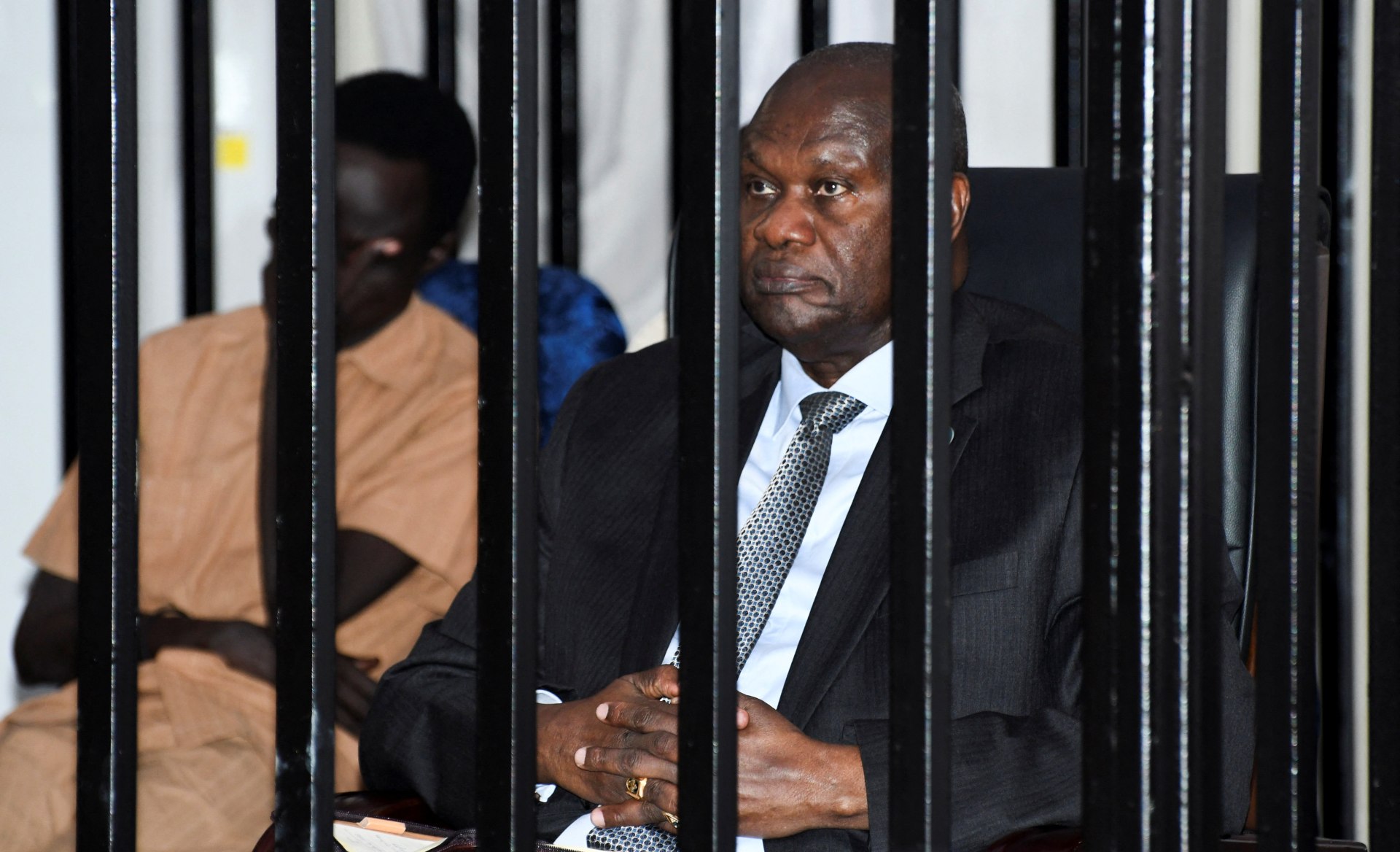
South Sudan’s suspended First Vice President Riek Machar sits inside a steel cage dock during his trial on charges including treason and crimes against humanity, at the Freedom hall in Juba, South Sudan, on September 29, 2025.Jok Solomun/Reuters
TYPE
Political Instability
IMPACT ON U.S.
Low
STATUS
Worsening
Related
South Sudan
Updated July 29, 2026
RelatedSouth Sudan
Updated July 29, 2026
Overview
Ethnic and political rivalry between President Salva Kiir and First Vice President Riek Machar has driven South Sudan’s cycles of war since 2013. Despite a 2018 peace deal, the agreement’s core reforms, including army unification, a permanent constitution, and elections, were never implemented. Kiir’s arrest of Machar in 2025 collapsed the unity government entirely, reigniting conflict that has since displaced hundreds of thousands and pushed the country toward full-scale famine.
South Sudan’s suspended First Vice President Riek Machar sits inside a steel cage dock during his trial on charges including treason and crimes against humanity, at the Freedom hall in Juba, South Sudan, on September 29, 2025.Jok Solomun/Reuters
Civilians Released After Surprise Abductions in Western Equatoria State
At least seventy-eight civilians were released four days after being abducted by unidentified attackers; victims described being beaten and robbed by kidnappers who called themselves “guerrillas,” but did not confirm any specific affiliation (Radio Tamazuj).
African Union Committee Presses Juba on 2018 Accord Before December Vote
Regional leaders met virtually as the African Union’s High-Level Ad Hoc Committee on South Sudan, known as the C5, urged all South Sudanese parties to comply with the 2018 Revitalised Agreement ahead of elections due in December, and called on Juba to release people held arbitrarily on political grounds and to guarantee due process for those facing prosecution (Radio Tamazuj).
Civilians Abducted, Vehicles Burned in Series of Surprise Abductions in Western Equatoria
Local officials reported at least seventeen civilian abductions and four civilian cars destroyed in a series of attacks in Western Equatoria state; authorities called on armed groups to stop targeting civilians, though no suspects have been arrested and no group has claimed responsibility for the attacks (Radio Tamazuj).
East African Community Delegation Begins Political Consultations in Juba
A delegation from the East African Community (EAC), led by Secretary-General Ambassador Stephen Patrick Mbundi of Tanzania, arrived in Juba to facilitate political transition discussions at the national and state levels (Radio Tamazuj).
The EAC announced consultations among “citizens and stakeholders” in Juba, Wau, Rumbek, and Bor through early October on social media (East African Community).
Kiir’s Decree Also Dissolves Parliament, State Governments
Kiir’s dissolution decree went further than previously reported, also dissolving the national legislature, all ten state governments and assemblies, and authorities in three administrative areas, with key caretaker ministers appointed to oversee key portfolios, including foreign affairs (AP News).
Amnesty International called the dissolution a “decisive step” toward South Sudan’s first-ever elections but urged authorities to protect civic space and human rights during the transition (Al Jazeera).
South Sudan’s Civil War (2013–2018)
In 1956, Britain and Egypt relinquished their colonial control over Sudan, forming the newly independent Republic of Sudan. After independence, internal divisions between the wealthier north and less-developed south triggered decades of violent conflict, including two civil wars. The second Sudanese civil war lasted from 1983 to 2005 and ended with the Comprehensive Peace Agreement. In 2011, nearly 99 percent of South Sudanese voted in favor of the independence referendum, and South Sudan officially gained independence from Sudan.
In the early years of South Sudan’s independence, peace processes failed to address long-standing grievances [PDF], including unresolved questions over federalism, the concentration of political power and oil revenues within the ruling Sudan People’s Liberation Movement (SPLM), and the failure to demobilize and integrate competing armed factions. Tensions came to a head in a power struggle between Kiir, an ethnic Dinka, and Machar, an ethnic Nuer—political rivals whose mistrust dates to the second Sudanese civil war.
In July 2013, Kiir dismissed Machar in a bid to consolidate control of the SPLM. Five months later, fighting broke out among the presidential guard. Kiir accused Machar of plotting a coup d’état, a claim Machar disputed, and violence quickly spread along Dinka-Nuer lines as soldiers and militias defected to either side, igniting a civil war.
In late December 2013, the UN Security Council authorized a rapid deployment of about 6,000 security forces, in addition to the 7,600 peacekeepers already in the country, to aid in state-building efforts. After just 5 months of fighting, more than 10,000 people were dead and 1.9 million displaced, prompting the Security Council to shift the mission’s mandate from state-building to civilian protection; in May 2014, it authorized UN troops to use force. Since reprioritizing protection, the UN Mission in the Republic of South Sudan has faced severe challenges due to deteriorating security conditions and strained relations with the government of the Republic of South Sudan.
From the outbreak of conflict, armed groups targeted civilians along ethnic lines, committed rape and sexual violence, destroyed property, looted villages, and recruited children into their ranks. Although official casualty figures are difficult to verify, a study estimated that 383,000 people died during the war, while an additional 4.5 million were internally displaced or forced to escape the country.
Violence also prevented farmers from planting or harvesting crops, resulting in nationwide food shortages. In July 2014, the Security Council declared South Sudan’s food crisis the “worst in the world.” In February 2017, various UN agencies, including the World Food Programme and the Food and Agriculture Organization, declared famine in South Sudan, with nearly five million people at risk from food insecurity.
2018 Peace Deal and Stalled Implementation
Under the threat of international sanctions and following several rounds of negotiations, Kiir signed a peace agreement with Machar in August 2015. Machar returned to the capital, Juba, in April 2016 and was sworn in again as vice president after spending more than two years in exile. Soon after his return, violence broke out between government forces and opposition factions, once more displacing tens of thousands of people. Machar fled the country, and the power-sharing arrangement collapsed. In 2017 and 2018, a series of ceasefires was negotiated and subsequently violated by both sides and other factions.
Kiir and Machar entered negotiations mediated by Uganda and Sudan in June 2018, resulting in the Revitalized Agreement on the Resolution of the Conflict in South Sudan (R-ARCSS). The peace deal established a new power-sharing structure and reinstated Machar as first vice president. Kiir and Machar formed a unity government in 2020 after delaying the original deadline twice.
Since then, the agreement has languished. Security sector reform to unify the armed forces into a national army and demobilize and disarm militias has not been implemented. A permanent constitution remains unfinished nearly eight years on. Long-delayed elections, originally scheduled for 2023, were further postponed to December 2026.
Collapse of Peace Process and Return to Conflict (2025–2026)
A renewed insurgency and Kiir’s persecution of political opponents have derailed South Sudan’s political transition. In early 2025, the White Army, an ethnic Nuer community militia loosely aligned with Machar, launched an offensive to take territory in Upper Nile state, eventually overrunning an army base in Nasir.
In response, Kiir arrested several opposition leaders and placed Machar under house arrest. Tensions continued to worsen when a prominent South Sudan People’s Defense Forces (SSPDF) general and dozens of soldiers were killed in an attack on a UN helicopter conducting an extraction from the Nasir army base. The widely condemned attack, which the United Nations said could amount to war crimes, triggered a rapid escalation of violence that spread south toward Juba.
As fighting threatened to reach Juba, Kiir requested urgent military assistance from Uganda. The deployment sparked concerns about igniting broader regional conflict, echoing Uganda’s intervention more than a decade earlier, when Kiir had similarly relied on Ugandan support to prevent his government’s collapse. A UN report later confirmed that Uganda’s forces conducted airstrikes, including the use of internationally banned cluster munitions, which killed civilians outside Juba.
After Machar denounced the government’s military response and Uganda’s involvement, Kiir arrested Machar and other senior opposition leaders. With Machar unable to perform his duties as vice president, his arrest effectively dismantled the 2018 peace agreement’s unity government. In response, the Sudan People’s Liberation Movement-In Opposition, Machar’s party, formally declared the R-ARCSS defunct. Machar is on trial for a range of charges, including treason and crimes against humanity during the March assault on Nasir—accusations Machar vehemently denied. The arrest, which many analysts viewed as Kiir’s ulterior motive to consolidate power and eliminate rivals, intensified the opposition insurgency and drew in allied armed groups.
Fighting in South Sudan’s central Jonglei state escalated at the end of 2025, disrupting daily life and humanitarian efforts. During the first months of 2026, reports of increased violence circulated as the SSPDF announced an offensive to recoup its territorial losses. Humanitarian groups warned that up to 280,000 people remain displaced across central and eastern South Sudan. In early March, thousands of civilians in the eastern city of Akobo fled to neighboring Ethiopia after SSPDF forces took control of the town and proceeded to loot and vandalize it.
Ten million South Sudanese—nearly 84 percent of the population—need humanitarian assistance, as reports of airstrikes on civilian areas, sexual violence, and forced recruitment have escalated since March 2025. Over two million people remain internally displaced, with hundreds of thousands more sheltering as refugees in neighboring countries, even as South Sudan continues to host over one million refugees fleeing from Sudan’s civil war. Humanitarian access has narrowed in conflict-affected areas, and food insecurity has reached catastrophic levels in parts of Upper Nile and Jonglei.
Key Actors
Government of South Sudan/President Salva Kiir
The ruling authority led by President Kiir, an ethnic Dinka, who has consolidated power by dismantling the 2018 peace agreement, arresting political rivals, and launching military offensives against opposition forces
South Sudan People’s Defence Forces (SSPDF)
Kiir’s national armed forces, which have conducted large-scale offensives against opposition groups and have been accused of airstrikes on civilian areas
Sudan People’s Liberation Movement-In Opposition (SPLM-IO)/Riek Machar
The main armed opposition movement whose arrested leader, Riek Machar, is on trial for treason, prompting the SPLM-IO to declare the 2018 peace deal defunct and continue armed resistance in Upper Nile and Jonglei states
White Army (Nuer White Army)
A loosely organized ethnic Nuer community militia whose 2025 offensive triggered the current escalation and which continues to fight alongside SPLM-IO forces
UN Mission in the Republic of South Sudan (UNMISS)
A UN peacekeeping mission renewed through April 2027 whose effectiveness has been severely undermined by government-imposed movement restrictions
Uganda People’s Defence Forces (UPDF)
Uganda’s military, deployed at Kiir’s request to support the SSPDF, whose airstrikes, including the use of banned cluster munitions, killed civilians and drew international condemnation
The Troika on South Sudan (United States, United Kingdom, and Norway)
The three Western countries serving as the primary international guarantors of South Sudan’s peace process, repeatedly urging a ceasefire and inclusive political dialogue
African Union High-Level Ad Hoc Committee for South Sudan (C5+)
A regional diplomatic body led by South Africa that has demanded a ceasefire and appointed former Tanzanian President Jakaya Kikwete as special envoy to mediate between the parties