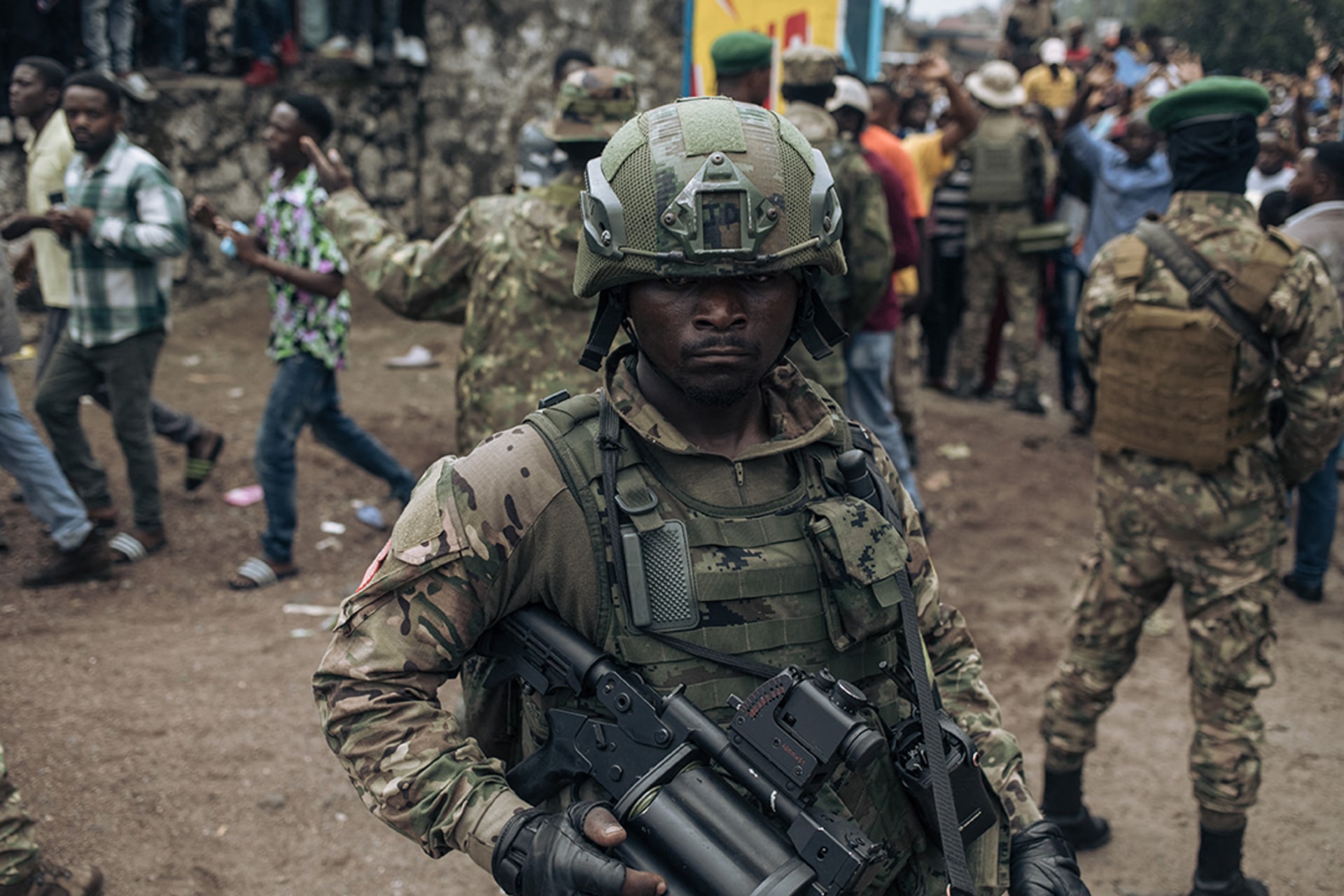
M23 soldiers are seen at the Stade de l’Unite’ in Goma on February 6, 2025, for a public gathering called by the armed group.Alexis Huguet/AFP via Getty Images
TYPE
Political Instability
IMPACT ON U.S.
Low
STATUS
Worsening
Related
Democratic Republic of Congo
Updated September 29, 2026
RelatedDemocratic Republic of Congo
Updated September 29, 2026
Overview
The Democratic Republic of Congo (DRC) has been stricken by decades of conflict over its mineral wealth and unresolved tensions from the 1994 Rwandan genocide. Rwanda-backed M23 rebels seized Goma and Bukavu in early 2025 and continue to hold significant territory in eastern DRC despite a U.S.-brokered peace agreement and ongoing Qatar-mediated talks. With over seven million people displaced, Rwandan troops remain on the ground, and key provisions of the peace deal are unimplemented.
M23 soldiers are seen at the Stade de l’Unite’ in Goma on February 6, 2025, for a public gathering called by the armed group.Alexis Huguet/AFP via Getty Images
Former Congolese President Joseph Kabila Leads M23 Successor
M23 announced that former Congolese President Joseph Kabila will take charge of a new political-military movement, the Front for the Refoundation of the Nation, which succeeds the dissolved AFC/M23 alliance (Africanews).
Former Congolese President Joseph Kabila Breaks Over Year-Long Silence
Former President Joseph Kabila delivered a national address on the country’s political and security crises, accusing the current government, without naming President Félix Tshisekedi directly, of “institutionalizing tribalism and nepotism” and warning that governance focused on regime survival had shattered national cohesion, giving way to “identity conflicts, insecurity, and war”; Kabila was sentenced to death in absentia by a Congolese military court in September 2025 and is under U.S. sanctions for alleged support of the M23-AFC rebel movement (Actualité).
Congolese Minister of Regional Integration Visits Regional Partners in Attempts to Reach Peace
Minister of Regional Integration Floribert Anzuluni traveled to Entebbe, Uganda to meet with Ugandan President Yoweri Museveni on regional involvement in the eastern DRC security crisis, including a plan for the disarmament of the FDLR; the Entebbe meeting is the latest in a series of Anzuluni’s diplomatic visits to neighboring capitals, including Lomé, Brazzaville, Luanda, and Bujumbura (Le Potentiel).
Wazalendo Reports Territorial Gains Across Masisi and Kalehe in North, South Kivu
FARDC and allied Wazalendo fighters began fighting before dawn in Masisi, North Kivu; sources close to the FARDC claimed government forces reclaimed several villages, including Nyakigano, Nkokwe, and Kashovu, with similar gains reported around Kalehe in South Kivu, though local reporting could not independently verify these accounts (Radio Okapi).
African Union Delegation, Including Three Former Heads of State, Meets With Rebel Alliance in Goma
A delegation from the African Union Panel of Facilitators, including former Kenyan President Uhuru Kenyatta, former Botswanan President Mokgweetsi Masisi, and former Ethiopian President Sahle-Work Zewde, traveled to Goma, a major city under control of M23 and the Congo River Alliance, to meet with leaders of the rebel alliance as part of a months-long effort aimed at restoring peace in eastern DRC (Radio Okapi).
Background
Since 1996, conflict in eastern DRC has led to approximately six million deaths. The First Congo War (1996–1997) began in the wake of the 1994 Rwandan Genocide, during which ethnic Hutu extremists killed an estimated one million minority ethnic Tutsis and moderate Hutus in Rwanda (DRC’s neighbor to the east). During and following the genocide, nearly two million Hutu refugees crossed the Congolese border, mostly settling in refugee camps in the North Kivu and South Kivu provinces. A small subset of those Rwandans who entered DRC were Hutu extremists who began organizing militias within the Congo. Pressure intensified as Tutsi militias organized against the Hutu groups and as foreign powers began taking sides.
Following the Rwandan Patriotic Front’s (RPF) victory against the genocidal Rwandan government, the new Tutsi-led government began its involvement in DRC (then known as The Republic of Zaire). Rwandan troops, under the leadership of President Paul Kagame, and Congo-based Tutsi militias with Rwandan backing launched an invasion of Zaire, which was ruled at the time by Dictator Mobutu Sese Seko. Kigali justified both efforts by arguing that Hutu groups in eastern DRC were still a threat to their Tutsi population and that the Mobutu regime was harboring Hutu extremists who had fled across the border. Rwanda waged the First Congo War against Zaire with the help of other African states (most significantly Uganda, but also Angola and Burundi), who had their own security concerns related to Mobutu’s support of rebel groups across the continent. The Rwandan coalition’s invasion was coordinated with the help of Zaire’s then-opposition leader, Laurent Kabila. Thousands died; some casualties were former Hutu militants and members of armed groups, but many were refugees and non-combatant Congolese in North and South Kivu, in eastern DRC. Methods of warfare were brutal, especially those employed by Rwandan soldiers and Tutsi groups. When Mobutu fled Kinshasa, the Kabila-Kagame coalition won the First Congo War in 1997. Kabila was installed as president of Zaire and changed the country’s name back to The Democratic Republic of Congo.
In 1998, the Second Congo War broke out following the deterioration of relations between Kigali and Kinshasa. To diminish the impression that Rwanda held undue influence over the Congolese government, Kabila denied claims that Rwanda had been responsible for winning the war and placing him in power. Kabila also began removing ethnic Tutsis from his government and took measures to weaken Rwanda’s military presence in eastern DRC. By the late 1990s, it was becoming clear to the world that targeted campaigns against Hutu populations during the First Congo War (led mainly by Kagame’s army) amounted to war crimes. This growing international consensus reflected poorly on the fledgling Kabila regime.
In a reversal of alliances, Kabila ordered all foreign troops out of the Congo and allowed Hutu armed groups to organize at the border once again. Rwanda responded by invading in 1998. Kigali’s stated aim was to create a zone in the DRC-Rwanda borderlands controlled by its own troops to create more distance from Hutu groups in eastern DRC. Congolese forces supported by Angola (which also reversed alliances following the ascent of Laurent Kabila), Namibia, and Zimbabwe fought the Rwandan, Ugandan, and Burundi militaries, as well as various rebel groups supported by Kigali and Kampala. Amidst the chaos of war, Laurent Kabila was assassinated in a 2001 coup attempt planned by his aides and guards. Those involved were imprisoned, and Kabila’s son, Joseph Kabila, took power. The Second Congo War was formally brought to a close under the junior Kabila in 2002. While estimates vary greatly, the death toll of the Second Congo War and the associated humanitarian disaster may have reached over three million people by 2004.
Between 2002 and 2003, Rwanda, Uganda, and DRC began implementing peace agreements that authorized a transitional government in Kinshasa led by Joseph Kabila. Despite these agreements, the establishment of truth and reconciliation commissions, and a renewed UN peacekeeping force, unrest and clashes persisted in eastern DRC. Joseph Kabila was formally inaugurated following a long-awaited popular election in 2006.
One of the most prominent rebel groups to emerge in the early 2000s was the March 23 Movement (M23), made up primarily of ethnic Tutsis. Between 2012 and 2013, M23 became an undeniable force in eastern DRC, and Kinshasa accused Kigali of backing the group. In 2013, The UN Security Council authorized a rare offensive brigade under the mandate of the UN Organization Stabilization Mission in the DRC (MONUSCO) to support the Congolese army in its fight against M23. MONUSCO effectively supported the Congolese army, and M23 called off its initial campaign in 2013. Evidence of Rwanda’s support for M23 caused lasting damage to the Kigali-Kinshasa relationship.
Over the past two decades, other flashpoints have arisen in states on the Congo-Rwanda border, such as Ituri, most often involving ethnic and militant groups with contestations going back to the Congo Wars, and the 21st century brought one more complication to peace efforts in the Democratic Republic of Congo: the proliferation of mining operations. DRC is home to some of the world’s largest reserves of metals and rare earth minerals used to produce advanced electronics. As the world has become more reliant on cobalt, copper, zinc, and other minerals, local and external groups have become more incentivized to get involved in the Congolese conflict.
Félix Tshisekedi was declared the winner of DRC’s December 2018 elections and was inaugurated in January 2019. The transfer of power from President Joseph Kabila marked the first peaceful transfer of power in the DRC’s history. However, the 2018 election results have since been questioned, and some polling data indicates that a different candidate, Martin Fayulu, may have won. Upon his inauguration, Tshisekedi inherited several crises, including outbreaks of Ebola and ongoing violence in eastern DRC.
The abundant natural resources—especially precious minerals—found in Congolese soil have globalized the conflict in eastern DRC. While U.S. companies once owned vast cobalt mines in the Congo, most were sold to Chinese companies during the Barack Obama and Donald Trump administrations. Chinese companies connected to Beijing now control the majority of foreign-owned cobalt, uranium, and copper mines in DRC, and the Congolese army has been repeatedly deployed to mining sites in eastern DRC to protect Chinese assets. The Joe Biden administration has acknowledged that China’s virtual monopoly in DRC’s mining industry plays a significant role in boosting China’s comparative advantage in the energy and technology arenas and hinders U.S. clean energy aspirations.
China is involved in Congo’s internal conflict as well as its economy: the Congolese government is fighting M23 rebels with the help of Chinese drones and weaponry, and Uganda has purchased Chinese arms to carry out military operations within DRC’s borders. The deals China negotiated with Congolese leadership, especially during the Joseph Kabila regime, have helped Chinese firms secure unprecedented access to metals that allow them to mass produce electronics and clean energy technologies. The Beijing-Kinshasa relationship came under international scrutiny leading up to President Kabila’s resignation in 2019 when evidence emerged that Chinese capital—intended for infrastructure investment as repayment for mining rights—was being funneled to Joseph Kabila and his associates. China and DRC’s complex, multi-layered economic and military relationship has resulted in limited access to the Congo’s vital resources and profits for other countries and the Congolese people themselves. China’s presence in resource-rich eastern DRC is not without its risks. In September 2023, Chinese nationals were among the casualties of a militant group’s deadly robbery of a mining company convoy. Additionally, a U.S. congressional human rights commission heard testimony in July 2022 regarding the use of child labor and other illegal practices in Congolese mines, allegedly including those owned and operated by Chinese companies. While the United States does maintain a relationship with DRC, the trade relationship is minimized by U.S. restrictions on imports from conflict-affected states and bans on importing “conflict minerals,” which are resources such as tin and gold mined for the profit of armed groups in the Congo and neighboring countries.
Recent Developments
The conflict’s most threatening possibility is the further regionalization and expansion of fighting in eastern Congo. While the situation is already lethal, full-scale wars in the Great Lakes region can be much worse; the Second Congo War is widely considered the deadliest in human history since World War II. Currently, DRC is embroiled in an ongoing political confrontation with Rwanda. In 2022, M23 rebels resurfaced after five years of inactivity and gained control of large parts of North Kivu province by July 2023. Kinshasa, along with multiple foreign governments, has repeatedly accused Kigali of funding and supporting M23’s resurgence. In return, Kigali accuses Kinshasa of supporting Hutu extremist militias such as the Democratic Forces for the Liberation of Rwanda (FDLR). Rwanda maintains a significant military presence in eastern DRC and along the countries’ shared border. Rwanda and Uganda—and militias with their support—have financial stakes in Congolese mines (though they are not always legitimate).
In October 2023, UN Special Envoy to the Great Lakes Region Xia Huang warned that tensions between the two countries could lead to an open military confrontation, expressing his concerns about “the military strengthening in both countries, the absence of direct high-level dialogue, and the persistence of hate speech.” The two countries agreed in late November 2023 to a U.S.-brokered pact to bilaterally reduce military presence near the border, reduce hate speech, and refrain from efforts to affect one another’s political systems. Despite the agreement and initial promise of a seventy-two-hour ceasefire ahead of the DRC’s national election, ongoing, lethal conflict in eastern Congo has continued largely unabated into 2024.
The role of international security forces in the Congo has been inconsistent and controversial for several years. Between 2022 and 2023, aseries of local protests against the presence of MONUSCO forces turned violent, exacerbating anti-intervention sentiment among the public and local officials who viewed the peacekeepers as ineffective. Despite those concerns, international and regional intervention continued. In May 2023, the South African Development Community (SADC) deployed troops to join UN stabilization forces before the December 2023 elections. However, that September, President Tshisekedi called on MONUSCO to withdraw before the new year, and the UN Security Council (UNSC) acquiesced. The decision was ultimately reversed when the UNSC, fearing a sudden security vacuum and further barriers to aid deliveries, voted to extend MONUSCO’s mandate through the end of 2024. A slower drawdown process is now underway, and MONUSCO is currently implementing the first phase of its disengagement plan. East African Community (EAC) troops, in contrast, followed through with a December 2023 withdrawal from the Congo, having only been present in the country for a year.
The Congolese military and residents of eastern DRC continue to contend with increasing attacks by the Islamic State-affiliated Allied Democratic Forces (ADF). Exchanges of fire, missile attacks, and skirmishes between M23, Rwandan troops, Congolese forces, and other militia groups remain commonplace. DRC’s relations with Rwanda, Burundi, and Uganda remain fragile.
More than seven million people have been internally displaced due to the constant threat of violence and atrocities, as well as extreme poverty and mining expansion, especially in the North Kivu, Ituri, and South Kivu provinces. Since the beginning of 2024, nearly 358,000 people have been displaced in DRC, 80 percent of which has been caused by armed conflict. New UN-verified data also reveals that there has been a 30% increase in grave violations against children in eastern DRC during the first quarter of 2024 compared to the last three months of 2023. A staggering 23.4 million Congolese suffer fromfood insecurity, making DRC the country most affected by food insecurity in the world. The displaced population urgently needssecurity support, medical aid, and other humanitarian aid. Approximately 1.1 million Congolese nationals are seeking refuge beyond the Congo’s borders.
Key Actors
Government of the Democratic Republic of Congo (DRC)/President Félix Tshisekedi
The internationally recognized governing authority led by President Félix Tshisekedi, which has lost significant territory in eastern DRC to M23 and Rwandan forces, signed a Strategic Partnership Agreement with the United States granting American companies preferential access to Congolese critical minerals in exchange for security cooperation, and remains under domestic pressure to resist any settlement that cedes de facto control of the east to M23
Armed Forces of the DRC (FARDC)
The national military, which has struggled to repel M23 and Rwandan forces in the east and relies heavily on allied militias, foreign mercenaries, and international partners to conduct operations, while itself facing accusations of human rights abuses
M23
A predominantly ethnic Tutsi rebel movement backed by Rwanda that captured Goma in January 2025 and Bukavu in February 2025, controls much of North and South Kivu, and has continued offensive operations despite multiple ceasefire agreements, including the U.S.-brokered Washington Accords for Peace and Prosperity
Congo River Alliance
The political umbrella movement allied with M23, led by Corneille Nangaa Yubeluo, that provides a broader civilian and political framework for the rebellion and has participated in separate peace negotiations with Kinshasa, though it did not sign the Washington Accords
Wazalendo and Pro-Government Militias
A loose coalition of local armed groups fighting alongside FARDC against M23 and Rwandan forces, playing a significant but often overlooked role in perpetuating cycles of violence in South Kivu
Democratic Forces for the Liberation of Rwanda (FDLR)
A Hutu extremist militia operating in eastern DRC that includes remnants of those responsible for the 1994 Rwandan genocide, whose continued presence Rwanda cites as justification for its military involvement in the DRC
Allied Democratic Forces (ADF)
An ISIS-affiliated armed group with roots in Uganda that operates in eastern DRC's Ituri and North Kivu provinces, conducting some of the region's deadliest attacks on civilians and accounting for a sharp rise in security incidents in mid-2026
Joseph Kabila
The former president who governed DRC from 2001 to 2019, currently living in Goma under M23 protection and sanctioned by the United States in April 2026 for allegedly supporting Rwanda-backed rebel groups
Rwanda/Rwanda Defence Force (RDF)/President Paul Kagame
The primary external backer of M23, led by President Paul Kagame, which deployed an estimated three to four thousand troops to support the rebel offensive, controls significant territory and mineral resources in eastern DRC, and has conditioned any withdrawal on the neutralization of the FDLR, while facing U.S. sanctions over its continued military presence
Burundi
A regional actor whose forces have deployed to eastern DRC in support of the Congolese government against M23, motivated by longstanding tensions with Rwanda and concern over the conflict's spillover effects along its border
Angola
A key African mediator that has hosted multiple rounds of negotiations between Kinshasa and Kigali, with President João Lourenço serving as the African Union's chief mediator for the DRC-Rwanda conflict
United States
A key mediating power that brokered the Washington Accords for Peace and Prosperity between DRC and Rwanda in December 2025 and a Strategic Partnership Agreement granting U.S. companies preferential access to Congolese critical minerals, while imposing sanctions on Rwandan officials and pressing for a durable ceasefire
China
The dominant foreign economic actor in DRC's mining sector, controlling the majority of foreign-owned cobalt, copper, and uranium mines, and deepening bilateral mineral cooperation with Kinshasa in March 2026 even as Washington courts Tshisekedi with its own minerals deal
UN Organization Stabilization Mission in DRC (MONUSCO)
The long-running UN peacekeeping mission gradually drawing down following the Congolese government's demand for its withdrawal, amid widespread public frustration over its perceived ineffectiveness in protecting civilians